Troubleshooting & Analysis
I didn't believe a $20 filter could be fine either
Here's the thing I want to admit up front: I was a snob about this. For two years I bought ResMed's own filters for my AirSense 10 without thinking twice, because some quiet part of my brain decided that anything touching air I breathe eight hours a night should have the brand name printed on it. Then I did the math on what I'd spent and felt a little sick. So when a friend told me he'd switched to a third-party pack for his AirCurve and noticed nothing, I rolled my eyes. A cheap hypoallergenic filter for a medical device? Sure. I gave it a shot mostly to prove him wrong.
I didn't prove him wrong. That's the whole review, honestly, but stick with me because the details are where you decide whether you should switch.
The price gap is the entire reason we're here
A genuine ResMed hypoallergenic filter pack runs me around $20–$24 depending on the week, and you go through them faster than you'd think. ResMed's own guidance — and the install card in the box — says swap the filter every two weeks, sooner if you've got pets or you're in a dusty room. Do that honestly and you're burning roughly 26 filters a year. The compatible packs I've been buying land closer to $13–$15 for the same count, sometimes a bigger quantity for the same money. Over a year that's the difference between spending maybe $45 on OEM and spending under $20 on the aftermarket ones. It's not life-changing money. But it's the kind of small, recurring leak that bugs me, and a CPAP filter is about the lowest-stakes place to plug it — it's a pleated rectangle of media that sits in a flap, not a precision part.
Does it actually fit the AirSense 10?
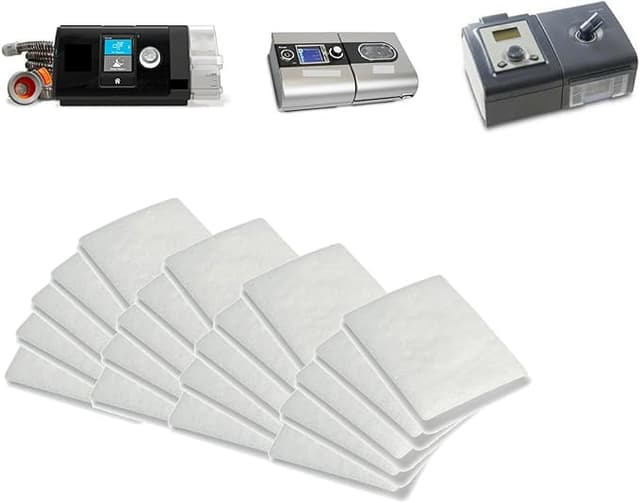
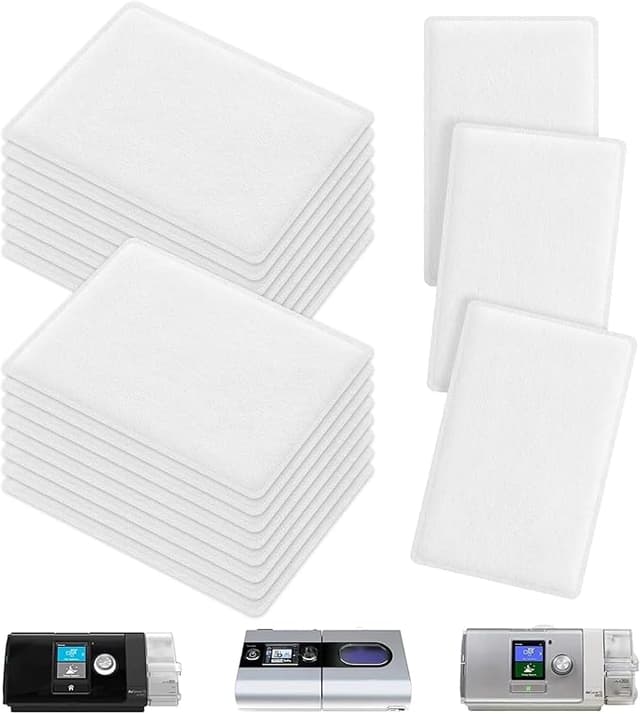
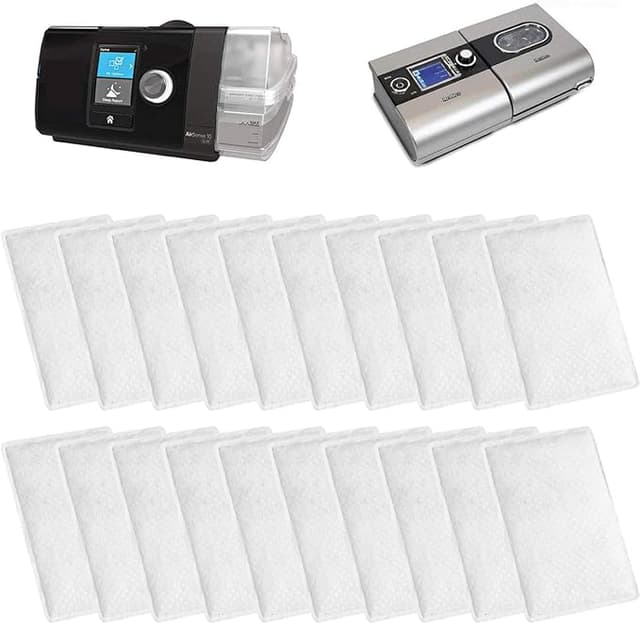
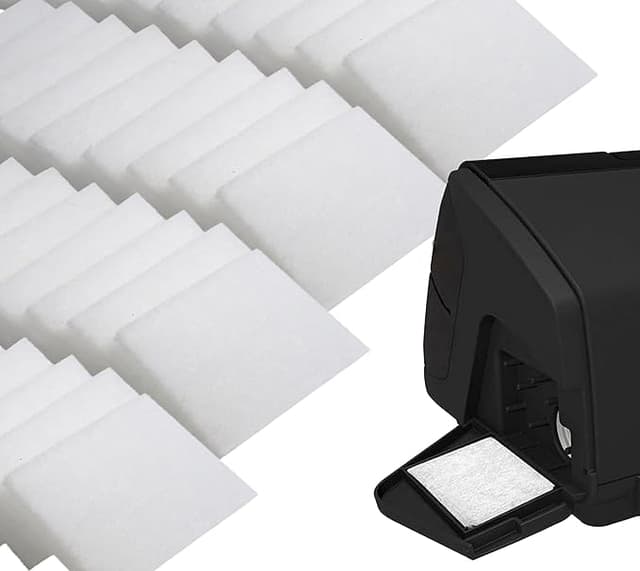
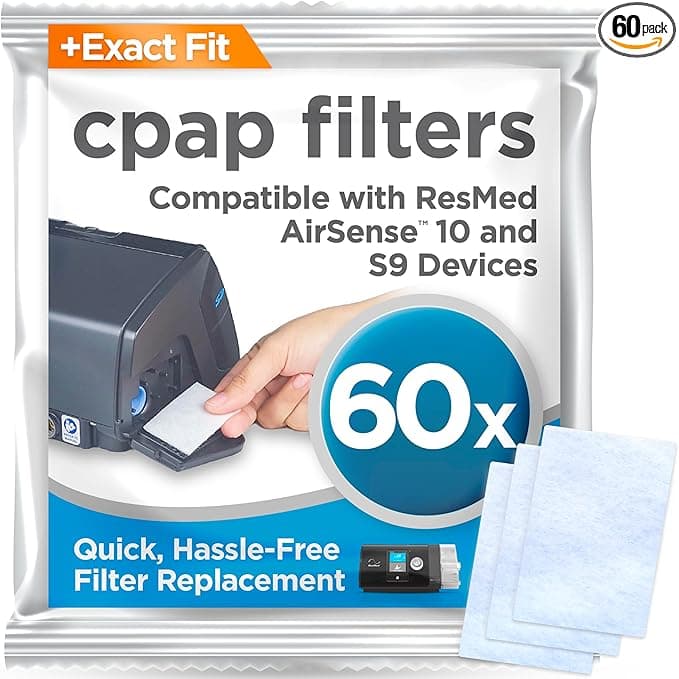
This was my real worry. The filter on the S9 / AirSense 10 / AirCurve sits behind that little flap on the back of the device, and the OEM piece seats with a specific snugness — you feel it tuck in flat against the intake. My first compatible filter? A hair looser. Not loose enough to rattle or shift, but I could tell the die-cut was maybe a half-millimeter off ResMed's, because it didn't grip the channel the same way. I pressed the flap shut, it clicked, and it held. I checked it the next morning and it hadn't budged. Three months of nightly use later it still sits exactly where I put it.
The install itself is nothing. Pop the flap on the back, slide the old grey-white filter out, drop the new one in with the mesh side facing the way the old one faced, close it. Took me under ten seconds and I'm not handy. If you've ever changed it once, the compatible filter goes in the same way — there's no relearning, no adapter, no trim-to-fit nonsense.
The honest performance read
Here's where I expected to catch it falling short, and mostly didn't. The whole job of this filter is to keep dust, dander, and fine particles out of the air the machine pushes into you. Subjectively, my morning congestion is the same as it was on OEM — which is to say, fine. The machine's airflow doesn't feel choked; my AirSense's pressure delivery is unchanged in the app's data, no weird spikes from a restricted intake. After two weeks the filter pulls out visibly grey, the same as the brand-name one did, which tells me it's genuinely catching stuff and not just sitting there pretending.
Where's it a touch behind? The media feels a shade thinner when I hold an OEM and a compatible one side by side, and the compatible one looks "spent" — that even grey loading — a day or two sooner. So if anything, the cheap filter nudges you toward changing it on time rather than stretching it, which for a CPAP is the right direction to err anyway.
The downsides — and there are real ones
I'm not going to pretend this is a free lunch. First: the packaging is cheap. The OEM filters come individually seated in a tidy molded tray; my compatible packs show up as a loose stack in a plastic sleeve, and once or twice a filter near the bottom had a slightly crushed corner. Never bad enough that it wouldn't seat — I just set the bent one aside and grabbed the next — but if you're someone who needs every piece pristine, that'll annoy you.
Second, and this is the one I'd actually weigh: brand-to-brand consistency is looser than ResMed's. With OEM, every filter is identical. With aftermarket, I've had the occasional one in a pack where the frame felt a smidge less rigid than its neighbors. None failed. None let go mid-night. But the variance is real, and it's the reason I tell people to buy from a seller with a pile of reviews rather than the absolute cheapest mystery listing — the savings aren't worth gambling on a no-name batch.
Third, the first night or two, there's a very faint clean-plastic smell off a fresh filter as it breaks in. It fades fast and I stopped noticing by night three, but I won't pretend it isn't there. If you're scent-sensitive, crack the pack and let one air out on the nightstand for a few hours before you install it.
Why I don't slack on this anymore
One real thing that switching taught me: when the filter's cheap, I stop rationing it. Back on OEM I'd catch myself thinking "eh, it's only been three weeks, it can go another few days." That's exactly the wrong instinct. A saturated filter doesn't just stop catching dust — it starts feeding whatever it already trapped back into the air going down your throat all night, plus it makes the machine work harder to pull air through. For something running directly into your lungs while you sleep, a loaded filter isn't a minor maintenance miss; it's the whole reason the part exists. Paying a few bucks instead of more for the same rectangle means I swap it on schedule without flinching, every two weeks, no internal negotiation.
So who should still buy OEM?
If you're in your first weeks on therapy and you want one fewer variable while you and your doctor dial in pressure, buy the ResMed filters — keep everything controlled, troubleshoot later. Same if a respiratory condition makes you genuinely reactive to that faint break-in smell, or if the idea of any variance at all will keep you up at night, which defeats the purpose. There's no shame in paying for the brand-name certainty.
But for me? Three months in, swapping on schedule, with airflow and morning congestion identical to what the $24 pack gave me — I'd buy the compatible filter again. I already have, twice. For a part that's a folded square of media in a flap, doing the exact job the expensive one did at less than half the yearly cost, that's an easy call. Just buy from a real seller, change it every two weeks like you're supposed to, and don't overthink the rest.