Troubleshooting & Analysis
I didn't believe a $20 filter could be fine either
For about a year I bought ResMed's own filters because the box said to, and because some quiet part of my brain assumed the cheap ones on the listing right below were a trap. You know the feeling. It's a medical device. It pushes air into your lungs all night. The little voice says: don't gamble on your breathing to save a few bucks. So I paid the OEM price, replaced on schedule, and felt responsible about it.
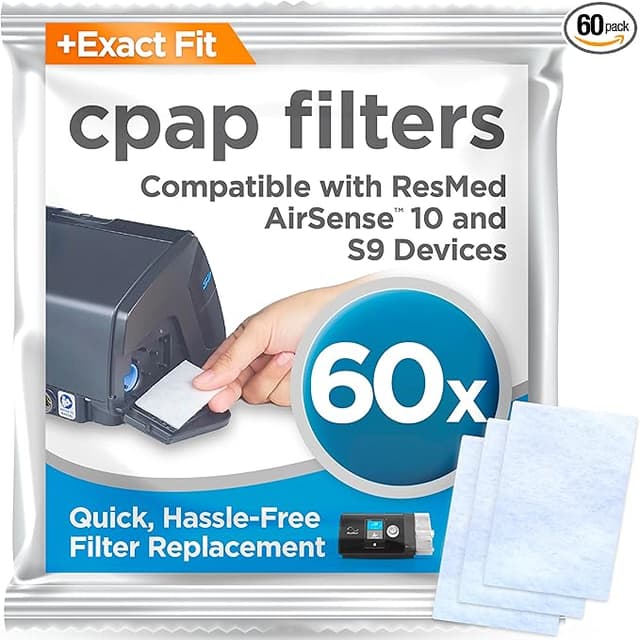
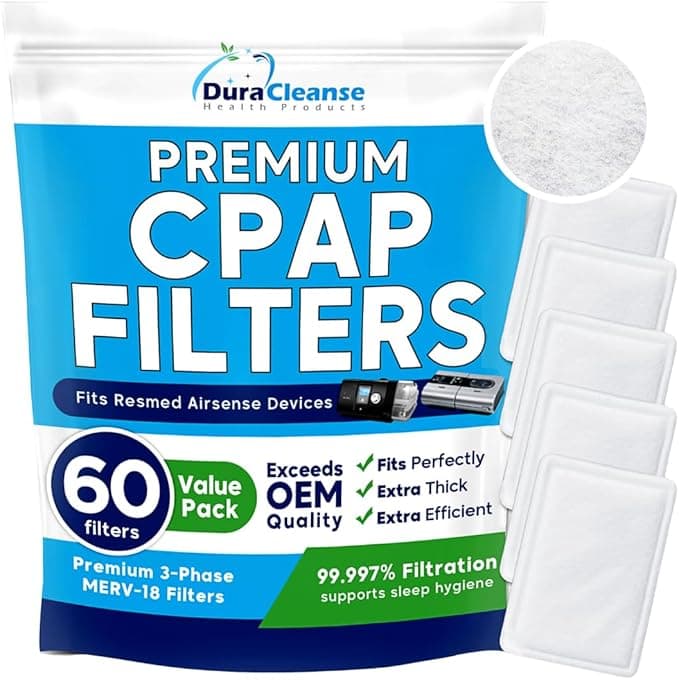
Then I actually did the math on what I was spending a year, and the responsible feeling started to look more like a reflex I'd never questioned. A two-week replacement cycle means roughly 26 filters a year. At OEM pricing that's real money for a strip of folded material smaller than a credit card. The compatible pack for the AirSense 10 / S10 / AirCurve / S9 line ran me about $20 for a multi-pack — call it under a dollar a filter versus the OEM markup. I bought one pack, half-expecting to write a cautionary tale about it. I've now been running these for months and the cautionary tale never showed up.
The first night, and the thing nobody warns you about
Here's the honest part. The first two nights, there was a faint smell. Not chemical-burning, not alarming — more like the inside of a new shoebox. A light plastic-and-paper note when the air first started moving. I noticed it because I was specifically sniffing for a reason to send them back. By night three it was gone and never came back. If you're sensitive to that, run the machine for an hour during the day before you sleep on it the first time and you'll skip the whole thing.
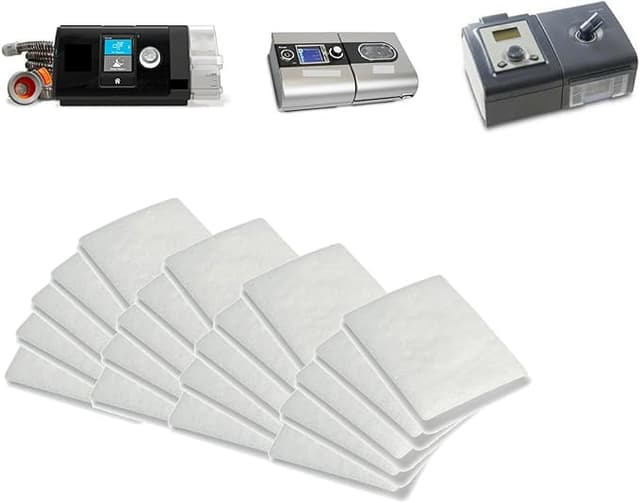
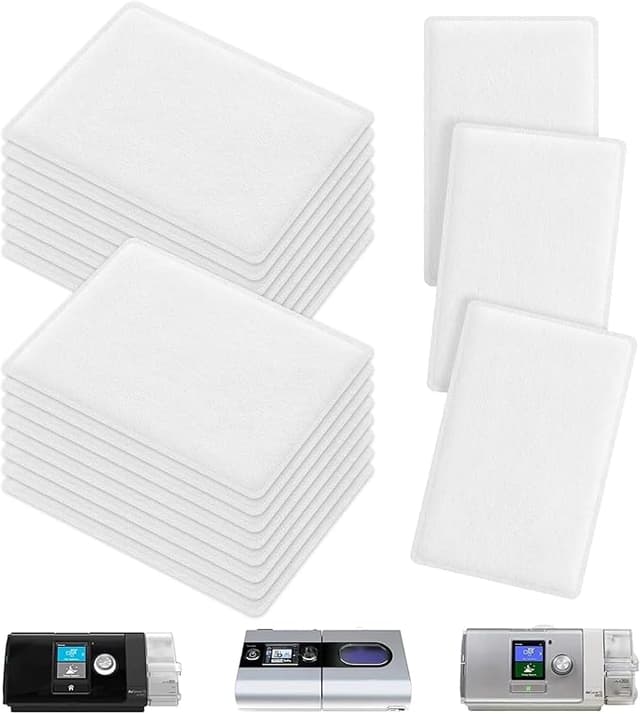
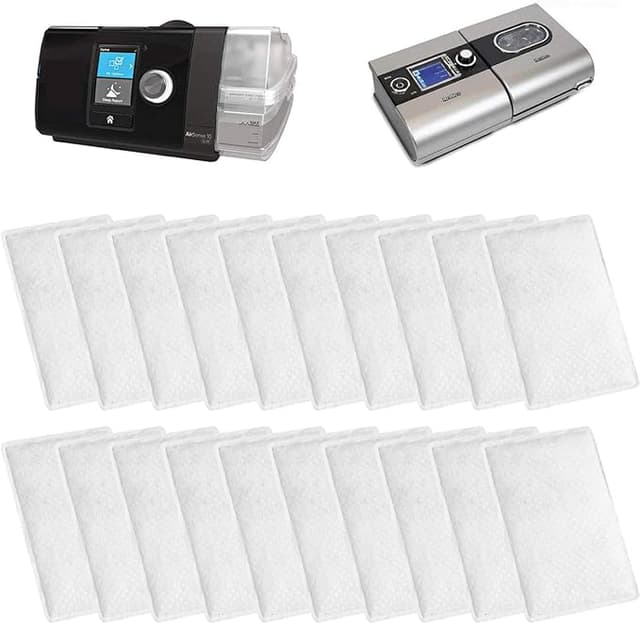
The fit, I have to give them credit for. The intake on these machines is the little flap on the back — you pop it open, the old grey-white pad lifts right out, and the new one drops in. The compatible filters seated flush against the housing with the same soft give as the OEM. No trimming, no folding a corner to make it cram in. The flap clicked shut without that resistance you get when something's a millimeter too thick. I've used aftermarket fridge filters that fought me on install; this wasn't that.
How they actually compare to OEM
The whole point of a CPAP intake filter is dead simple: catch dust, dander, pollen, and the general grit floating in your bedroom before the machine pressurizes it and sends it down the tube. These are hypoallergenic, fine-particle filters, and on the only test that matters to me — pulling one out at the two-week mark and looking at it — they were doing the job. The grey side facing the room turns visibly dirtier than the inside face. That gradient is exactly what you want to see. It means the material is catching what it's supposed to and the clean side is still clean.
Airflow felt identical. My therapy pressure didn't change, the machine didn't ramp or labor, and I sleep the same as I did on OEM. If a compatible filter is too dense it'll choke airflow and your device works harder; if it's too loose it's just decoration. These sat in the right middle — enough resistance to filter, not so much that the blower noticed.
The genuine downsides — and there are a couple
I said I'd be straight, so here's where they're behind. First, the frame edge is a hair softer than ResMed's. On a couple of filters in the pack, the bonded border that holds the pad's shape was very slightly less crisp — one had a corner that wasn't perfectly square. It still seated fine and sealed fine, but if you're the type who notices, you'll notice. It didn't affect filtration; it's a manufacturing-polish gap, not a performance gap.
Second, the packaging is cheap. The OEM filters come individually sealed; these came stacked in a single bag. For a filter that's about keeping particles out, I'd prefer each one wrapped, and I store the open pack in a zip bag in a drawer now so they're not collecting the very dust they're meant to block before I even install them. Minor, but it's the kind of corner-cut that tells you where the price savings came from.
Third — and this is on the whole category, not just this brand — the consistency across a pack isn't as tight as OEM. Most were excellent. One or two were merely fine. With ResMed you're paying partly for the boredom of every single filter being identical. With the compatibles you're paying less and accepting a tiny bit of variance. For an intake filter, I'll take that trade. For something downstream of the humidifier I might think harder.
Why I don't skip this, cheap filter or not
Whichever one you buy, change it. A saturated filter is the actual danger here, not the brand on the box. When that pad clogs, it stops catching allergens and starts holding a reservoir of them right at the mouth of your air intake — and then the machine pulls air around or through that gunk and sends it to you all night. That's the real respiratory risk, and it happens identically to people running $60 filters they forgot about for three months. The two-week cycle exists for a reason. Honestly, the lower price is what finally got me to change them on time, because I stopped flinching at the cost of doing it.
So who should buy what
If you have a documented severe respiratory condition and your sleep doc has told you to use only manufacturer-spec consumables, listen to your doctor over me — buy OEM, no argument. Same if the few-dollars difference genuinely doesn't register for you; then there's no reason to chase it.
But for the ordinary user staring at a $20 compatible pack next to the OEM price, nervous the cheap one will hurt their machine or their lungs — I was you, and the fear didn't survive contact with actually using them. They fit, they filter, they don't strain the device, and the only real complaints I have are a slightly rougher frame and bag packaging. For the money, doing the same job, I'd buy them again. I already have — twice now.