Troubleshooting & Analysis
Two little discs, one weirdly hard decision
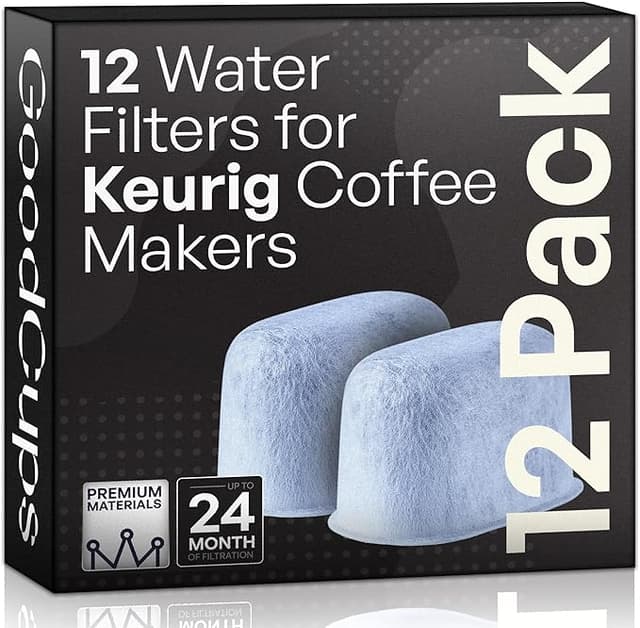
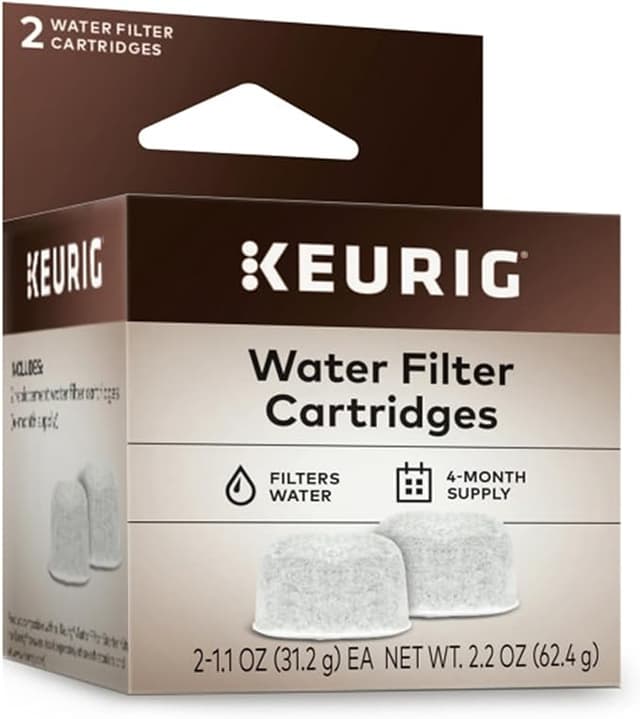
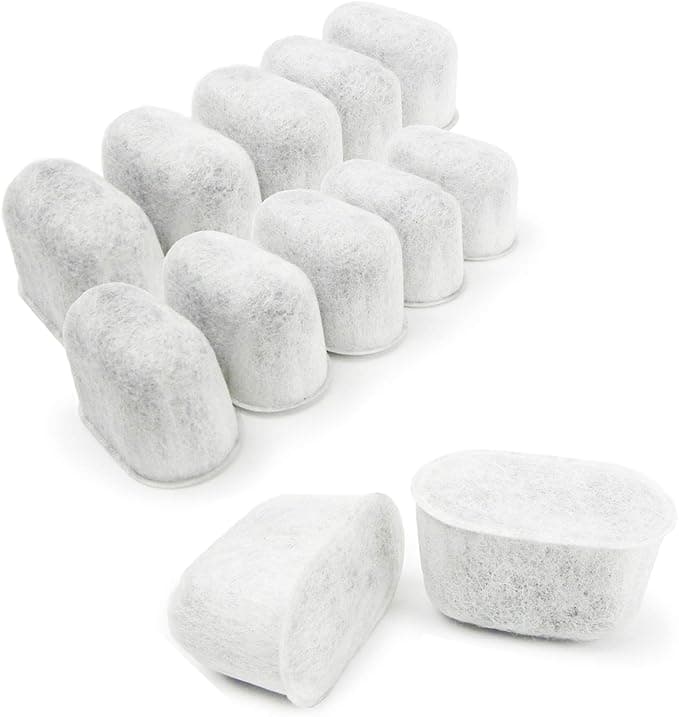
I was standing in the coffee aisle holding two packs of Keurig water filter cartridges — the same flat charcoal discs, near enough identical through the plastic — and the only real difference was the price tag. The Keurig-branded refill 6-pack rang up around $20. The compatible 6-pack next to it was $11. Same shape, same job, almost half the money. And I just stood there for a second doing the thing we all do: okay, but what's the catch.
I'd already killed one Keurig to scale. Not dramatically — it just got slower, then it started spitting half-cups, then it sounded like a kettle full of gravel every morning. So I'm not casual about filtration anymore. I run these little charcoal cartridges in the reservoir of my K-Elite, and the question that kept me frozen in that aisle was simple: does the cheap one actually filter, or is it a $11 placebo that lets scale chew through my machine while I feel responsible?
Short version, because you probably want it before the 800 words: I bought the compatible pack. I've now run them for the better part of a year. I'd buy them again. But there are a couple of honest catches, and I'm going to tell you both before I tell you why I still grab them.
The actual money, over a year
Here's the math that pushed me. These cartridges want swapping every two months — that's the schedule Keurig prints, and it's the one I keep because a charcoal filter doesn't get "more used up gracefully," it just stops adsorbing and starts being a wet sponge in your tank. Six per year, basically.
On the OEM 6-pack at roughly $20, that's about $20 a year. On the compatible 6-pack at around $11, that's $11. So we're talking a $9 gap, year over year. Look — nine bucks is not life-changing, and if that were the whole story I'd shrug and tell you to buy whichever's in front of you. But it stacks. Two Keurigs in a house, a few years each, and you've quietly handed Keurig fifty, sixty dollars for a charcoal disc that a third party makes for a fraction. That's the part that bugged me more than the absolute number. It's not that OEM is expensive. It's that the markup is on something this simple.
Fit and install: this is where compatibles usually fail, and these didn't
This is the part I was most nervous about, because a filter that doesn't seat right is worse than no filter — it lets water route around it. The install itself is nothing: soak the cartridge in a cup of water for about five minutes first (don't skip this — a dry charcoal disc traps air and floats wrong), press it into the little filter holder, and drop the holder down into the reservoir. On my K-Elite the holder clicks onto the post at the bottom of the tank.
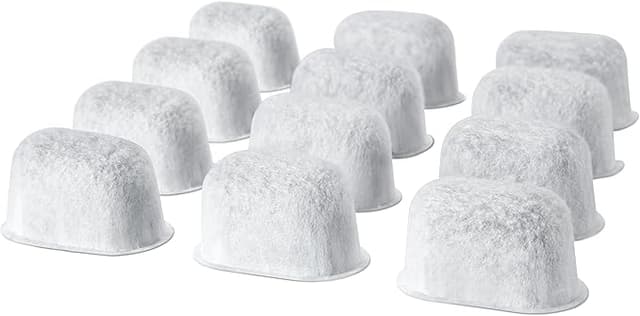
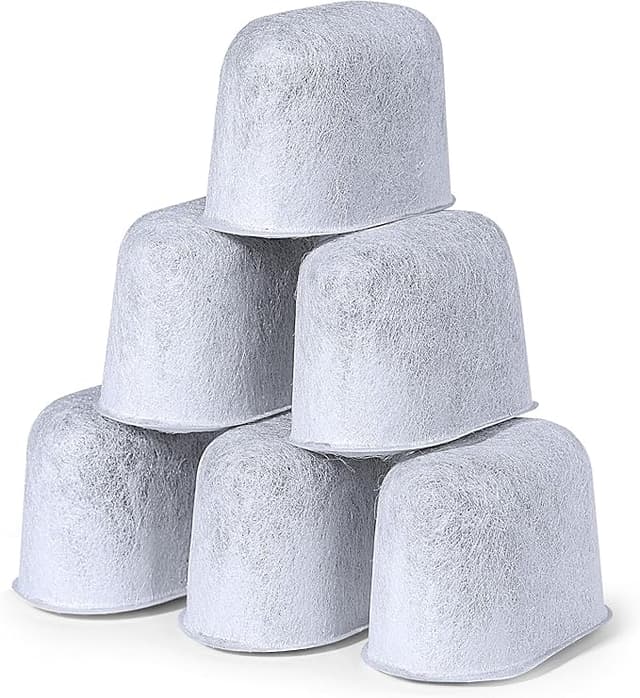
The compatible disc snapped into the holder with the same firm little click as the Keurig one. No shaving it down, no forcing it. Held in the water without bobbing loose, sat flush. I genuinely could not tell you by feel which brand was in the tank a week later. If you've ever fought an aftermarket fridge filter that needed a quarter-turn of prayer to seat, relax — this is not that. It's a friction-fit disc and they nailed the dimensions.
Performance, the honest version
What charcoal does in a Keurig is take the chlorine bite and the flat municipal-water taste off, so your coffee tastes like coffee and not like the pool deck. The compatible discs do this. First pot after a fresh swap, the water tastes clean, the coffee's rounder, the chlorine edge is gone. On taste, head to head, I could not reliably pick OEM from compatible in my own kitchen. That's the real test and it passed it.
Where it's a touch behind: I think — and I'll be honest that this is a feel, not a lab result — the OEM disc holds its taste-cleaning a hair longer into the back half of the two months. Around week six or seven the compatible one starts letting a faint flatness back into the cup, where the Keurig one seemed to hold cleaner right up to swap day. The fix is dumb-simple: I just swap on schedule and don't push my luck to ten weeks. On the two-month interval they're meant for, it's a non-issue.
The genuine downsides — both of them
First, the smell. New compatible disc, first day or two, there's a faint plastic-and-charcoal note off the cartridge. I now run one full reservoir of water through and dump it before I trust the first real cup. After that it's gone. Annoying, real, and frankly the OEM ones aren't totally innocent here either — but the compatibles are a little stronger about it on day one.
Second, the packaging is cheap. The discs come loose or in a thin plastic sleeve, not individually sealed the way Keurig blisters theirs. It doesn't affect the filter — charcoal doesn't care about a fancy wrapper — but if you're the type who likes a sealed unit, the compatibles will feel a little flea-market. I keep mine in a ziploc in the cabinet and it's fine.
Why this matters more than nine dollars
The reason I won't run a Keurig without one of these — branded or not — is the machine I already lost. A saturated or missing filter means chlorine and minerals go straight at the heating element and the internal lines, and scale is the number one thing that kills these machines. The filter is the cheap insurance on a $130 appliance. So the real question is never "OEM or compatible," it's "filtered or not," and on that front a working $11 disc protects your Keurig exactly as well as a working $20 one. Both are charcoal. Both adsorb. Physics doesn't read the brand on the wrapper.
Who should buy OEM instead — and who should grab these
Buy the Keurig-branded ones if you genuinely stretch your filters past the two-month mark and won't change that habit — that extra bit of late-cycle staying power is worth paying for if you're going to abuse the schedule. Buy them too if you just want zero thinking and the sealed packaging matters to you.
For everyone else — anyone who'll soak the disc, run one tank through to clear the day-one smell, and swap on time — the compatible cartridge does the same job, fits with the same click, and saves you the $9 a year while protecting your machine just as well. I stood in that aisle nervous about the cheap one. A year of clean cups and a Keurig that still doesn't rattle later, I grab the $11 pack without a second thought. And I have.