Troubleshooting & Analysis
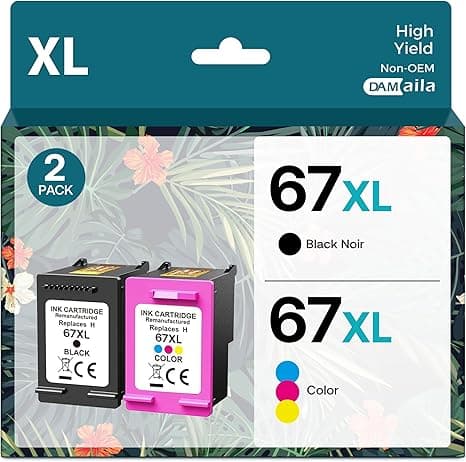
The click. That's the thing I remember from the first time I dropped a compatible 67XL into my HP DeskJet 4140. OEM cartridges seat with this confident little snap, and honestly I was braced for the off-brand one to feel mushy, like it wasn't going to register. It didn't. Same click. Same little carriage shuffle as the printer woke up and figured out it had ink again. I sat there for a second almost annoyed that it was that easy.
I'll back up. I've got the 4140 at home and I've fed compatible cartridges through a 6020 at my sister's place and a 6034 a buddy uses for his side gig printing shipping labels and the occasional kid's homework. Three machines, same 67XL slot, same question every time: is the cheap one going to be fine, or am I going to clog a printhead and end up buying a whole new printer to save twelve bucks?
The price is the whole reason we're here
Let's just say it plainly. A genuine HP 67XL high-yield black runs me around $38 when I'm not catching a sale. The compatible high-yield I keep buying is about $19. That's a $19 gap on a single cartridge. And nobody buys one cartridge — you go through black faster than color, color faster than you'd think if there's a kid in the house, and suddenly you're restocking three or four times a year.
Do the annual math on a normal household that prints, I don't know, a few hundred pages a year plus the occasional photo. Two black cartridges, two color, call it four a year. OEM: roughly $152 if I'm averaging the black and color prices out. Compatible at half that markup: somewhere around $76. So I'm pocketing about $76 a year to print the exact same kid's book report. That's not a rounding error. That's a tank of gas and a couple of coffees, every year, for the rest of the time you own the printer.
Install is genuinely nothing
I want to be useful here, not vague. You open the cover, the carriage slides over and parks itself — wait for it to actually stop, don't fight it. Press the little tab to pop the old cartridge loose, it lifts right out. New one comes with a strip of protective tape over the contacts and nozzle; peel that fully, all of it, because a half-peeled strip is the number one reason a perfectly good cartridge prints nothing and gets blamed unfairly. Then you slide it in until you get that click I was going on about, close the cover, and run a test print.
That test print matters. First page out of a fresh compatible can look a hair light or show one faint streak. Don't panic and rip it back out. Run two or three pages and it evens out as the ink starts flowing properly. Every single one of the three machines did this. By page four it was solid black text, no streaking.
Where it matches OEM, and where it doesn't quite
Text? I genuinely can't tell the difference. Black document printing — invoices, forms, the shipping labels my buddy lives on — is sharp, dark, no complaints. If you mostly print plain documents you are getting OEM output for half the money and I'd stop reading right here and go buy it.
Color is where I'll be straight with you. On plain paper, flyers and charts and homework, it's vibrant and fine, nobody's going to squint at it. On glossy photo paper, side by side against a genuine HP color cartridge, the OEM has a slightly richer depth in the dark reds and the skin tones. It's subtle. You'd have to hold both prints under a lamp to call it. But if you're a photographer printing portfolio shots, that small gap might matter to you, and I'm not going to pretend it isn't there.
The real downsides — because there are some
The packaging is cheap. Thin cardboard, a baggie, none of the molded plastic theater HP gives you. Doesn't affect the ink one bit, but the first time it shows up it looks like something fell off a truck, and I get why that rattles people.
Bigger one: the ink-level monitor gets weird. Your HP will very likely throw a "non-genuine cartridge" warning, and on some firmware the on-screen ink gauge either won't read at all or shows a question mark instead of a percentage. You click through the warning once and it prints normally — but you lose the little fuel gauge. I've adjusted by just keeping a spare in the drawer and swapping when prints start going light, the old-school way. If you're someone who relies on that percentage readout, know that you're trading it away.
And once in a while you get a dud. Out of maybe a dozen compatible cartridges across these three printers, I had one black that printed faint no matter how many cleaning cycles I ran. The seller swapped it free, no argument, but it cost me a few days. With OEM that basically never happens. So factor in a slightly higher dud rate — buy from a seller with a real return policy and you're covered, but it's a real difference.
Why a dead or failing cartridge is its own problem
Quick note that's easy to skip: don't run a cartridge bone dry and keep hammering print jobs at it. An empty or near-empty cartridge can let the printhead run hot and dry, and on these integrated-head HP models that's the kind of thing that actually shortens the machine's life. Swap when prints go pale. At $19 a cartridge there's zero reason to squeeze the last ghost-gray page out of a dead one — that's the false economy that wrecks printers.
So who should skip it
If you print professional photos for clients and that last few percent of color depth is your livelihood, buy the genuine HP 67XL. Same if you absolutely need the on-screen ink percentage and the warning popups will drive you up a wall — your sanity might be worth the $19.
Everybody else? Look. I've put compatible 67XL cartridges through three different HP printers — the 4140, the 6020, the 6034 — for over a year now, and they print the same documents the OEM does for roughly half the price. One faint streak on page one, a warning popup you click past, a dud now and then. That's the whole list of complaints. For about $19 instead of $38, doing the identical job, I buy the compatible one. I have, repeatedly, and I'll do it again next time the black runs low.