Troubleshooting & Analysis
I didn't believe a $20 cartridge could be fine either
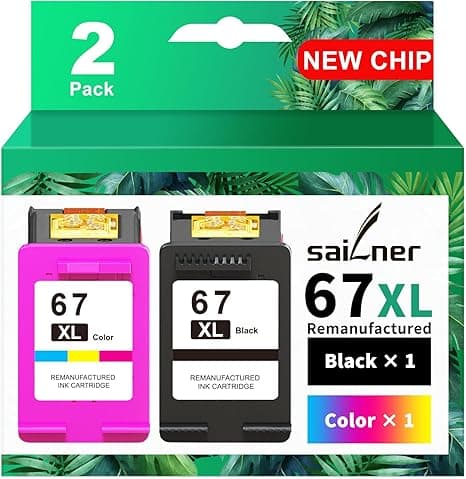
Here's where my head was at last spring. My HP 4122E was flashing the low-ink warning mid-way through printing my kid's permission slips, and I clicked over to reorder the genuine HP 67XL. Forty bucks. For a thimble of ink. And right under it, the marketplace dangled a compatible 67XL at half that — call it $20 — with a star rating that looked suspiciously good. My gut said: scam. Clogged nozzles, faded print, maybe a fried printhead. I'd read the horror stories. So I did the dumb thing and bought one anyway, mostly to prove myself right and write a snippy review.
I was wrong. Mostly. Let me walk you through it, warts included, because the warts are the whole point.
The money, laid out plain
The genuine HP 67XL high-yield runs around $40 where I shop. The compatible 67XL I grabbed was about $20. That's a $20 gap on a single cartridge — and if you're a normal household that swaps maybe three or four times a year between black and color, you're looking at sixty to eighty dollars a year you're handing HP for the name stamped on the plastic. Over the life of a 2722E, 4122E, or 6022E, that's real money. The kind of money that, honestly, made me feel a little stupid for never questioning it before.
The pitch on the compatible is "same high-yield performance for half." I went in assuming that was marketing nonsense. So I tested it the only way that counts — I ran the thing.
Fit and install: it just clicked
This was my first surprise. I opened the cover, waited for the carriage to slide over and stop, pressed the little tab to pop the old HP cartridge out, peeled the protective tape off the new compatible one, and pushed it in until it clicked. That click is the tell. On a bad knockoff the cartridge sits a hair proud and the cover won't close clean, or the contacts don't line up and you get the dreaded "cartridge not recognized." Didn't happen. Seated flush, cover snapped shut, and a test print came right out.
The frame plastic feels cheaper than HP's — a touch lighter, the molding lines a little rougher if you look close. But dimensionally it was dead on. No shimming, no wiggling, no praying. It went in like it belonged there.
How it actually prints
Black text? I genuinely can't tell the difference. I printed a dense ten-page PDF, all small body type, and held it next to a page from the genuine cartridge. Same crispness, same darkness, no feathering at the edges. For documents — which is 90% of what most of us do on these little HP all-in-ones — it's a wash. The compatible does the job.
Color was where I expected it to fall apart, and it... mostly held. Photos came out a shade cooler than the genuine HP — a little less warmth in skin tones, reds that lean slightly toward orange. If you're printing the kid's worksheet or a recipe, you will never notice. If you're printing photos to frame, you'd notice if you put them side by side, but on their own they look perfectly good. I'm not running a print shop out of my office, so for me it's a non-issue.
The downsides — and there are real ones
Okay, here's where I earn your trust. This is not a flawless product and anyone telling you it is hasn't actually used one.
First: the first-print hiccup. Out of the gate my very first color page had a faint horizontal banding streak — looked like a nozzle hadn't fully primed. I ran one cleaning cycle from the HP software, printed again, and it was gone and never came back. But that ten-second panic of "great, I broke my printer" is real, and on a genuine cartridge I've never had it. Budget a minute for a cleaning cycle and don't judge it on the first sheet.
Second: the ink-level readout lies to you. This is the big one. Your HP printer is designed to recognize genuine HP chips, and with a compatible cartridge the on-screen ink gauge either reads inaccurately, gets stuck, or throws a "non-genuine cartridge" nag screen you have to dismiss. Mine showed full forever, then dropped to empty almost overnight. So you're flying a little blind — you replace it when print quality dips, not when the software tells you. If you're the type who needs that little gas gauge to be precise, that nag will bug you every single print. It bugged me for about a week, then I stopped noticing.
Third: the packaging is genuinely cheap. Thin plastic clamshell, no fancy box, instructions that read like they went through a translator twice. It doesn't inspire confidence when it lands on your porch. It works fine — but it does not feel like $40, because it isn't.
And one more, while I'm being honest: yield felt a touch shy of the genuine "XL." HP claims big page counts on the real 67XL, and my compatible ran dry a little sooner than I'd have liked. Still way ahead on cost-per-page given the $20 price, but don't expect it to outlast the real thing page-for-page.
Why I don't just let it ride till it sputters
Quick word on running a cartridge bone-dry, because people do it to squeeze every drop. Don't. On inkjets, printing with a near-empty cartridge can let the printhead run hot and dry, and that's how you actually risk clogging the thing — which is a far more expensive problem than a $20 cartridge. When print quality starts going pale or streaky and a cleaning cycle doesn't fix it, that's your cue. Swap it. The whole savings argument falls apart if you cook your printhead to save fifty cents of ink.
The verdict — who buys what
Buy the genuine HP 67XL if you print photos that matter — gallery stuff, client work, anything where a slightly cool red ruins your day — or if a "non-genuine" nag screen will genuinely make your blood pressure spike every time. For those people the $40 is buying exact color and a quiet life, and that's fair.
For everybody else running a 2722E, 4122E, or 6022E — the school-form, boarding-pass, recipe, occasional-snapshot crowd — I grab the compatible 67XL and I don't lose sleep. It fit, it clicked, the black text is indistinguishable, and it cost me $20 instead of $40. I went in trying to prove the cheap one was junk. Instead I bought a second one. That's the most honest endorsement I've got.