Troubleshooting & Analysis
Two cartridges, one shaky hand, and a print job due in twenty minutes
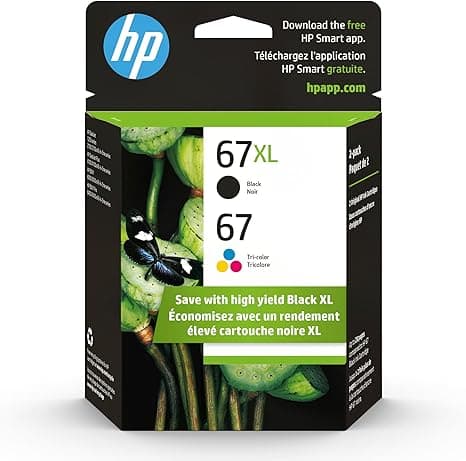
I was standing at the office supply shelf with a dead 2722E at home and a presentation that needed to print before noon. In one hand, the genuine HP 67XL — the box with the swirl and the hologram and the price tag that made me do a double-take. In the other, a compatible 67XL that did, on paper, the exact same thing for roughly half the money. And I just stood there. Because here's the honest truth: I'd been burned before by a no-name cartridge that leaked all over a carriage, and I wasn't sure I wanted to gamble on my printer to save twenty bucks.
I bought the compatible one anyway. That was about five months ago. I've gone through two of them since. Here's everything I learned, the good and the genuinely annoying, so you can make the call I was sweating over.
The price gap is not subtle, and that's the whole point
Let me put the real number on it, because vague "save money!" talk is useless. The genuine HP 67XL high-yield runs me somewhere around $40 depending on where I look. The compatible 67XL I've been using lands at about $20 — call it half. So we're talking a real, in-your-pocket gap of roughly $20 per cartridge. If you print like I do — a couple hundred pages a month, school stuff, shipping labels, the occasional photo — you're refilling maybe three or four times a year. That's $60 to $80 a year saved, every year, on a printer you probably paid less than $80 for in the first place.
That math is the entire reason this category exists. HP basically gives the printer away and makes its money on the ink. The compatible market exists to claw some of that back. The only real question is whether the cheaper cartridge actually does the job without wrecking your machine. So let's get into that.
Does it fit and seat right? Mostly yes — with one fussy moment
Installing it is the same dance as the genuine one. You lift the cover, wait for the carriage to slide over and stop, press the little tab to pop the old cartridge loose, then pull the protective tape off the new one and push it in until you feel and hear that click. Run a test print. Done.
The fit on the compatible 67XL is good. It clicks into the carriage the same way the genuine one does, sits flush, no wobble. But — and this is a real thing — the contact strip on the cheaper cartridges is a hair more sensitive about being clean. On my second compatible cartridge, the first test print threw a "cartridge not recognized" error. I pulled it, wiped the gold contacts with a dry microfiber cloth, reseated it, and it took fine. Genuine HP almost never does that to me. So budget thirty extra seconds and don't panic if the first insert hiccups. It's not a defect, it's just a slightly cheaper contact tolerance.
One more install note from actually doing it: peel the tape fully. The compatible tape is flimsier than HP's and tends to tear, leaving a sliver stuck over a vent hole. A torn-off scrap covering that vent will starve the cartridge and give you streaky prints that look like a clog when they're really just a piece of tape. Check it before you blame the ink.
How it actually prints: black is great, color is a touch behind
Black text is where the compatible cartridge genuinely holds its own. Crisp, dark, no graying, no skipping on a 30-page document. If you're printing forms, labels, school worksheets, anything text-heavy, you would not be able to tell my compatible prints from genuine HP ones in a blind test. I've tried.
Color is where I'll be straight with you. It's good — not quite genuine-good. On a photo with a lot of sky in it, the compatible tri-color leans very slightly cooler, a touch more toward blue, than the genuine HP does. On a normal color document — a pie chart, a flyer, a kid's homework with a map on it — you will never notice. On a glossy 4x6 photo you're going to frame, you might. So if your printer is mostly a photo printer and color accuracy is sacred to you, that's the one honest reason to stick with genuine. For the other 95% of what people actually print, the compatible is plenty.
The downsides I'm not going to pretend away
The packaging is cheap. The cartridge shows up in a thin plastic clamshell instead of HP's sealed box, and that's fine, but it means you want to check the install date and not let these sit in a drawer for a year — a compatible cartridge that's been sitting too long is more likely to have a partially dried printhead than a genuine one. I now buy them in pairs and use the spare within a couple months, not a couple years.
The page yield is, in my experience, a little under what the box claims. HP's genuine 67XL high-yield gives me close to its rated pages. The compatible "XL" gets me maybe 85 to 90 percent of the way there before it starts fading. Honestly? At half the price, getting 88% of the pages is still a massive win on cost-per-page. But if you were expecting identical yield, lower the expectation a notch.
And the ink-level reading is unreliable. Your printer may show a "non-genuine cartridge" warning and the on-screen ink gauge can be flaky or stuck — sometimes it won't track the level at all. You learn to print until quality drops instead of trusting the bar. Mildly annoying. Never once damaged anything.
Why a dead or near-empty cartridge is worth not gambling on
The thing nobody tells you: running a cartridge bone-dry and then printing anyway is what actually hurts these printers. A near-empty cartridge that you keep forcing can let the printhead run hot and dry, and that's where you get permanent streaking. So the real value of a cheap, easy-to-replace cartridge is that you stop hesitating to swap it. When ink's $40, you nurse a dying cartridge for another week of bad prints. When it's $20, you just change it. Keeping a fresh cartridge in is better for the machine than squeezing the last drops out of an expensive one.
The verdict: who should buy genuine, and why I keep grabbing this one
Buy genuine HP 67XL if you're a photo printer who frames your prints, or if a flaky ink gauge will genuinely drive you up the wall. For those two people, the extra $20 buys real peace where it matters to you.
For everyone else — and that's most of us — the compatible 67XL for around $20 against the genuine's roughly $40 is the easy call. It fits, it clicks in, the black text is indistinguishable, the color is fine for normal life, and the worst thing it's done to me is ask for a contact wipe once. I've bought it three times now with my own money, and the fourth is already sitting in my drawer. That's the most honest endorsement I can give: I'm a repeat customer, and I wasn't paid to be.