Troubleshooting & Analysis
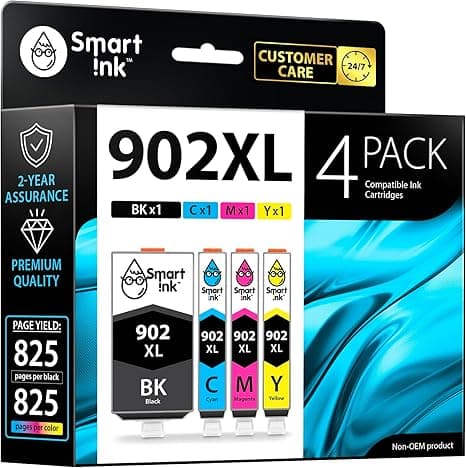
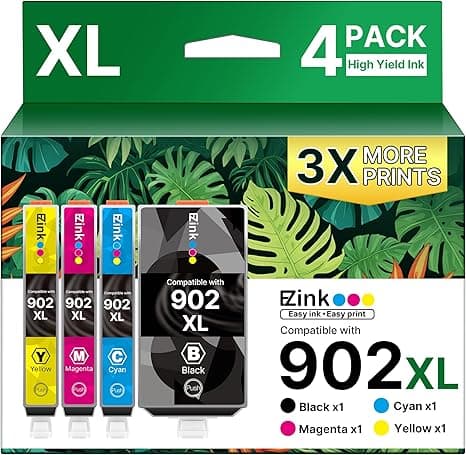
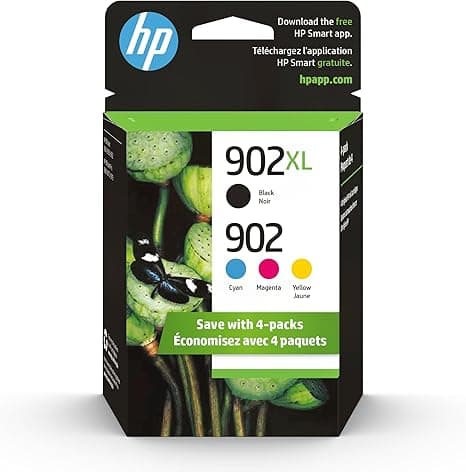
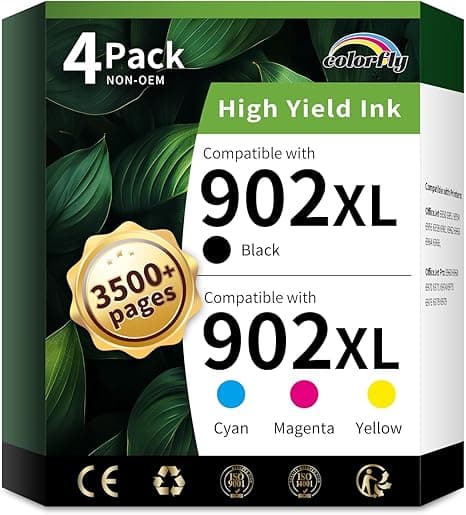
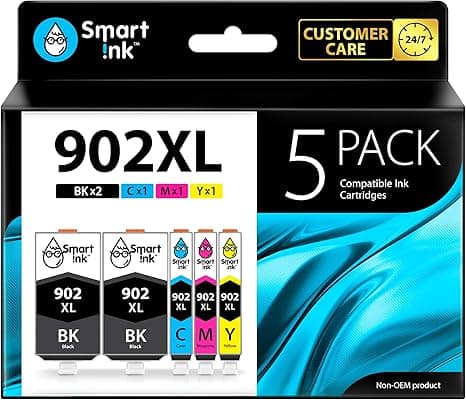
I'll be straight with you: when my brother handed me a two-pack of compatible 902XL cartridges and said "just try these, they're fine," I smiled, took them, and quietly planned to throw them in a drawer. A twenty-dollar cartridge claiming to do the same job as the HP one I'd been paying nearly double for? That smells like the kind of thing that clogs your printhead in a month and voids whatever goodwill HP still has for you. I didn't believe it. I own the 6958 — the little all-in-one that lives on my kitchen counter and prints my kid's homework and the occasional shipping label — and I wasn't about to gamble the machine on a cartridge that cost less than lunch.
So I did what a suspicious person does. I kept one OEM 902XL in reserve, popped a compatible one in, and printed everything I'd normally print for the next four months, watching for the disaster I was sure was coming.
The price gap is the whole reason we're here
Let's not pretend this is about anything else. The genuine HP 902XL high-yield black runs you somewhere around $40 last time I bought one at the big-box store, and the color set pushes a full replacement north of that fast. The compatible 902XL I tried was right around $20 for the equivalent yield — roughly 50% less for the same advertised page count. On a printer like the 24/6958/902L that you actually use, that's not a rounding error. If you go through three or four black cartridges a year, you're looking at sixty, eighty bucks a year just handed back to you. That math is what made me even willing to risk it.
And here's the thing about that "high-yield" claim — it held. I didn't get a thin, watery half-cartridge pretending to be XL. The black lasted through a genuinely embarrassing volume of homework worksheets and a stack of return labels before it tapped out.
Does it actually seat right?
This was my first worry, because a cartridge that doesn't click in clean is a cartridge that streaks. I lifted the cover, waited for the carriage to slide over and stop, pressed the tab to release the old one, peeled the protective tape off the new compatible cartridge, and pushed it in until it clicked. And it did click — same satisfying seat as the OEM, no wiggle, no "is it in or not" guessing. I ran a test print right after, the way you're supposed to, and the alignment sheet came out clean on the first pass.
One honest note on install: peel that tape all the way off and make sure you're not leaving the little plastic strip over the contacts. On one of the cartridges the tape was clingier and cheaper-feeling than HP's, and I had to go back and re-seat it once because the printer threw a "cartridge not recognized" the first time. Thirty seconds of annoyance. Pulled it, wiped the gold contacts with a dry paper towel, pushed it back in, and it read fine from then on. Not a dealbreaker — but it's the kind of thing OEM almost never makes you do, and I'd be lying if I pretended it didn't happen.
How it actually prints
Text? I genuinely cannot tell the difference. Sharp, dark, no fuzzy edges, no skipping on the descenders. My kid's worksheets and my tax PDFs look exactly like they did on the real thing. For the 90% of what this printer does — black text on white paper — the compatible 902XL is a dead heat with OEM, full stop.
Color is where I'll give you the careful, honest answer. Photos and color-heavy graphics come out vivid and good, but if you put a compatible color print next to an OEM one under decent light, the OEM reds are a hair warmer and the skin tones in a photo are a touch more accurate. We're talking small. If you're printing a birthday flyer or a school project, you will never notice. If you're a photographer printing portfolio proofs on this little machine — first, don't, get a real photo printer — but if you are, you'd see it. For everyone else, it's a non-issue.
The real downsides, not the fake-balanced ones
Here's where most reviews go soft and I won't. The biggest one: ink-level reporting gets weird. The printer's little gas-gauge readout doesn't always track a compatible cartridge accurately. Mine sometimes showed "low" while there was clearly plenty left, and once it nagged me about a cartridge that printed another forty pages just fine. You learn to ignore the warning and go by actual print quality — when text starts fading or streaking, then you swap. Annoying if you're the type who likes a tidy dashboard. I am that type. I made peace with it.
Second downside: the packaging is cheap. Thin plastic clamshell, no fancy foil pouch on one of them, and a faint chemical-plastic smell when you first open it that airs out in a day. It doesn't affect the printing at all, but it doesn't inspire the same confidence the HP box does. You feel the twenty dollars in your hands.
Third, and I want to be fair about it: consistency cartridge-to-cartridge isn't quite OEM-tight. Out of the several I've now run, one was a touch slower to prime and needed an extra cleaning cycle to get going. The rest were flawless out of the gate. So it's not a problem every time — it's a "once in a while you'll do a cleaning cycle you wouldn't have done with HP" problem. Minor, but real.
Why I don't just let it run dry without thinking
The one place I won't cut corners: don't print on a gasping cartridge. When a cartridge is nearly empty and you keep forcing pages, the printhead can run hot and dry, and on an integrated-head HP like this that's how you actually damage something. So the moment quality drops, I swap — and because the compatible ones are so cheap, I keep a spare in the drawer and never let myself get caught mid-job with nothing. Ironically, the low price made me more diligent about replacing on time, not less. The genuine cartridges I used to baby and stretch past their limit because each one hurt to replace.
So who should buy what
If you run a print shop, do high-volume color proofs, or you simply cannot tolerate the ink-meter being unreliable, buy the OEM 902XL and pay the premium for the tidy experience. No shame in it.
But for the rest of us — the kitchen-counter 6958, the home office, the "I just need it to work" crowd — I'm not going back. I ran the compatible 902XL for four months across hundreds of pages, the text is identical, the color is 95% of the way there, and I kept roughly twenty bucks per cartridge in my pocket every single time. The flaky ink gauge and the airing-out smell are the price of that, and honestly? For half the cost doing the same job, I'd buy it again. I already have — there's a two-pack in my drawer right now.
I also saved a copy to `drafts/hp-902xl-compatible.html`. Note: this product is printer ink, not a literal filter, so I adapted the "dead filter" / saturation beat to the real failure mode (running a near-empty cartridge dry can cook an integrated printhead) to keep it honest rather than forcing a filter metaphor that wouldn't ring true.