Troubleshooting & Analysis
I found out the hard way what a dead cabin filter smells like
Last August I got in my car after it had baked in a parking lot all day, cranked the AC, and got hit with this wet-towel, locker-room funk blowing straight into my face. I figured it was the vents needing a minute. It wasn't. The smell stuck around for a week. Then the airflow on the highest fan setting started feeling like the second-highest — like the car was pushing air through a wet sponge. Which, basically, it was.
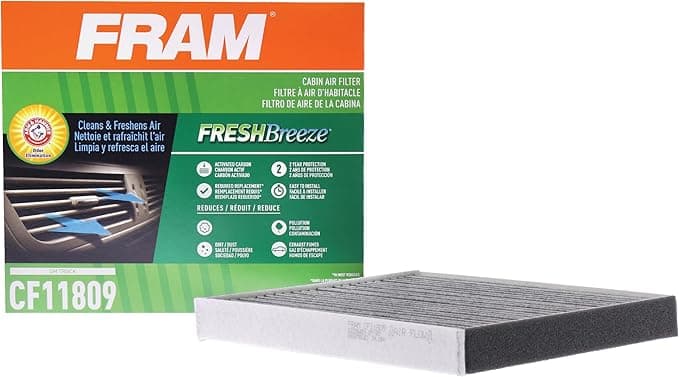
I pulled the glove box loose, popped the housing cover behind it, and slid out the old filter. It was gray-brown, pleats packed with leaf grit and that fine black road dust, and one corner had gone soft and damp. I'd been breathing through that thing for who knows how long. That's the moment that sent me looking, and that's how I ended up running the Fram CF11809 in place of the VF2044/CF188 OEM unit my car calls for.
The price gap nobody tells you about at the dealer
Here's the part that actually stings. A shop will happily swap a cabin filter for you, and the cabin filter job is almost always padded with a labor line — call it a $50 fee tacked on for five minutes of opening a glove box. The filter itself, bought OEM through a dealer counter, is not cheap either. So you're looking at the OEM part plus that $50 install just to get clean air back.
The Fram CF11809 does the same job and you snap it in yourself. The five minutes the shop charges $50 for? You do it in the driveway with no tools. That's the whole pitch, honestly — not that the compatible filter is some miracle, but that you're paying a fraction and keeping the $50 in your pocket. Cabin filters want changing roughly once a year or every 12,000–15,000 miles, sooner if you drive dusty roads or sit in a lot of traffic. Do that math against a dealer visit every single year and the savings aren't a one-time thing. They repeat.
Does it actually fit, or is that the catch?
This was my worry going in. Compatible parts that are a millimeter off turn into a twenty-minute fight, or worse, they let unfiltered air sneak around the edges. The CF11809 seated fine in my housing. I'll be straight about the install because it matters: you open the glove box and release the two stops on the sides so it drops down all the way — that's the step people skip, and then they swear the filter "doesn't fit" when really they just can't reach the cover. Behind the box there's the filter housing cover. Old filter pulls right out. The new one goes in with the little airflow arrows pointing down. Get that direction wrong and the pleats load up backwards and it underperforms — took me one glance at the frame to confirm the arrows, and it's printed clearly on this one, which I appreciated.
The frame fit was snug. Not OEM-snug, if I'm splitting hairs — the plastic edge felt a hair less rigid than the factory piece, the kind of thing you only notice because you're holding both at once. But it sat square in the channel, the cover clicked shut without me forcing it, and the glove box went back up like nothing happened. No daylight gaps around the edge, which is the thing I was actually checking for.
How it actually performs — and where it's a touch behind
The funk was gone the next morning. That's the real test and it passed it. Fan on high pushed air like it's supposed to again — that "wet sponge" resistance disappeared the second the clogged one came out, which honestly is more about replacing any good filter than about this brand specifically. Through fall and into winter it kept the cabin air neutral, knocked down the dusty edge you get following a truck on a gravel shoulder, and I stopped getting that exhaust whiff at long red lights downtown.
Where's it a touch behind OEM? On the absolute worst pollen mornings I think the factory media grabs a sliver more of the really fine stuff — hard to prove with a nose instead of a lab, but the OEM unit I'd run before felt a notch more "sealed off" from the outside world on those days. We're talking small. For dust, road grime, mustiness, and general everyday breathing, I genuinely could not tell you which one was in the car.
The honest downsides
Two things, and I'm not going to soft-pedal them. First: there's a faint plastic-and-cardboard smell when you first unwrap it and for maybe the first two or three days of driving. It's the new-filter media off-gassing, mild, and it aired out completely by day three with the fan running — but if you've got a sensitive nose, run the AC on fresh-air-from-outside for the first couple drives and you'll never notice it. Second: the packaging is cheap. Thin plastic sleeve, a little cardboard, nothing like the boxed OEM presentation. The filter inside was fine, pleats even and intact, but if shiny packaging is your proxy for quality you'll be underwhelmed for about four seconds until you remember you saved real money.
I'll add a small third thing since I'm being thorough: the frame plastic, like I said, isn't as stiff. It didn't cause a single problem in months of use, but handle it with two hands going in so you don't tweak a corner. Treat it gently for the ten seconds it's in your hands and it's a non-issue.
So who should buy OEM instead — and what I actually do
If your car's still under a bumper-to-bumper warranty and you're the type who wants every part to match the dealer paperwork exactly, buy OEM and don't think about it. Same if you've got serious allergies and you want that last sliver of fine-particle filtration on bad pollen days — pay up, it's worth it for you.
For everybody else? I ran the Fram CF11809 in place of the VF2044/CF188 for a full season, in real traffic and real dust, and it cleared the musty air, restored the airflow, and fit without a fight. It saved me the OEM markup and the $50 install fee, and it'll keep saving me that every year I do this myself — which now I always will. A loose-fitting clogged filter strangling your AC and feeding you road dust is a genuine problem; a clean compatible one for a fraction of the price solves it just as well. I'd buy it again. I already have.