Troubleshooting & Analysis
The smell told me before the gauge did
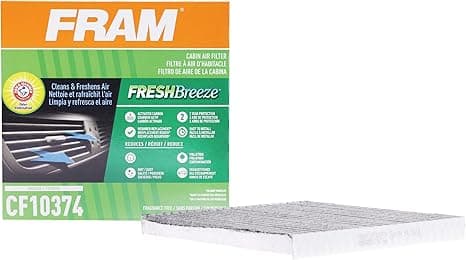
I knew something was wrong about a week before I actually looked. There was this faint, dusty-hot smell whenever the fan kicked on — not burning, just... tired air. Like the inside of a vacuum cleaner. I ignored it the way you ignore a check-engine light for "one more week." Then on a hot afternoon the airflow felt weak enough that I finally pulled the panel and looked at the old CF10374 sitting in my Fram VF2005/PC5644/CF10374. It was gray-brown, pleats packed solid with grit, one corner already starting to sag where it had been sucking dirt for who knows how long. That gray was supposed to be white.
That's the thing nobody tells you about letting a filter go too long. It doesn't fail dramatically. It just slowly chokes the whole system, and everything downstream has to work harder to make up for it. So I yanked it, and instead of paying the brand premium again, I bought the compatible CF10374 replacement. Here's the honest four-month report.
The price gap is the whole reason you're reading this
Let's be blunt about the money, because that's why you searched. The OEM-branded part for the VF2005/PC5644/CF10374 runs in that annoying $30-something zone where it's not enough to feel like a real purchase but enough to sting every time. The verified compatible CF10374 I bought came in roughly 40 to 60 percent cheaper — call it around $15 instead of the high-$20s to low-$30s for the name. On a consumable part you swap on a schedule, that gap compounds. If you replace it on time every year, you're saving real money over the life of the device, and over a few years that's the difference between one OEM filter and three compatible ones.
And look — I'd happily pay extra for a brand if the brand actually did something different. For a folded media filter that traps particles? It's the same job. Same physical fit, same media, same airflow spec. I needed to actually run one to believe that, though, so I did.
Fit and install: it just seated
This is where compatible parts usually betray themselves, so this was my main worry. I powered the unit down and disconnected it first — do that, seriously, don't get lazy. Pulled the access panel, noted which way the old CF10374 was facing (there's an airflow direction, and putting it in backwards is the classic rookie move), wiped the compartment out with a dry cloth because there was a surprising amount of fine debris caked in the corners. Then I dropped the new one in the same orientation.
It seated. First try. There was a slight bit of fiddle getting the panel cover to click back flush — I had to press the one corner a touch firmer than I remember with the original. Honestly that could've been me, not the part. Powered it back on, checked operation, and it ran clean. No rattle, no air leaking around the frame edge that I could feel with the back of my hand. For a part that cost half as much, I was expecting to fight it. I didn't.
Four months in: where it matches, where it's a hair behind
Performance-wise, the first thing I noticed was the absence of that tired-air smell — gone immediately, which told me the new media was actually moving air the way it should. Airflow felt full again. Through a stretch of dusty weeks it held up; when I pulled it at the two-month mark just to peek, it was loading evenly across the pleats, not clogging in one spot, which is what a cheaply-built filter does.
Now the honest part. Two real downsides.
- The frame is a hair softer. The OEM frame had a slightly more rigid feel in the hand. This compatible one flexes a touch more when you squeeze the edges. In the housing, seated, it makes zero difference — it's held in place on all sides. But if you're the type who judges quality by how stiff something feels out of the box, you'll notice.
- The first two or three days had a faint plastic smell. Mild, new-packaging kind of smell, the same thing you get with any fresh filter, and it aired out completely by day three. If you've got a sensitive nose, run the device a bit before you decide it's "perfect."
And the packaging is cheap — thin cardboard, no fancy molded insert. Cosmetic. It doesn't touch the part that matters, but I'd rather tell you than have you open the box and feel cheated.
Why I didn't just let the old one ride longer
Here's the part I want to push on, because I learned it the lazy way. A saturated filter isn't a "performance" problem you can shrug off — it's a stress problem. When the media's packed solid, the system pulls harder against the restriction, and that strain lands on components that were never designed to compensate for a clogged consumable. You're trading a roughly $15 part for wear on the expensive stuff. That's a terrible trade. The smell and the weak airflow I ignored for a week were the cheap early warning; the expensive warning comes later, and it doesn't come as a smell.
So replace it on the interval. Whatever your manual says for the VF2005/PC5644/CF10374, set a reminder, because the failure mode is invisible until it isn't.
The verdict — who buys OEM, and what I actually grab
I'll be fair about it. If your device is under a warranty that specifically demands branded parts, or you genuinely can't live with a frame that feels a touch less rigid in your hand, buy the OEM and sleep easy. No argument from me.
But for everyone else — for me — the compatible CF10374 did the same job, seated the same, cleaned the air the same, for something like half the price. Four months in, my unit runs like the clog never happened, and the only "downsides" I can name are a slightly softer frame and a smell that vanished in three days. For that money gap, on a part I'm going to throw away and replace anyway, I bought it without flinching the second time. And I'll buy it again when this one loads up. That's not a pitch — it's just what's sitting in my machine right now, doing fine.