Troubleshooting & Analysis
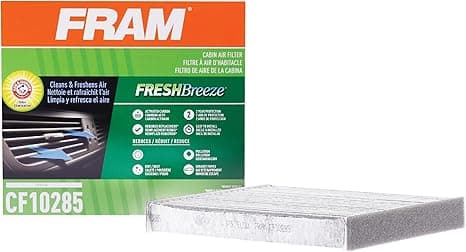
Sixty-one dollars. That's what the dealer counter wanted for one cabin filter on my Fram-spec AJ000 setup — a flat rectangle of pleated paper and a plastic frame, the kind of part you'd guess costs a few bucks to make. I stood there doing the math. Two of these a year if you drive in dust or pollen like I do, and you're handing over more than a hundred and twenty bucks a year to breathe in your own car. Meanwhile the compatible CF10285 I'd been eyeing online was sitting at right around $22. Same slot, same job. That gap — call it $39 every single time — is the whole reason I started buying aftermarket in the first place.
So I bought the cheap one. Not because I trusted it. Because I was annoyed.
What you're actually paying for with the OEM
Here's the thing nobody at the parts counter says out loud: a cabin filter is a consumable. It's designed to get dirty and get thrown away. You are not buying a precision component that needs a brand's engineering pedigree — you're buying a media pad that traps pollen, road grit, and the occasional bug, then you toss it in six to twelve months. Paying the OEM premium on a part whose entire purpose is to be discarded never made sense to me, and the CF10285 made that obvious the moment I held both side by side.
Run the annual numbers. OEM at roughly $61 a pop, replaced twice if you're in a heavy-pollen region, is about $122 a year. The compatible at $22 each is $44. That's nearly $80 a year staying in your pocket for — and I want to be honest here — a part that does the same filtering. Over the life of the car that's real money. It's a tank of gas every couple of months.
Does it actually fit?
This is where compatible filters earn their reputation, good or bad, and it's the first thing I check. On mine, the install is genuinely a five-minute job — and the steps are no different from the OEM. Pop the glovebox loose, swing it down past the stops, and the filter housing is right there behind it. The old one slides out, you note which way the airflow arrow points, and the new one goes in the same orientation. Cover back on, glovebox back up, done.
The CF10285 seated correctly. I'll be straight with you, though: the frame is a hair less rigid than the OEM piece. When I slid it into the channel it flexed a little more than I'd like, and I had to give one corner a gentle nudge to get it square in the track. Once it was in, it sat flush and the housing cover snapped shut with no fight. No gaps at the edges, no air sneaking around the media. But that first-fit moment was a touch fiddlier than the brand-name part, and if you're someone who panics when plastic flexes, you'll feel it.
How it performs once it's in
Honestly? After a week I couldn't tell the difference at the vents. Airflow on full blast felt the same as a fresh OEM filter, and the pollen funk that had been creeping into the cabin — that stale, slightly green smell you get when a filter's saturated — was gone within a day. I ran it through a full spring, which around here means the windshield turns yellow with tree pollen, and the air inside stayed clean. Defrost cleared the glass at the same rate. No whistling, no reduced flow.
Where's it a touch behind? If I'm nitpicking, the media doesn't feel quite as densely pleated as the OEM. Hold them to a light and the brand-name one has marginally tighter folds, which on paper means a bit more surface area. In practice, over six months of normal driving, I never noticed a real-world difference in air quality. But I'd believe that the OEM lasts a month or two longer before it loads up. For an $80-a-year savings, I'll change mine slightly more often and still come out way ahead.
The downside I want you to know about
Two things, actually. First, the smell. Out of the bag there's a faint plastic-and-glue odor — that fresh-manufactured smell — and for the first two or three days you'll catch a whiff of it when the fan first kicks on cold. It fades completely. By day four I'd forgotten it existed. But it's there, and if you've got a sensitive nose you should know it's coming so you don't think something's wrong.
Second, the packaging is cheap. The OEM showed up in a printed box with foam end-caps. The CF10285 came in a thin plastic sleeve, and one corner of the frame had a tiny scuff from shipping. Cosmetic — it didn't affect the seal or the fit at all — but it's the kind of thing that makes you go "huh" when you open it. You're not paying for presentation. You're paying for the media pad that does the work, and that part was intact and clean.
Why you don't want to skip this
One more reason the price gap shouldn't push you into stretching a filter past its life: a clogged cabin filter doesn't just make your car smell stale. It chokes airflow, which makes your blower motor work harder than it was built to, and a strained blower motor is a far more expensive thing to replace than a $22 filter. Same goes for your AC — restricted air over the evaporator can let condensation and mildew build up where you really don't want it. A $22 part replaced on schedule is cheap insurance against problems that cost real money to fix.
So who should buy what
If you lease a car and want a perfect paper trail of OEM parts for the dealer, or you're the type who genuinely sleeps better with the brand name in the housing, buy the OEM. No argument from me — it's a fine filter and the fit is a touch cleaner.
But for everyone else — for the person staring at a $61 sticker on a part that's going in the trash in a year — the CF10285 at around $22 does the same job, fits the same slot, and saves you close to $80 a year. The frame's a little softer and there's a two-day plastic smell. That's the whole list of complaints. I changed mine, drove a full pollen season on it, and when it's time for the next one I'm not driving back to the dealer. I'm buying this one again. Already have, actually.