Troubleshooting & Analysis
The click is what sold me
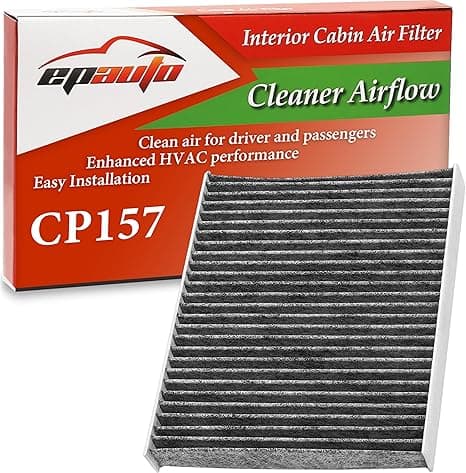
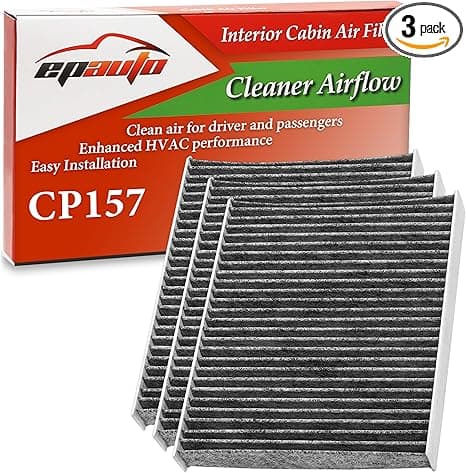
Here's the thing nobody tells you about the EPAuto CP157: you can hear when it's right. I'd pulled the old cabin filter out of my CF12436 — gray, fuzzy, a dead leaf wedged in one pleat — and dropped the new one in expecting the usual aftermarket wiggle. Instead it slid the last quarter-inch and gave this small, flat tock against the housing back. Seated. No shimming, no thumb-pressing one stubborn corner. I sat in the driver's seat afterward kind of annoyed at myself, honestly, because I'd been paying someone else to do this for years.
And that's really the whole story of this filter. Let me back up.
What you're actually deciding between
If you've got a UX250 or UX300, you already know the cabin filter situation is a quiet little racket. The shop quotes you the part plus a $50 labor fee to do a job that touches exactly two plastic stops and takes five minutes. I've paid it. More than once, before I knew better. The CP157 itself runs you around $14 for a two-pack — so call it $7 a filter — versus the dealer part that'll land north of $30 before anyone's even turned a wrench.
Do the math over the life of the car and it's not subtle. Most people swap a cabin filter once a year, some of us twice if we drive dusty roads or sit in a lot of traffic. At the shop rate you're looking at $80-plus a year for what is, functionally, a folded rectangle of pleated media. The annual cost of doing it yourself with the CP157? Under fifteen bucks, and you keep the spare in the door pocket for next time.
That gap is the entire reason this article exists. So the only real question is whether the cheap one does the job. I'll tell you where it does and where it doesn't.
The install — and yes, you can do it
I'm not handy. I want that on the record. The reason I outsourced this for years is that I assumed "filter housing" meant something would fight me. It doesn't. You open the glove box, and there are two little stops on the sides — you squeeze them in and the whole box drops down past its normal stopping point. Behind it there's a flat cover for the filter housing. Pop that, slide the old filter out (brace yourself, mine was genuinely gross), and the new one goes in.
One thing that actually matters here, and it's the one mistake people make: there are airflow arrows printed on the edge of the CP157, and they need to point down. Put it in upside down and the filter still "works" but you've defeated the layered media — the side meant to catch the big stuff is now facing the wrong way and it'll load up and choke faster. Took me ten seconds to check. Don't skip it.
Whole thing, start to glove-box-clicked-shut, was about five minutes. The second time I did it I didn't even look anything up.
How it actually performs
This is where I expected the aftermarket part to show its price. It mostly didn't. The first thing I noticed driving off was that the musty edge that had crept into my AC over the previous months was just... gone. That stale, slightly-wet-towel smell when the fan first kicks on — gone after the swap. Airflow on the lower fan settings came back too; I'd gotten so used to bumping the fan to 3 to feel anything that I didn't realize how restricted the old filter had gotten until the new one made setting 1 feel normal again. A clogged filter strains the whole AC system and you stop noticing because it happens slowly. You notice when you fix it.
On dust and road grime, it holds its own. I run mine behind a fair amount of highway and some gravel-road cabin trips, and after four months it's loaded evenly across the pleats the way you'd want — no blown-out section, no bypass gaps around the frame. It does the actual job of keeping exhaust haze and pollen out of your face, which on a bad-air commute is not nothing.
Where it's a touch behind — the honest part
It's not a perfect twin of the OEM piece, and I'd be lying to say so. Two real things.
First, the smell. For the first two or three days there's a faint plastic-and-cardboard odor when the fan runs, strongest on day one. It's the new media off-gassing and it fully airs out by about day three — I cracked the windows and ran the fan on high for the first drive and it sped that along — but if you're sensitive to smells, know it's coming so you don't think something's wrong.
Second, the frame. The CP157's plastic mesh frame is a hair softer and a touch looser in the housing than the rigid OEM frame. Not loose enough to rattle or let air sneak past — mine sealed fine and that satisfying click I led with is real — but if you handle the OEM and this one back to back, you can feel the OEM is the more confidently built object. The packaging tells the same story: it shows up in a thin plastic sleeve, no fancy box, looking exactly as cheap as it costs. None of that changes what it does in the car. It just means you don't get the premium-feel handshake on the way in.
I'll add one more small thing: the printed airflow arrows are a little faint on the dark plastic. In the dim footwell I had to angle it toward the door to read them. Minor, but it's the kind of corner an aftermarket part cuts that the OEM doesn't.
Who should skip it — and who I'd point at this
If your UX250 or UX300 is under warranty and you're the type who wants a dealer paper trail on every part, or you genuinely never plan to open your own glove box, buy the OEM and let the shop do it. No shame in that. You're paying for the rigid frame and the clean record, and for some people that's worth the premium.
For everyone else — and that's most of us — I keep coming back to the same numbers. Same job, cleaner cabin air, a frame that's slightly less fancy but seals where it counts, in exchange for paying single digits instead of eighty-plus dollars a year. I've now bought the CP157 twice for my own car. The first time to test it. The second time because I already knew. That second purchase is the only review that really counts: I spent my own money on it again, on purpose, and I'd tell my brother to do the same.