Troubleshooting & Analysis
The click is how I knew it was right
I'll be honest — I bought the EPAuto CP134 mostly to spite my mechanic. He'd quoted me fifty bucks to "service the cabin filter," which is shop-speak for sliding a $20 piece of pleated paper into a slot behind the glove box. So I ordered the CP134 instead and decided to do it myself in the driveway on a Saturday.
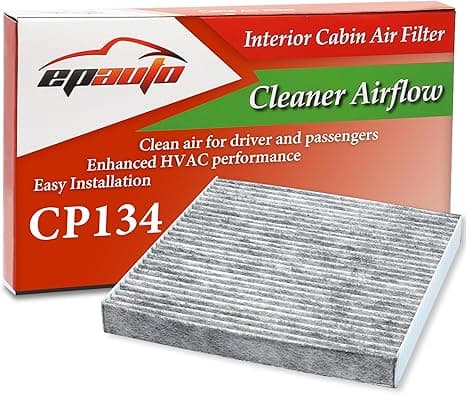
First thing I noticed pulling it out of the box: the smell. Faint, sort of papery, a little plastic — that fresh-out-of-the-bag scent that every aftermarket filter has and nobody warns you about. It's not chemical, not strong, but it's there for the first day or two until air moves through it. I'll come back to that, because it's the one downside I want you to actually expect.
The part I didn't expect was the click. When I dropped the CP134 into the housing behind the glove box and pushed it home, it seated with this small, definite click — the same sound the factory filter made coming out. That click is the whole ballgame. It's the difference between a filter that fits and a filter you're going to be fighting with, taping in, cursing at six months from now. This one fit like it belonged there.
The money, plainly
Here's the math that got me off the couch. The shop wanted $50 for the install, on top of whatever they'd mark up the filter to. The CP134/CF10134 itself runs about $20. The job took me five minutes — and I'm slow, I stopped twice to read the airflow arrows. So I'm $50 ahead on labor alone, and I'll be that much ahead every single time the filter needs swapping, which for most people is once a year or every 12,000 to 15,000 miles.
Do that across the life of a car you keep for, say, eight years, and the gap isn't a rounding error. That's a few hundred dollars that stays in your pocket for a job you can genuinely do standing in your own garage. The dealer cabin filters — the "genuine" boxed ones — routinely cost more than double the EPAuto and do, as far as my nose and my AC can tell, the exact same thing.
Fit and install: where the five minutes actually go
If you've never done this, don't let the "behind the dash" thing scare you. You open the glove box, and on most cars there are little stops or tabs on the sides — you squeeze or release those so the box swings all the way down past its normal stop. Behind it you'll see the filter housing cover. Pop that off, and the old filter slides right out. Mine came out gray-brown and faintly disgusting, which is its own kind of satisfying proof you needed to do this.
Then the one step people get wrong: the new filter goes in with the airflow arrows pointing down. They're printed right on the frame. Match them, push until you feel that seat, close the cover, swing the glove box back up onto its stops. Done.
The CP134's frame felt maybe a hair softer than the rigid OEM frame — you can flex it a touch more in your hands. Didn't matter once it was in. It held its shape in the slot and didn't bow or sag against the cover. Some aftermarket filters are a millimeter off and you have to persuade them; this one I didn't.
How it actually performs
I've had the CP134 in my daily for a few months now, through a dusty stretch of late spring and a lot of stop-and-go behind diesel trucks. Two things I can tell you for real.
One: the musty, socks-in-a-gym-bag smell that had crept into my vents over the last year — gone within a day of swapping. That smell is almost always a saturated, mildewy filter choking on its own trapped grime, and a fresh one fixes it fast. Two: airflow on the fan came back. I'd gotten used to running the blower on 3 to get the same push I used to get on 2, and didn't even register it as a problem until the new filter gave me back the lower setting. A clogged filter doesn't just smell — it makes your AC work harder, which is the part that quietly costs you.
Where's it a touch behind OEM? If I'm being picky, the pleating on the EPAuto looks very slightly less dense than the factory original I pulled, and I'd believe the genuine filter edges it out by a hair on the finest particulate over a long interval. In four months of daily breathing I could not feel or smell that difference. It's the kind of gap that exists on a spec sheet and disappears in a car.
The real downside, said plainly
So, that break-in smell. For the first two or three days, when the AC first kicks on cold in the morning, there's a faint plastic-and-paper note riding the air. It's mild and it fades completely once air has been pulling through the media for a bit — mine was unnoticeable by day three. But if you swap it the night before a long road trip and you're scent-sensitive, you'll catch it, and I'd rather you expect it than think something's wrong.
The other nitpick is the packaging. It's cheap. Thin cardboard sleeve, a bit of plastic, nothing premium about the presentation. The filter inside was fine — clean, undamaged, arrows clearly printed — but you're not paying for a fancy box, and it shows. Honestly, good. I'd rather the money go into the media than the marketing.
Who should skip it
If your car is under a bumper-to-bumper warranty and you're the type who worries a service writer will side-eye a non-genuine part, buy the dealer filter and keep your receipts clean. And if you genuinely cannot tolerate any break-in odor — bad asthma, severe sensitivity — the slightly pricier OEM tends to off-gas a touch less out of the box. Those are the only two camps I'd point toward the expensive option.
Everyone else? I put the CP134 in my own car, I'd do it again, and I'm not paying a shop fifty dollars to spend five minutes doing what I just walked you through. Same job, fresh air back in the vents, fan working like it should, and twenty bucks instead of a service-bay markup. That's the easiest yes I've given a filter in a while.