Troubleshooting & Analysis
The dealer wanted $89. The filter costs eleven bucks.
Let me set the scene. My Lexus — UX250, the kind of car that lulls you into thinking everything about it has to be expensive — started smelling like a gym bag left in a trunk. So I called the service desk, half expecting a quick answer. They quoted me $89 for a cabin air filter replacement. The part itself, the genuine one off their shelf, was around forty. The rest was labor. For a filter you slide into a slot behind the glove box.
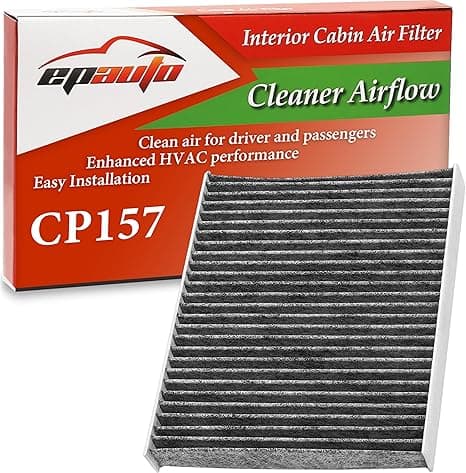
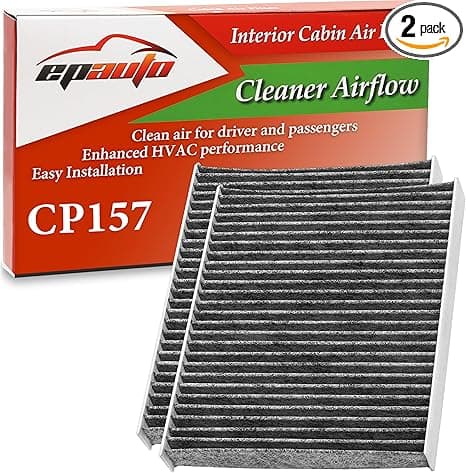
I bought the EPAuto CP157 instead. Eleven dollars and change. And here's the part that still mildly annoys me: the job took me five minutes, and four of those minutes were me figuring out the glove box stops for the first time.
So that's the gap we're talking about. Call it $78 saved on the first one, and since I do this myself now every spring, that's $78 a year I'm just... not handing over. If you've got the same CF12436 fitment — the UX250, the UX300, a few of the Lexus/Toyota cousins that share this housing — this is the math you're staring at too.
Does the cheap one actually fit?
This is the real question, right? Nobody's nervous about saving money. They're nervous the budget part will be a hair too small, rattle around, let unfiltered air sneak past the edges, and you've just paid eleven dollars for nothing.
I'll be straight with you: the CP157 seats correctly. The pleated media block is the right footprint for the CF12436 housing, and when you press it home you get that little resistance-then-settle feeling that tells you the gasket edges are doing their job. It's not floating in there.
The install itself is genuinely a non-event. Open the glove box, squeeze the sides in to release the stops so the box drops all the way down — that's the step people miss. Behind it you'll see the filter housing cover. Pop that, pull out the old filter (brace yourself, mine came out gray-brown and smelled exactly like the problem), and slide the new one in. The one thing you cannot get lazy about: there's an airflow arrow printed on the frame, and it points down. Get that backwards and the filter still fits, but you're running air through it the wrong way and it won't seal or flow like it should. Arrow down. Close it up. Done.
How it actually performs — the honest version
First thing I noticed within a day: the musty smell was just gone. Not masked, gone — because the actual saturated filter that was breeding it was now in my garbage can. That's not really a credit to EPAuto specifically; that's what any fresh filter does. But airflow on the AC came back noticeably stronger. On the previous filter, my fan on setting 3 felt like setting 2. After the swap, 3 felt like 3 again. That restriction had crept up so gradually I'd stopped noticing it.
Filtration-wise, after a full season in the car — pollen season included, and I park under a tree that hates me — the EPAuto pulled its weight. The media looked appropriately loaded with the usual road grime and pollen when I checked it, which is what you want to see. It's catching dust, the fine grit that blows in off the highway, the pollen that used to make my eyes itch on the morning commute. For a cabin filter doing cabin-filter work, it held up.
Is it identical to the OEM media? I'm not going to pretend I ran it through a lab. Side by side, the genuine Lexus filter feels a touch denser in the hand, and a true carbon-activated OEM option will knock down odors a little more aggressively over time. If you live somewhere with serious exhaust soup — bumper-to-bumper city air, tunnels, that kind of thing — that's a real, if small, difference. For my suburban-plus-highway mix, I couldn't feel it.
The downsides, because there are some
I promised honest, so here's honest.
One: the first two or three days, there's a faint plastic-and-cardboard smell on startup. It's the frame and the fresh media off-gassing, and it fades. Run your fan on high with the windows cracked for the first couple of drives and you'll barely catch it. But it's there, and if nobody warns you, you'll think you did something wrong. You didn't.
Two: the packaging is cheap. Mine showed up in a thin plastic sleeve, and one corner of the pleats had a slight crease from shipping. It didn't affect the fit or the seal — pleats flex back — but next to the OEM's nice boxed presentation, it feels like what it is: a budget part. If you're someone who gets uneasy when a thing arrives looking less than premium, adjust your expectations. The performance is in the media, not the wrapper.
Three, and this is the one I'd actually weigh: the frame is a hair less rigid than the genuine filter. It seats fine and seals fine, but when you're sliding it in, it's got a little more give to it. You just want to make sure you push it fully home and the housing cover clicks shut without forcing. If the cover fights you, the filter isn't fully seated — pull it, reseat it, try again. Took me one re-do to get it dead flush. Not a dealbreaker, just don't rush that last inch.
Why none of this is optional
Here's the thing people forget: a clogged cabin filter isn't just a smell problem. When it saturates, it chokes airflow to your whole climate system, and your blower motor and AC have to work harder to push air through a brick. That's wasted effort, and over time, wear you didn't need. Plus you're breathing whatever that old filter stopped catching — road dust, brake particulate, exhaust off the car in front of you, sitting in traffic. A $11 part that you change once a year is one of the cheapest pieces of maintenance on the entire car, and one of the few you actually feel every single drive.
So who should skip it?
If you commute through heavy urban exhaust every day and you specifically want maximum odor and carbon filtration, buy the genuine carbon-activated OEM filter and pay the premium — that's a real use case where the extra spend buys you something. And if you're truly never going to open your own glove box, then the labor cost is coming for you regardless of which filter you pick.
But for everybody else with a UX250, UX300, or anything on the CF12436 fitment? I've run the EPAuto CP157 through a full year, watched it do the job, smelled my car go from gym-bag to neutral, and saved myself the better part of eighty bucks doing it. The downsides are minor and honest — a faint break-in smell, flimsy packaging, a slightly softer frame. None of them touched the thing that matters, which is clean air moving through my vents.
I'd buy it again. Actually — I already have. There's a spare one sitting in my garage waiting for next spring.