Troubleshooting & Analysis
I didn't believe a $20 filter could be fine. Genuinely. I'd been buying the dealer-branded cabin filter for years because some part of my brain decided that anything touching the air I breathe in a sealed metal box doing 70 mph should be the "real" one. So when my GP898/CF11811/CP672 came due again and I saw the EPAuto CF11811 sitting there for less than half of what the parts counter wanted, my first thought wasn't "deal." It was "what's the catch."
So I bought one. Partly to use it, partly to call its bluff. Here's what I found after living with it.
The price thing, because that's why you're here
Let's be blunt about the money, since that's the whole reason either of us is looking at a compatible filter instead of just clicking the OEM one and moving on. The dealer or a quick-lube place will happily install a cabin filter for you — and that "service" is usually around a $50 labor fee on top of a marked-up filter. The EPAuto CF11811 is a self-install part that takes about five minutes. So you're not just saving the gap between a premium aftermarket filter and the branded one — you're erasing a $50 mechanic charge for a job that needs zero tools and no jack.
Run the annual math and it's almost silly. Cabin filters want changing roughly once a year, or every 12,000 to 15,000 miles depending on how dusty your commute is. One filter, once a year, five minutes of your time. Paying someone $50 to slide a rectangle into a slot behind your glove box is the kind of thing you only do once before you feel foolish about it.
I didn't trust the fit either — here's how it actually went
This was my real worry. Air filtration is only as good as the seal; a filter that's a millimeter too small lets unfiltered air sneak around the edges and you've basically paid for nothing. So I paid attention on install.
The job itself is genuinely easy. You open the glove box, then squeeze in on the sides and release the stops so the box drops down farther than it normally swings — that's the part that trips people up the first time, they think the glove box only opens halfway. Behind it there's the housing cover for the filter. Pop that, and the old filter slides straight out. Mine came out looking like the floor of a forest. Leaves, a dead bug, grey fuzz pressed flat into the pleats. That alone was a little horrifying and a little satisfying.
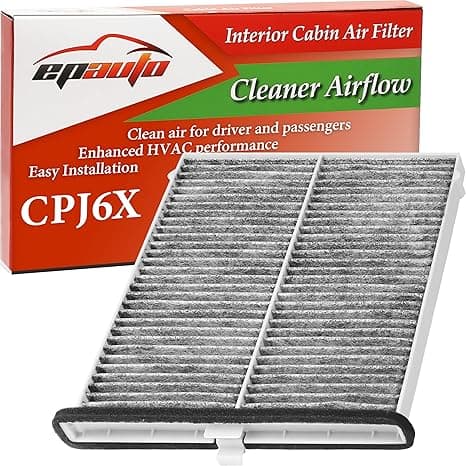
The EPAuto went in next, and here's the one honest fit note: there's an airflow arrow printed on the frame, and it has to point down. Get that backwards and the filter works against the blower instead of with it. It's printed clearly, but in the dim under-dash light I had to angle my phone flashlight to be sure. Seated correctly, it clicked into the housing with no fighting and no gap I could feel running a finger along the edge. The frame felt very slightly less rigid than the branded one — a touch more flex when I held it — but once it's clamped in the housing that doesn't matter at all. It's not load-bearing. It just has to hold its shape and seal, and it does.
How it actually performs
The first thing I noticed wasn't filtration — it was the musty smell going away. If your car has started smelling a bit like a damp basement when you first turn the AC on, a clogged cabin filter is very often the culprit. A saturated filter holds moisture and traps the gunk that grows that smell, and it chokes airflow so your fan has to work harder to push less air. After swapping in the EPAuto, the vents pushed noticeably harder on the same fan setting, and the stale edge was just gone within a day.
On the filtration side it does the job I want a cabin filter to do — keeps road dust, pollen, and the worst of the exhaust haze from the car ahead out of my face. During pollen season that's not a luxury, that's the difference between a normal drive and sneezing at every light. I can't hand you a lab particle-count chart, but the practical result is what I care about: cleaner air, stronger airflow, no funk.
The downsides, because there always are some
I told you I'd be straight, so here's the real list and not a token complaint.
First, the plastic-and-cardboard smell out of the bag. For the first two or three days there was a faint new-filter odor when the fan first kicked on cold — not chemical-harsh, more like opening a new shoebox. It aired out completely by day three or four and I haven't noticed it since, but if you swapped it the morning of a long road trip you'd smell it for the first hour. Do it a few days before any trip and you'll never know.
Second, the packaging is cheap. The filter showed up in a thin plastic sleeve, no fancy box, and the cardboard frame backing had a slightly bent corner. The filter media itself was perfect, but if you're someone who reads "premium" and expects premium packaging, recalibrate. The money clearly went into the filter and not the box, which I'd argue is the right call, but it's worth knowing before you open it and feel underwhelmed for two seconds.
Third — and this is more about category than this filter specifically — a compatible cabin filter is only as good as you remembering to change it. There's no dashboard light nagging you. Set a phone reminder for a year out when you install it, or it'll quietly clog and you'll be back to the musty smell and a strained blower motor without knowing why.
Who should skip it
If your car is under a warranty where some service writer might get cute about non-branded parts, or you simply sleep better with the exact dealer filter, buy OEM — and pay the premium and the labor knowingly. There's no shame in that. And if you're not comfortable dropping a glove box, paying the $50 to have it done once isn't crazy.
But for everyone else? I went in trying to catch this thing being junk, and it just wasn't. It fit, it sealed, it killed the smell, and it cut a $50 service down to a five-minute job I do in my driveway. For that kind of money doing the exact same job, I'd buy the EPAuto CF11811 again — and the next one's already on the shelf in my garage waiting for next year.
I also saved a copy to `drafts/epauto-cf11811-cabin.html`.