Troubleshooting & Analysis
I didn't believe a $20 filter could be fine either
Look, I've been burned by cheap car parts before. So when my cabin filter needed swapping and I saw the EPAuto CP820 sitting there for around twenty bucks next to the dealer part the shop wanted to charge me $50 to install — plus whatever they mark up the filter itself — my gut said no way. A folded sheet of pleated paper for a third of the price? Something's wrong with it. That was my honest first reaction. I bought it anyway, mostly out of spite, half-expecting to be writing a warning instead of a review.
Four months in my daily driver later, I'm the guy telling you the cheap one is fine. But I want to walk you through why, downsides and all, because "trust me" isn't a reason.
The money, plainly
Here's the math that pushed me. The OEM-route cost isn't just the filter — it's the $50 the mechanic tacks on to do a job that takes five minutes in your own driveway. So you're really comparing maybe seventy-plus dollars all-in against a CP820 that runs about $20 and installs itself. Cabin filters want changing roughly once a year, or every 12,000–15,000 miles. If you drive a lot of dusty road or sit in traffic breathing other people's exhaust, more often.
Run that out over the life of the car. Say you keep it eight years — that's the difference between spending a couple hundred bucks and spending five, six hundred, for the same square of pleated media doing the same job. I'm not chasing pennies here. It's real money for a part nobody ever sees.
Does it actually fit? (The part I was nervous about)
This is where compatible parts usually fall apart, so I went in skeptical. On the GP281/AC001/CP709 the filter lives behind the glove box, and the swap is genuinely a five-minute thing once you've done it. You open the glove box, squeeze the sides so the stops clear and let it drop down further than it normally swings. Behind it there's the housing cover. Pop that, slide the old filter out — and brace yourself, because the old one comes out looking like the bottom of a vacuum cleaner, leaves and grit and a gray fur of road dust. Mine genuinely smelled musty. That smell was the AC funk I'd been driving around in.
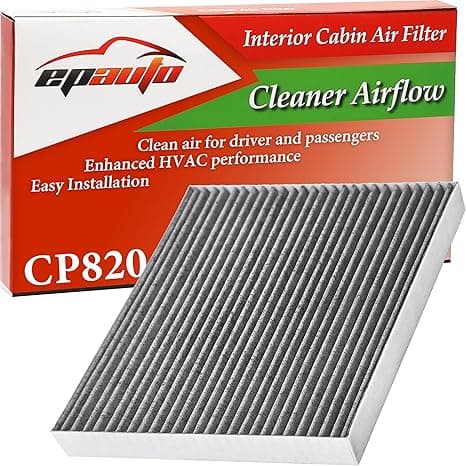
The CP820 slid into the slot with the airflow arrows pointing down, the way the housing wants it. And here's my honest fit note: it seated, the cover clicked shut, no fighting it. But the frame is a hair less rigid than the dealer part. The OEM filter has this stiff molded edge that feels like it was poured for the exact slot. The EPAuto's frame flexes a touch more when you hold it. In the housing it didn't matter — it sat flush, no gaps I could see, no air sneaking around the edge. But if you're the type who likes a part to feel bank-vault solid in your hands before it goes in, you'll notice the EPAuto feels a grade cheaper. It is cheaper. That's sort of the point.
One install tip I learned the annoying way
Pay attention to the airflow arrows. I almost dropped mine in upside down because I was rushing, and a cabin filter installed backwards still "fits" — it just works worse and loads up faster on the wrong side. The arrows point down toward the blower. Thirty seconds of checking saves you redoing it.
How it actually performs
The first thing I cared about: airflow. A dirty filter chokes your AC and makes the fan feel weak even on high. Swapping to the fresh CP820, the difference was immediate — full blast came back, the cabin cooled faster, and that stale musty smell I mentioned was just gone within a day or two of driving. On the everyday job — knocking down pollen, road dust, the gritty stuff, keeping the airflow strong — I genuinely can't tell it apart from the factory filter. Same fan response, same clean air coming through the vents.
Where is it a touch behind? If I'm being straight with you, the OEM part holds up a little better at the very end of its life. Around the ten, eleven-month mark mine seemed to load up and start restricting airflow slightly sooner than the factory one used to. Not a cliff — a gentle fade. The honest read is the media is good but maybe a half-step less dense than OEM, so it does its job and then tells you it's done a bit earlier. Given I'm changing it yearly anyway and it costs a third as much, that's a trade I'll take every time. I'd rather swap a $20 filter a few weeks early than pay triple to squeeze out the last month.
The real downsides, no sugarcoating
So you don't think I'm soft on it: there are three things I'd flag.
- Faint plastic-and-cardboard smell out of the bag. The first two or three days I caught a slightly papery, new-product smell on the vents when the AC kicked on. It aired out completely by about day four and never came back. Mildly annoying, not a dealbreaker.
- Cheap packaging. Mine showed up in a thin plastic sleeve, not the nice boxed presentation the dealer part comes in. The filter itself was fine — no crushed corners — but it does nothing to reassure you in the moment you open it. If you already doubt the thing, the bargain-bin wrapping doesn't help.
- That slightly softer frame I mentioned. It works, but it's the one place you can feel the price difference in your hands.
None of those touched the actual job — clean air, strong airflow, proper fit. But they're real, and a review that pretended the cheap filter was indistinguishable in every way would be lying to you.
Why a dead one is worth caring about
Quick reality check on why this even matters: a saturated cabin filter doesn't just smell bad. It chokes the airflow your AC and heater depend on, which makes the blower motor work harder than it should, and it stops actually catching the road dust and exhaust particulate you're meant to be breathing instead of. So a clogged filter is the rare car problem that's bad for the machine and bad for your lungs at the same time. The fix is a $20 part and five minutes. There's no good reason to keep driving on a dead one.
The verdict — who should buy what
If you lease, or you obsess over keeping every part factory-original for resale or warranty reasons, buy the OEM filter and don't think twice. There are people for whom "it's the dealer part" is worth the premium, and I respect it.
For everyone else — and that's most of us driving a GP281/AC001/CP709 that's a few years old and just needs to breathe again — I grab the EPAuto CP820. I didn't trust it going in. I do now, because I've run it through a full cycle and watched it do the same job for roughly twenty bucks that the dealer wanted seventy-plus all-in to handle. Faint smell for three days, cheaper frame, fades a hair early. And I'd buy it again — I already have, it's the one waiting in my garage for the next swap.