Troubleshooting & Analysis
The seat, then the smell
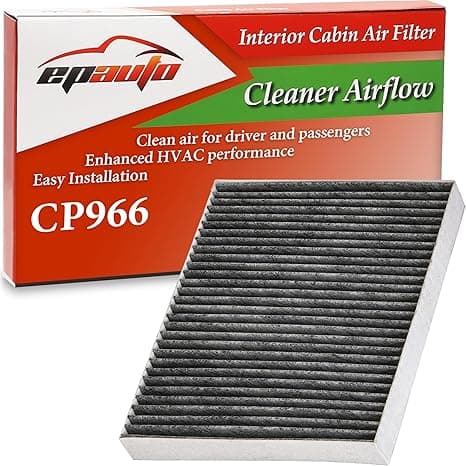
The first thing I noticed wasn't airflow or filtration or any of the stuff the box brags about. It was the sound. A soft, plasticky shunk when the EPAuto CP966 slid past the housing tabs and seated. My old factory filter never made that noise going in — it just sort of wedged. This one clicked home like it knew where it belonged. And then, for about two days, my car smelled faintly like a new shower curtain.
I'll get to that smell. It's real, it's a little annoying, and it goes away. But it's exactly the kind of thing nobody tells you when they're trying to sell you a $20 filter, so I'm telling you up front.
Here's where I was standing before any of that. My cabin filter was overdue — I knew because the vents had started pushing this stale, slightly damp gym-bag funk every time I turned the fan past two. Classic saturated filter. The dealer wanted to "inspect and replace" for a number that, with the labor line, lands around $50 just to have a guy spend five minutes behind my glove box. The OEM filter on its own runs north of forty bucks at the parts counter. The EPAuto CP966/CF11966 was twenty. Do that math over the life of the car — this thing wants changing roughly once a year, or every 12,000 miles or so — and you're looking at a $30-plus gap every single time. I've owned this car long enough that the difference has paid for a couple tanks of gas by now.
Does it actually fit, or do you fight it?
This is the part people are nervous about, and fairly so. A cabin filter that's a millimeter too wide is genuinely worse than no filter, because then dust just rides the gaps around it.
The install itself is stupid simple once you stop being scared of your glove box. You open it all the way, then squeeze the two sides in so the little stop arms clear — the box drops down and hangs there. Behind it there's the filter cover. Pop that, slide the old gray brick out (mine came out looking like the bottom of a fireplace, honestly), and the new one goes in with the airflow arrows pointing down. That's the one thing you cannot get lazy about: the arrows go down. Put it in backwards and you've defeated the whole point.
Fit on the CP966 was honest-to-goodness fine. Not "OEM perfect," but fine. The plastic frame is a hair more flexible than the factory one — you can feel it flex if you press a corner — and the foam gasket edge is a touch thinner. When I first dry-fit it I had a half-second of "is this too loose?" doubt. It wasn't. Once it's fully home and the cover snaps over it, the cover itself holds everything square. No rattle, no whistle at highway speed, no gap I could find when I shined a phone light around the edges. The frame being a little softer than OEM is the trade you're making for the price, and in this spot, behind a closed cover, it just doesn't matter.
How it actually performs
The funk was gone the first drive. That's the headline. Fan on four, and instead of damp-basement air I got... nothing. Neutral. Which is what you want — a cabin filter doing its job is supposed to be invisible.
I ran it through a full spring, which around here means tree pollen thick enough to write your name in on the hood. Inside the car, allergy-wise, it was the difference between miserable and fine. Airflow out of the vents felt every bit as strong as it did with a fresh OEM filter the year before — no noticeable choke, no weird new vacuum noise from the blower having to work harder.
Where is it a touch behind OEM? If I'm being a stickler: I think the factory filter held its game a little longer at the tail end of its life. Pulling this EPAuto at the eleven-month mark, it looked more loaded — grayer, more packed — than I remember the OEM looking at the same age. Could be a media-density thing, could be I just drove through a dustier year. But I'd rather a filter that visibly does its work and asks to be swapped on schedule than one that hides it. At this price I'm changing it on time anyway.
The downsides, said plainly
So. The smell. For the first two, maybe three days, there's a light plastic-and-foam off-gassing thing happening, most noticeable on a cold start with the fan up. It's not chemical-harsh, it's more "new product" than "wrong." Crack the windows for the first couple of drives and it burns off. By day four I'd completely forgotten about it. If you're sensitive to that kind of thing, know it's coming so you don't panic and think you got a bad filter.
Second gripe, smaller: the packaging is cheap. Mine showed up in a thin plastic sleeve with a slightly crushed corner on the frame. The crush popped right back and changed nothing about the fit, but if you're the type who needs the box to feel premium, this ain't that. You're paying for the filter, not the unboxing.
Third, and this is the one that actually matters: that softer frame means you should take thirty extra seconds making sure it's fully seated and the cover is properly latched. With OEM you can be a little careless and it still locks in. With this one, be deliberate. Seat it, confirm the cover clicks, done.
Why none of this is something to shrug off
It's easy to treat a cabin filter as optional because you can't see it working. But a saturated one isn't just a smell problem — it chokes airflow, which leans on your blower motor and your AC, and it stops actually catching the road dust and exhaust particulate you're otherwise breathing in stop-and-go traffic. A clogged filter is the thing quietly making your defroster weak and your car smell like a locker. Twenty bucks and five minutes fixes all of it.
The verdict
Buy OEM if you lease, if you're meticulous to the point that a flexible frame will bug you every time you think about it, or if you simply never want to think about a cabin filter for a second longer than you have to and the $30-plus premium buys you that peace. No shame in it.
For everyone else — for me — the EPAuto CP966/CF11966 does the same job for less than half the money. It seated right, it killed the funk, it carried me through pollen season, and the only real cost was three days of faint new-filter smell and a little extra care on install. I've already got the next one sitting in my garage for when this one's due. That's the most honest endorsement I can give: I bought it again before I even finished using the first.