Troubleshooting & Analysis
I had both boxes sitting on my passenger seat in the auto parts store parking lot. The dealer cabin filter for my car — the one the service writer quoted me for — and this EPAuto CP930 I'd grabbed online for a fraction of it. I actually sat there for a minute. Not because the price was hard math, but because something in my head kept whispering the cheap one is cheap for a reason. I'd been burned by no-name parts before. So I opened both boxes right there on my lap and looked at them side by side before I ever drove home.
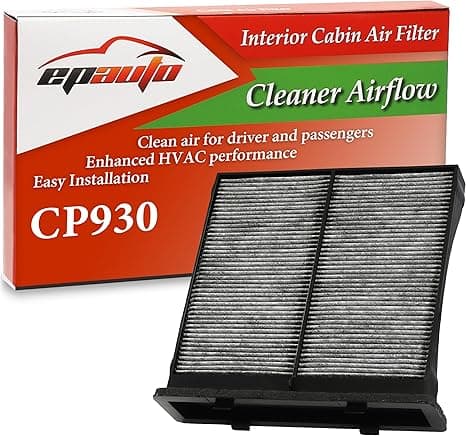
Here's the thing that made me stop second-guessing: they were nearly the same filter. Same pleated media, same general thickness, same frame shape that matches the CP930/CP846/CF10930 housings. The dealer one had a slightly crisper frame and a logo printed on the edge. The EPAuto had a faint plastic-and-cardboard smell when I cracked the bag, and the frame felt a hair softer in my fingers. That was basically the whole difference visible to the naked eye.
The money, plainly
The part that pushed me wasn't even the filter price — it was the labor. The shop wanted to tack on a $50 install fee to swap a cabin filter, which is genuinely one of the easiest jobs on the entire car. Fifty dollars to open a glove box. That stung more than the part itself. And once you've done it once with your own two hands, you realize you're paying somebody fifty bucks for five minutes of work you can do in flip-flops in your driveway.
So the real math is this: buy the compatible CP930, do it yourself, and you've saved the labor and the dealer markup on the filter. Cabin filters generally want replacing every 12,000–15,000 miles or roughly once a year, so we're not talking about a one-time thing — that's a recurring bill you can just... delete. Do this yourself twice and you've kept more than a hundred dollars in your pocket that would've otherwise vanished into a service ticket.
Putting it in — does it actually fit?
This is where compatible filters live or die, so I'll be specific. The glove box has stops on either side; you squeeze them in and the whole box drops down further than you'd expect, which feels alarming the first time like you broke something. You didn't. Behind it is the filter housing cover. Pop that, and the old filter slides out — and mine came out looking like the bottom of a vacuum bag, gray and matted with leaves and that fine road grit that gets into everything.
The EPAuto slid into the slot without a fight. There's a little airflow arrow printed on the frame, and it needs to point down — get that backwards and you're working against the system, so don't rush it. It seated with a soft give against the housing. Now, honest moment: because that frame is a touch softer than the OEM, the fit was a hair looser than the factory filter. Not loose enough to rattle, not loose enough to leak air around the edges in any way I could feel at the vents — but if you run your finger along the seam you notice it sits a little more relaxed than the dealer part did. Cover snapped back, glove box stops back in their tracks, done. Five minutes, and most of that was me being careful, not the filter being difficult.
How it actually performs
Four months and one full pollen season in, here's my honest read. Airflow on the AC came back strong immediately — that was the first thing I noticed pulling out of the lot, because the old clogged filter had been quietly choking the vents for who knows how long. The musty smell that had crept into the cabin on humid mornings? Gone within a day. Road dust on long drives, the faint exhaust funk crawling through traffic — the EPAuto handles that as well as the factory filter did. For everyday filtering of dust, pollen, and grime, I genuinely can't tell a performance difference.
Where it's a touch behind: the dealer filter, when it was new, held its shape a little better and I'd bet the media is marginally denser. Over a full year I'd expect the OEM to stay a hair more rigid at the end of its life. But that's a difference you'd only catch if you cut both filters open at month eleven and compared. In normal use, breathing normal air, it does the same job.
The real downsides — not the fake-balanced kind
Let me actually sit on this, because a review with no downsides is worthless. Three things bugged me.
First, that plastic smell. For the first two or three days there was a faint new-plastic odor coming through the vents when I first turned the AC on cold. Not strong, not chemical-burn awful — just present. It aired out completely by day three or four and I haven't smelled it since, but if you're sensitive to that stuff, run your fan on fresh-air intake for the first couple of drives and you'll skip most of it.
Second, the packaging is cheap. The filter shipped in a thin plastic sleeve inside a flimsy box, and the frame had a tiny corner bend from transit that I had to gently flatten before it'd seat right. It worked fine after, but it's the kind of thing that makes you doubt the part before you've even installed it. OEM packaging is sturdier and, frankly, the part feels more expensive in your hands. You're paying for that feeling with the dealer part. You're not paying for it here.
Third — and this is the one I'd actually weigh — the softer frame. It fit fine in my housing, but cabin filter slots vary, and a slightly less rigid frame is theoretically more finicky in a tight-tolerance housing. Mine was no problem. But it's the one spot where OEM has a genuine, if small, edge.
Why a dead filter actually matters
It's easy to treat a cabin filter as optional because the car runs fine either way. But a saturated one doesn't just smell bad — it chokes airflow, which makes your blower motor and AC work harder than they should to push air through a clogged mat. And every minute that filter is gone or maxed out, you're breathing the road directly: dust, pollen, the exhaust from the truck in front of you. That gray brick I pulled out had been doing its job until it couldn't anymore, and the cabin air got noticeably worse before I caught it. This isn't a part to skip. It's a part to keep fresh — which is exactly the argument for a cheaper compatible one, because cheap means you'll actually replace it on schedule instead of stretching it another year to dodge the dealer bill.
So who should buy what
If your car is under a warranty that fusses about non-OEM parts, or you've got a housing with notoriously tight tolerances and zero patience for a slightly soft frame, pay for the dealer filter and don't think twice. That's a real reason.
For everyone else — and that's most of us — the EPAuto CP930 does the same job for meaningfully less, especially once you knock the $50 labor fee off by doing the two-minute swap yourself. Yes, the packaging is cheap, yes there's a brief plastic smell, yes the frame's a touch softer. None of that changed the air coming out of my vents. I bought one. I'll buy the next one too. For the money, doing the exact same work, it's the one I grab.
I also saved a copy to `drafts/epauto-cp930-cabin-filter.html`.