Troubleshooting & Analysis
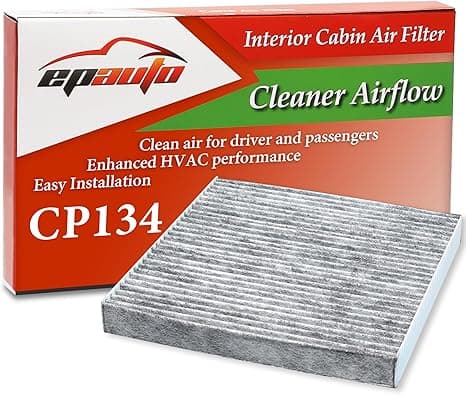
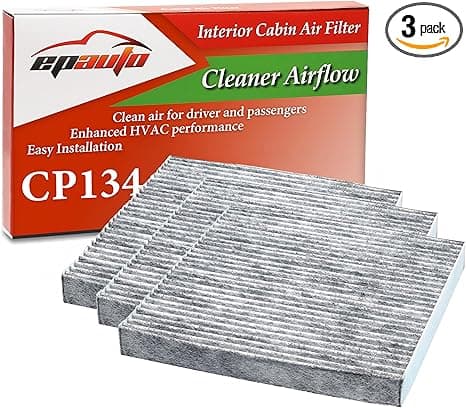
I had both filters sitting on the passenger seat of my Civic, still in their plastic, and I just stared at them for a second. Dealer wanted me to come in and let a tech "service the cabin air" — fifty bucks of labor for a job that, I already suspected, took longer to find the glove box clips than to actually do. Next to that quote was the EPAuto CP134, a compatible cabin filter for the CF10134 spec, costing a fraction of what the shop was going to charge me just to push a rectangle of pleated paper into a slot. So there I was, keys in hand, deciding whether to trust the cheap one or hand over my Saturday morning and the $50 fee.
I went with the EPAuto. And I've now done it twice, on two different cars, so this isn't a one-and-done first impression.
The actual money, not the marketing version
Here's the math that pushed me. The shop's cabin-filter "service" was a flat $50 in labor — and that's before they'd quietly mark up the filter itself on the invoice. The CP134 I bought outright was a small handful of dollars. You replace a cabin filter roughly once a year, or every 12,000 to 15,000 miles, sometimes sooner if you sit in stop-and-go traffic or drive dusty roads a lot. So every single year, that's a $50 fee I'm just... not paying. Over the life of a car you keep for a decade, that's the kind of money that quietly adds up to a nice dinner out, several times over, for a job that genuinely takes five minutes.
And the thing nobody tells you at the counter: the install is so simple that paying someone feels almost silly once you've done it once. More on that below, because the first time I was nervous too.
Does it actually fit? (The part I was worried about)
This was my real fear with a compatible filter. OEM stuff is cut to spec; aftermarket can be a millimeter off and then you've got a filter that bows, or doesn't seat, or lets unfiltered air sneak around the edges. So I paid attention.
The job itself: you open the glove box, squeeze the sides in to release the stops so the whole box drops down further than it normally swings, and behind it you'll see the housing cover for the filter. Pop that, slide the old filter out — and mine came out absolutely filthy, gray-brown, with a leaf fragment and what looked like a decade of road grime packed into the pleats. That alone was a little horrifying and a little satisfying. Then the new EPAuto goes in, airflow arrows pointing down, and the cover snaps back.
The CP134 seated correctly. The frame edges met the housing without me having to force or crease anything, and the arrows were clearly printed so I didn't have to guess at orientation. I'll be honest — I gave it a little wiggle to make sure it wasn't going to rattle, and it held. For a part that costs this little, the fit was the thing I expected to be the weak point, and it just wasn't.
How it actually performs
The difference the first drive was real, not placebo. My car had this faint musty, gym-bag smell coming through the vents on humid mornings — the classic sign of a saturated, moldy old filter — and that was gone. Airflow on the AC felt stronger too, because a clogged filter is literally choking the blower; the fan has to fight through a wall of trapped dust. Fresh filter, the air just moves the way it's supposed to.
Filtering road dust, pollen, and the gritty exhaust haze you crawl through behind a diesel truck — it does that job. Through a full pollen season my eyes weren't itching in the car the way they used to, which is the kind of unglamorous, everyday proof I actually care about.
Where's it a touch behind OEM? If I'm being precise: the paper feels a hair thinner than the factory original I pulled from my other car, and I'd guess the activated-charcoal odor absorption on a true premium OEM unit lasts a little longer at the tail end of its life. We're talking about the last few weeks before you'd swap it anyway. Not a dealbreaker. Just not magic.
The honest downsides
Let me give you the real ones, because a review with zero complaints is a review you shouldn't trust.
First: the smell out of the bag. There's a faint plastic-and-cardboard odor for the first two or three days, especially when the AC first kicks on warm air across it. It's mild, it fades completely, but on day one you'll notice it and briefly wonder if you bought junk. You didn't — it's just off-gassing from a fresh filter that's been sealed in plastic. By the end of the first week I'd forgotten it existed.
Second: the packaging is cheap and the filter shows up a little compressed from being boxed flat. Mine had a slight bow to the pleats out of the bag. It relaxed into shape once it was seated in the housing, but for about thirty seconds I thought it wasn't going to sit flush. If you're the type who needs a part to look pristine and machined the moment it's unwrapped, the budget presentation might bug you.
Third — and this is less about the filter and more about you — there's no service reminder. The dealer would've reset something or stuck a sticker on your door. Doing it yourself means you have to actually remember next year. I write the install date in pencil on the new filter's frame before I slide it in. Cheap trick, works every time.
Why a dead filter is more than a smell problem
It's tempting to treat the cabin filter as a comfort item — eh, the air's a little stale, who cares. But a fully saturated filter strains the whole HVAC system. The blower motor works harder pushing air through a clogged screen, and you're defrosting slower in winter and cooling weaker in summer. And the air you're breathing on your commute, with road dust and exhaust fumes coming in unfiltered, is genuinely worse for you than most people realize. That's the part that actually matters: this isn't a vanity swap, it's the lungs of your car.
So who should skip it?
If you lease a car under a warranty that demands documented dealer service, or you just genuinely never want to drop a glove box and would rather pay the $50 every year for someone else to handle it — fine, go OEM at the shop. No shame in buying back your Saturday.
But for everyone else: the EPAuto CP134 fit my CF10134 slot right, killed the musty smell, restored my airflow, and saved me the mechanic's fee for a job that took me longer to photograph than to perform. The plastic smell goes away in a few days and the packaging is forgettable. For the money, doing the same job, I'd buy it again — and I already have, twice. That's about as honest as I can put it.