Troubleshooting & Analysis
The smell hit me at a red light. Not a "did I leave something in the car" smell — a wet-basement, gym-bag-left-in-the-trunk smell that came up through the vents the second I turned the AC on. I'd been ignoring it for weeks, blaming the floor mats, blaming the kid's spilled juice box. Then one humid morning the airflow on max fan felt like someone breathing through a pillow, and I finally pulled the cabin filter. What came out wasn't a filter. It was a gray felt mat packed with leaf grit, a dead stink bug, and enough road dust to plant a garden. That was the smell. That was the weak airflow. I'd been recirculating it into my own face for who knows how long.
So I went looking for a replacement, and that's where the sticker shock started.
The OEM number that made me close the tab
The dealer wanted to sell me the genuine filter and charge a shop fee to install it — the kind of "we'll just pop it in for you" line that turns a $15 part into a $50-plus visit. That's the part nobody tells you: the cabin filter itself isn't expensive, but the labor markup is where you bleed. A mechanic charges around $50 to install a part that takes five minutes of your time and zero tools. I almost paid it anyway, because I assumed the job was buried somewhere behind the dashboard.
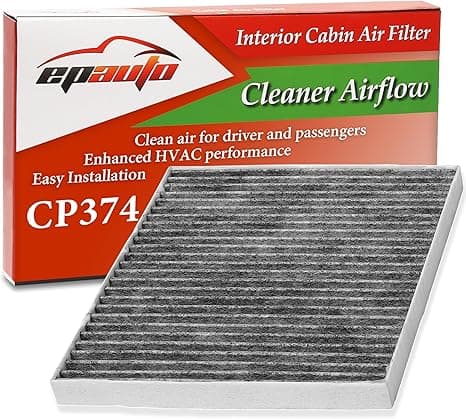
It isn't. It's behind the glove box. And the compatible filter — the EPAuto CP374, which covers the CF10374/CP374/GP895 spec — runs a fraction of what the OEM-plus-labor route costs. I'd been about to hand over fifty bucks in install fees for something I could do standing in my driveway with a podcast on. Once that clicked, the math wasn't close.
Doing it myself in five minutes (I timed it)
Here's the whole job, because I was nervous about it too and it turned out to be almost insultingly easy. Open the glove box, then squeeze the sides so it drops past the little stops that normally limit how far it swings down. Behind it there's a rectangular plastic cover for the filter housing. Pop that off, and the old filter slides straight out — and trust me, you'll know it's the right part the moment you see the crud caked on the intake side.
The one thing that actually matters: airflow direction. The CP374 has little arrows printed on the frame, and they need to point down toward the floor. I've read enough forum horror stories of people jamming the filter in backwards and then wondering why their AC got worse, so I double-checked mine before clicking the housing shut. New filter in, cover back on, glove box snapped back over the stops. Done. The first thing I noticed pulling out of the driveway was that the musty smell was just… gone. Not masked — gone. And the fan on setting two now moved more air than the old one did on four.
Where it matches OEM, and where it doesn't
Let me be straight, because a review that's all sunshine is useless to you. The EPAuto isn't a perfect twin of the genuine part. The frame is a hair more flexible — slightly cheaper-feeling plastic on the edges — so when you seat it, give it a deliberate push to make sure it sits flush in the housing instead of bowing. Mine seated fine, but I had to be a little more intentional about it than I'd expect with a factory filter that clicks in like it was molded for the slot.
And there's a faint smell out of the package the first day or two. Not chemical-harsh, just that new-material plasticky note you get from anything freshly unwrapped. I ran the fan on high with the windows cracked for the first morning commute and by day three I couldn't detect it at all. If you're sensitive to that kind of thing, pop it out of the bag the night before and let it air out — problem solved before it starts.
On the actual job — trapping dust, pollen, and that exhaust-and-road-grime funk before it reaches your lungs — I genuinely can't tell it apart from the factory filter that came in the car. Same multi-layer feel when you flex it, same fit in the slot once it's seated, same fresh airflow. The packaging is cheaper, sure. The cardboard sleeve looked like an afterthought. But the cardboard isn't what's filtering my air, so I don't much care.
Why I didn't just keep driving on the old one
The thing I underestimated for those weeks of ignoring the smell: a clogged cabin filter isn't only a comfort problem. That gray mat I pulled out was choking the airflow, which means the blower motor was working harder to push air through a wall of compacted dirt. Strain the blower long enough and you're looking at a far pricier repair than any filter. Worse, a saturated filter stops filtering — it just becomes a sponge for moisture and mildew, which is exactly why my vents smelled like a locker room. You're not "saving money" by stretching a dead filter. You're slowly cooking your AC system and breathing the result.
Most cars want this swapped somewhere around every 15,000 miles or once a year, sooner if you drive dusty roads or sit in heavy traffic eating other people's exhaust. I'd gone way past that, which is how mine got so bad. Now that I know it's a five-minute driveway job, there's no excuse to let it slide again.
So — OEM or the compatible one?
If you lease a car you'll hand back in a year and you want the dealer paperwork to say "genuine parts only," fine, pay the premium and let the shop do it. There's a narrow case for that. For literally everyone else — anyone who owns their car and would rather not light $50 in labor on fire for a five-minute job — the EPAuto CP374 is the easy call. It fits, it kills the smell, it moves air like the factory part, and the only real gripes are a slightly softer frame and a day of break-in odor that airs out on its own.
I've now put one in two different cars in my driveway, and I'd grab it again without thinking twice. The musty-vent version of me from a month ago would've paid anything to make that smell stop. Turns out the answer was a cheap filter and five minutes.