Troubleshooting & Analysis
The smell hit me first. Mid-July, windows up, AC blasting, and somewhere around mile three of my commute the vents started pushing out this damp, sour, locker-room funk. I cranked the fan higher thinking I just needed more air. Bad move — more fan, more funk. That's the tell. When a cabin filter dies, it doesn't fail quietly; it sits in there packed with months of pollen, leaf bits, and road grime, going soft and musty every time condensation hits it. Mine had been in the car for what I'm pretty sure was two years. I pulled it out and it was the color of a coffee filter that had clearly given up.
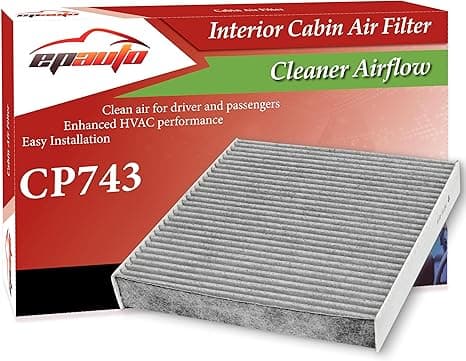
That filter was for an AR225/VX000/AY680 setup, and the part I dropped in to replace it was the EPAuto CP743. I'd been putting it off because I assumed cabin filter work meant a shop visit. It does not. And that assumption is exactly what the dealer is counting on.
The math that actually annoyed me
Here's the part that stung once I looked into it. Most quick-lube places and dealers will happily swap a cabin filter for you — and tack on roughly a $50 labor fee for what is, I promise, a five-minute job. Some of them mark up the filter itself on top of that. So you're staring at a number that can creep toward $70-$80 for one of the easiest maintenance tasks on the entire car.
The CP743 itself ran me about $13. No labor, because I did it in my driveway between sips of coffee. So the honest comparison isn't really compatible-versus-OEM here — it's "do it yourself for thirteen bucks" versus "pay a stranger fifty dollars to open your glove box." Cabin filters want changing roughly once a year, or every 12,000 to 15,000 miles, sooner if you drive dusty roads or sit in a lot of traffic. Over the life of the car that labor fee adds up to real money for a job you can learn once and own forever.
Putting it in — and the one part that tripped me up
The whole thing lives behind your glove box, which sounds intimidating and isn't. You open the glove box, then release the little stops on each side so the box swings down further than it normally does — on mine that was a gentle squeeze inward on the side walls until the arms popped past their catches. Behind it you'll see the filter housing cover. Pop that, and the old filter slides right out. Mine came out in a small cloud of debris, which told me everything about how overdue it was.
The CP743 went into the slot cleanly. Snug fit, no shoving, no praying. Here's the one thing I'll flag because I almost got it wrong: there are airflow arrows printed on the frame, and they need to point down (the direction the air travels into the cabin). I had it backwards for about ten seconds before I caught the little arrow and flipped it. Get that right and the rest is nothing — slide the cover back, swing the glove box up, re-seat the stops. Door open to filter breathing fresh: about five minutes, and most of that was me fumbling the glove box stops the first time.
Fit-wise the EPAuto seated as tightly as the factory one I pulled. No gaps around the frame, no daylight, nothing rattling. If you've heard horror stories about aftermarket filters being a few millimeters off and letting unfiltered air sneak around the edges — I looked for that specifically, and this one filled the housing edge to edge.
How it's actually performed
I've had the CP743 in for about four months now, straight through pollen season and a couple of dusty backroad trips. The musty smell was gone the same day — that's mostly just having a clean filter, but it confirmed the airflow was no longer fighting through a clogged mat. Airflow at the vents came back to full strength; the AC stopped feeling like it was straining to push through a wall.
It's a carbon-style filter, so beyond catching dust and pollen it's supposed to knock down odors — exhaust when you're stuck behind a diesel, that sharp tar smell near roadwork. Honestly? It does a noticeably better job than I expected on the exhaust smell. Not a sealed-cabin miracle, but I stopped instinctively hitting the recirculate button every time a truck pulled in front of me, which is the real-world test.
Where it's not perfect
I said I'd give you a real downside, so here it is. The media on the CP743 feels a touch less dense than the factory filter I removed — when you hold the two side by side, the OEM pleats are packed marginally tighter and the frame plastic is a little more rigid. Does that matter in practice? For dust and pollen, I genuinely can't tell a difference at the vents. But if you've got severe allergies and you're the type who wants the absolute densest media money can buy, the premium OEM might pull slightly ahead on the finest particulates. I'm not going to pretend a $13 filter out-engineers the factory part on every spec.
Second nitpick: the packaging is bare-bones. It showed up in a thin plastic sleeve, no rigid box, and the frame had a very faint plastic-and-carbon smell for the first day or two of driving. By day three I couldn't notice it at all, and it never made the cabin smell chemical — it was the kind of thing you only catch because you're looking for it. But if you're sensitive to that, run the fan on fresh-air mode for the first couple of drives and it airs out fast.
And one practical caution that has nothing to do with EPAuto and everything to do with not skipping this job: a saturated filter isn't just a smell problem. When it clogs, it chokes the airflow your blower motor has to push against, and a strained blower works harder and gets hotter than it should. You're also breathing whatever that filter stopped catching once it's full — road dust, exhaust, pollen straight into your face. The filter is cheap. Letting it go isn't.
So who should buy what
If you've got severe respiratory issues and you want the densest, most rigid media available regardless of cost — or you just genuinely never want to touch your glove box and don't mind paying the labor — buy the OEM and have someone install it. No shame in that.
For everyone else: the EPAuto CP743 cleared the funk, restored my airflow, knocks down road smells better than I expected, and cost me about $13 versus a $50 shop fee for five minutes of work I now know I can do half-asleep. The frame's a hair less premium and there's a faint break-in smell. I noticed both, and I still put it in again on my second car two weeks later. For the money, doing the same job, that's an easy call — and I made it twice.
I saved a copy to `drafts/epauto-cp743-body.html` as well.