Troubleshooting & Analysis
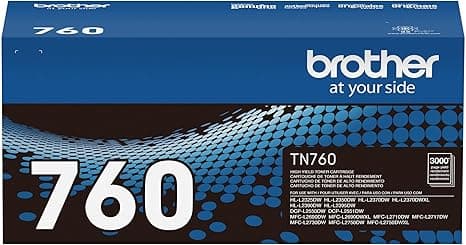
The page came out streaked — three pale gray bands running top to bottom, right through the middle of a contract I needed to sign and scan back in twenty minutes. My OEM TN760 had been in the printer maybe a year, and I'd been babying it, shaking it sideways every time the print went light to squeeze another fifty pages out. That morning the shaking stopped working. The toner was just gone, packed and clumped at one end of the drum, and the printer kept insisting it was fine because the chip still read 8 percent. That's the moment that pushed me off OEM for good. Not the streaks. The fact that I'd paid Brother's price and was still standing there hammering the cartridge against my desk like it owed me money.
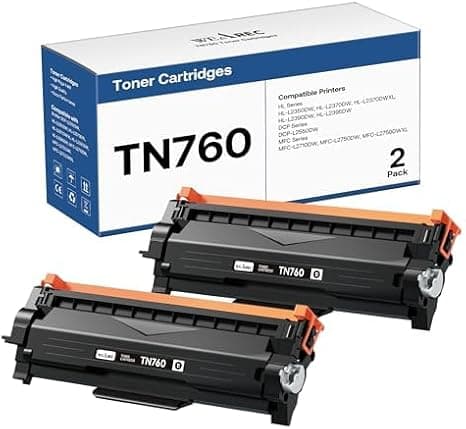
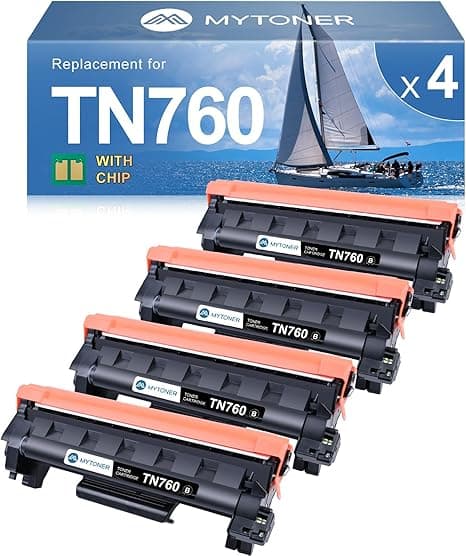
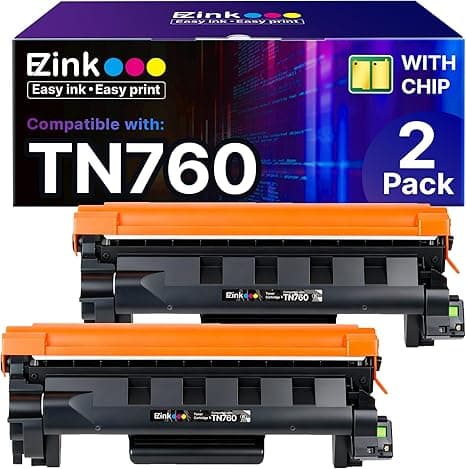
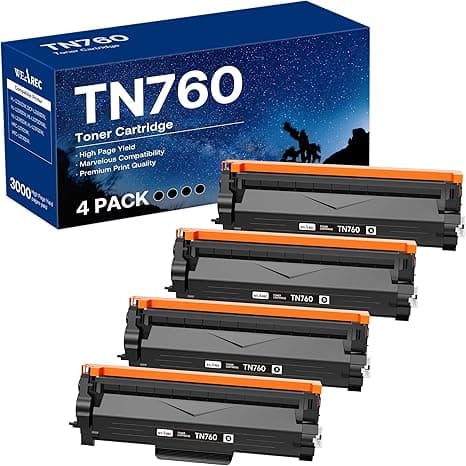
So let me tell you about the compatible TN760 I've been running in my Brother 2550DW since — the one that replaces the same part number for a fraction of the cost — because I went in expecting it to be junk and it mostly wasn't.
The price gap is not subtle
Here's the math that actually moved me. A genuine Brother TN760 high-yield cartridge runs around $75 most places, sometimes dipping to $68 on sale. The compatible version I bought was a hair under $24. That's not a coupon. That's 60 to 70 percent off the same job. Brother rates the TN760 at roughly 3,000 pages, and the compatible I'm using is built to the same ISO yield standard — so you're comparing apples to apples on output, not paying for a smaller tank dressed up cheap.
Run the per-page numbers and it gets stark. With the OEM you're sitting somewhere around $0.05 to $0.12 a page depending on how black your documents are. The compatible drops that to about $0.02 to $0.05. For me, printing maybe 150 pages a week of invoices, shipping labels, and my kid's homework, that's the difference between buying a new cartridge twice a year at $75 and twice a year at $24. Over the life of the printer that's real grocery money, not a rounding error.
Does it actually fit and seat right?
This was my worry going in — that the cheap shell would be a half-millimeter off and rattle around or refuse to lock. It didn't. You pop the front access door, the carriage shifts to position, you wait for it to stop moving, then press down on the old cartridge to release it. The new one slides into the color-coded slot at a slight angle and you push up until you hear the click. On the compatible, that click was a touch shallower than the OEM — less of a confident snap, more of a soft seat — but it locked, the door closed flush, and the printer initialized without throwing a fit. Pull the protective tape off the contact strip first, don't touch the copper, and you're done in under a minute.
One honest install note: my first unit had a thin film of toner dust on the outside of the cartridge, the kind of factory-floor residue you never see on Brother's sealed OEM packaging. I wiped it with a dry paper towel before loading it and had no mess. Just know the packaging is cheaper — a plain box, a generic bag, none of the molded plastic OEM theater. The cartridge inside was fine.
How it prints, honestly
On standard business documents — black text, spreadsheets, forms, the stuff a mono laser actually exists for — I genuinely cannot tell the compatible from the OEM. The blacks are dense, the edges are sharp, no ghosting, no streaking even at the bottom of a long print run. I printed a 40-page PDF the first night just to stress it and page 40 looked exactly like page 1.
Where it's a touch behind: heavy graphics coverage. If you're printing a page that's 60 percent solid black fill — a flyer, a dark photo, a full-bleed header — I noticed the compatible lays it down very slightly less uniform than OEM, a faint unevenness you'd only catch holding two prints side by side under a lamp. For text and normal office work, invisible. For someone printing dense visual layouts all day, that's the gap you're paying $50 less to accept.
The real downside — and it's the chip
Here's the thing nobody tells you up front, and it's the one place I'd push back if a friend asked. Brother pushes firmware updates, and those updates have a history of suddenly deciding third-party cartridges are "not genuine" and refusing to print. It has happened to people mid-deadline. The compatible I bought ships with an updated chip that the current firmware reads fine, but there's no guarantee Brother won't change the handshake again in six months.
So I did two things. I disabled automatic firmware updates on the 2550DW — you can do this from the printer's network settings or by just not clicking "update" when it nags you. And I keep a spare compatible cartridge in the drawer so I'm never one bad print away from a $75 emergency run to the store. Honestly, that's the move regardless of which cartridge you buy: never let yourself get caught with one cartridge and a deadline. A printer that won't print is worse than a printer that prints slightly uneven flyers.
The second smaller annoyance: the toner low warning on the compatible is less accurate. Mine jumped from "fine" to "replace" faster than the OEM's gradual countdown, so I got less of a heads-up. Not a dealbreaker, but it's why the spare in the drawer matters.
Who should actually buy OEM
If you run a print shop, push heavy graphics coverage daily, or you're the kind of person who genuinely cannot tolerate the slim chance of a firmware spat at the worst possible moment, buy the Brother OEM and pay the $75. The reliability tax is real for you and worth it.
But for me — and for most people running a 2550DW for invoices, labels, school stuff, the occasional contract that streaks at exactly the wrong time — I grab the compatible TN760 every time now. Same 3,000-page yield, same crisp text, a third of the price, with the firmware lockout managed by just not updating and keeping a backup. I've gone through four of them. I'd buy the fifth tomorrow, and I will, because there's already one waiting in the drawer.