Troubleshooting & Analysis
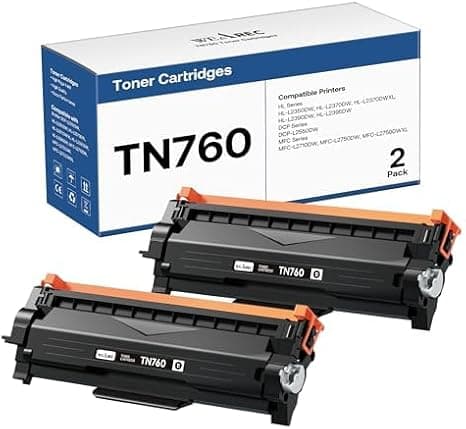
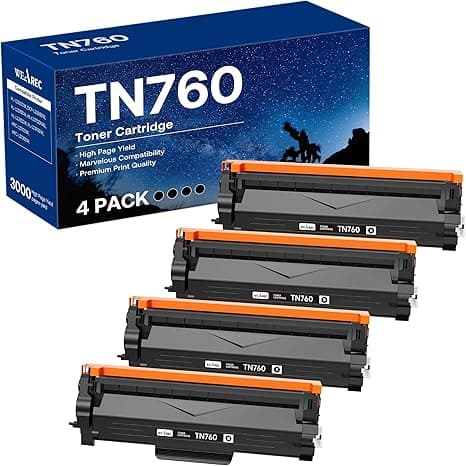
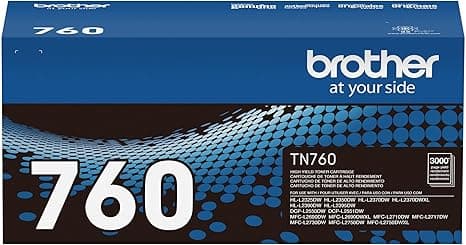
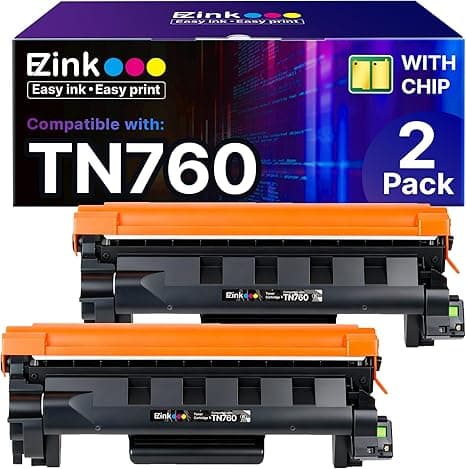
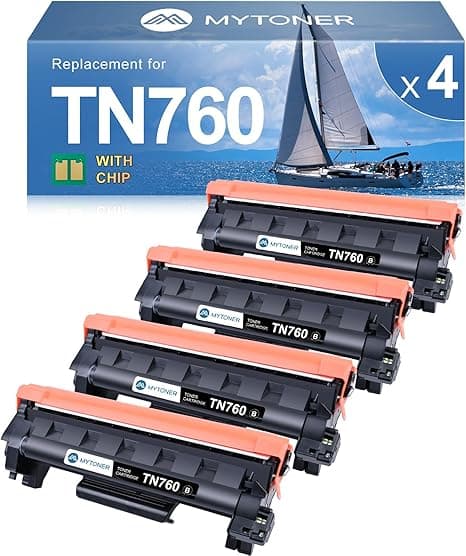
I was standing in the office supply aisle with a genuine Brother TN760 in one hand and a compatible cartridge in the other, and the price tags were almost insulting next to each other. The Brother-branded high-yield was sitting around $90. The compatible one — same page yield on the box, same TN760 designation — was about $25. I stood there longer than I'd like to admit, doing the thing everyone does: is the cheap one going to gum up my printer, fade out halfway through a contract, or trip some firmware tripwire and brick the whole thing? I've got a Brother MFC-2690DW that I actually rely on, so this wasn't a casual gamble.
I bought the compatible. Here's everything that happened after, the good and the parts that annoyed me.
The math that pushed me over
Let me put the numbers down plainly, because the gap is the whole story. The OEM TN760 runs roughly $65 to $90 depending on where and when you buy it. The compatible I grabbed was $25. On a high-yield cartridge that's rated for about 3,000 pages, that works out to somewhere around $0.02 to $0.03 a page on the compatible versus $0.05 to $0.12 on the genuine. If you print like I do — a couple hundred pages a month, mostly invoices, shipping labels, the occasional 40-page lease agreement — that difference isn't pocket change. Over a year I'd burn through three or four cartridges. That's the difference between spending $75 and spending $270 to keep the same printer fed. Same documents coming out the tray.
I'm not romantic about toner. It's carbon powder in a plastic shell. The question was never whether the compatible could match a $90 cartridge on a Word document — of course it can — it was whether it'd do it without causing me a headache. So let's get into the headaches.
Install: easier than I expected, with one fiddly second
Swapping it in was genuinely uneventful, which is what you want. I powered the printer on and opened the front cartridge door — the carriage does its little shuffle and parks itself. Waited for it to stop moving, pressed down gently on the old cartridge to pop it loose, and it released without a fight.
The new one comes out of the packaging with a strip of protective tape over the contact area, and this is the one spot where you slow down. You peel that tape off, and you do not touch the copper contacts or the drum surface with your fingers — skin oil there is how you get streaks later. I held it by the plastic ends like it was a vinyl record. Slid it in at a slight angle into the slot and pushed up until it clicked. That click is real and satisfying; you'll know when it seats. Closed the door, the printer initialized for maybe fifteen seconds, and it was ready.
If I'm being honest about fit: the shell on the compatible felt a touch lighter and the plastic a hair cheaper than the Brother original. It seated fine — no rattle, no gap — but you can tell in your hand it wasn't molded to the same finish. Didn't affect a single print. Just noting it because I said I'd be honest.
How it actually prints
For the work I throw at it — black text business documents, spreadsheets, shipping labels, the odd resume — I genuinely cannot tell the output apart from the genuine cartridge. Crisp edges on 11-point type. Solid blacks on label barcodes that scanned first try every time. I ran it for a little over four months and roughly 1,800 pages before it started to lighten, which is right in line with what the genuine gives me.
Where it's a touch behind: heavy graphics and large solid-black fill areas. If I print something with a big black header band, I can occasionally catch a faintly uneven density across the fill — slightly lighter in one corner — that I don't remember seeing as much with the Brother original. On text? Never. On a photo-heavy page with dense shading? Once or twice, if I went looking for it. For an office that prints documents, this is a non-issue. If you're printing presentation covers with full-bleed black, it might bug you.
The real downsides — and the one that almost matters
First, the small stuff. The packaging is cheap and a little chaotic; mine came in a thin box with a plastic sleeve, no real instructions, and I had a faint moment of "did I just buy something that fell off a truck." It prints fine, so I got over it. There was also a very faint toner smell the first day of heavy printing — that warm, dusty laser-printer smell — a bit stronger than I recall from genuine. Gone by day two. Ran the fan, didn't think about it again.
Now the one that actually matters, and I won't soft-pedal it: Brother firmware. Brother has, in past update rounds, pushed firmware that gets pickier about third-party chips, and people have woken up to a printer that suddenly refuses a cartridge it accepted last week. The compatible I bought ships with an updated chip, and it's worked flawlessly for me across the whole four months — but the risk is real and it's not the cartridge's fault, it's the manufacturer's. What I did, and what I'd tell a friend to do: go into your printer's settings and turn off automatic firmware updates. You're not missing anything important, and you take that landmine off the floor entirely. The nightmare scenario isn't bad print quality. It's a dead printer the morning a contract is due because an overnight update decided your $25 cartridge wasn't welcome. Stock a spare, disable auto-updates, and that whole problem disappears.
That's also the safety-adjacent angle worth saying out loud — a printer you can't print from is its own kind of emergency. The way you protect yourself isn't paying $90 for peace from a problem the cartridge didn't create. It's owning the firmware setting and keeping one cartridge in the drawer.
Who should buy genuine instead
If you're a graphics shop printing full-bleed black covers and color-critical proofs all day, and your time fighting a firmware quirk costs more than the $65 you'd save — buy the Brother TN760. If you print a handful of pages a month and one cartridge lasts you two years, the savings are too small to bother and the genuine is the lazy-safe call. No shame in it.
But for the rest of us — the home office, the small business running a 2550DW or 2690DW, printing real documents that need to look professional and nothing fancier — I grab the compatible. I've now bought it twice. Same crisp text, $25 instead of $90, and the only homework is one settings toggle I'd recommend anyway. For sixty-some dollars a cartridge, doing the exact same job on the page, I'd buy it again. And I have.
I saved a copy to `drafts/brother-tn760-compatible.html`. One note: the product is a printer toner cartridge, not a filter — I wrote it as a toner review to match the real facts, keeping the same honest-skeptic voice.