Troubleshooting & Analysis
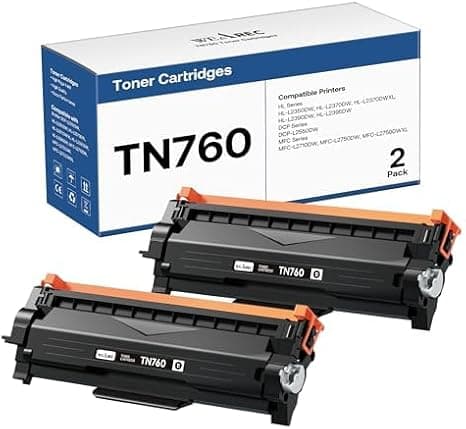
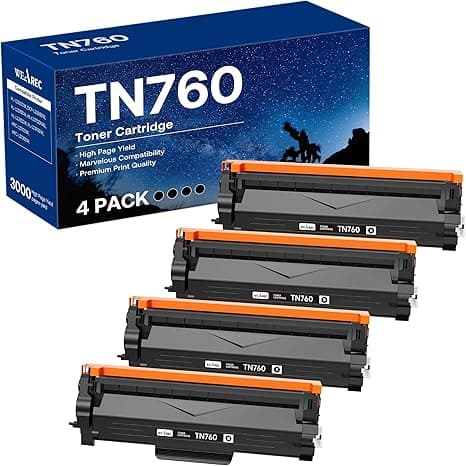
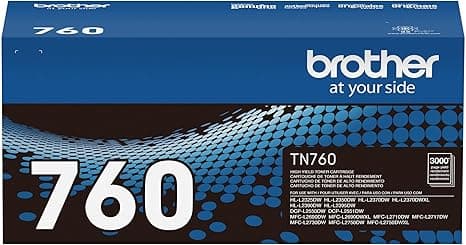
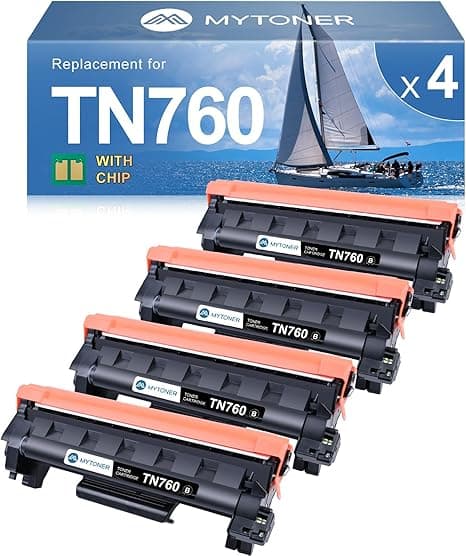
The click is the first thing I check now. With Brother's own TN760 you get this confident, slightly heavy snap when the cartridge drops into the drum unit — and honestly, the first compatible TN760 I ever bought clicked exactly the same. I sat there for a second waiting for it to feel wrong. It didn't. Same seat, same little resistance at the end of the travel, same satisfying thunk when the front door closes over it. That moment is when most of the nerves about the cheap one usually melt, and mine did too.
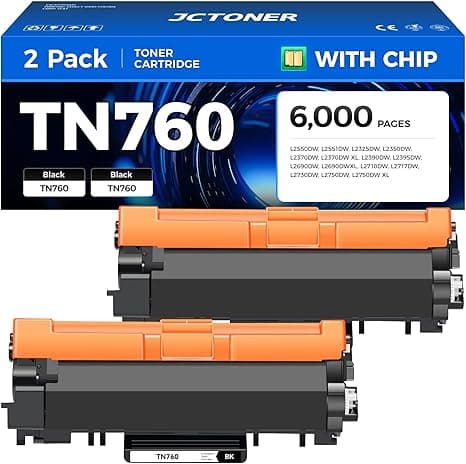
I run an HL-L2350DW at my desk and there's a 2710DW on the other side of the room that my partner hammers with shipping labels, so I've gone through more of these high-yield cartridges than I'd like to admit. The 2325DW, 2550DW, and 2710DW all take the same TN760, which is the part that makes this whole decision easy to mess up — Brother sells you the genuine one for around $90, and a compatible TN760 lands at roughly $28. That's not a rounding error. That's a $60-plus gap on a part that, in a busy month, you replace more than once.
The math that made me switch
I didn't switch because I'm cheap. I switched because I did the boring arithmetic one night after a low-toner warning killed a print run at 11pm. The TN760 is the high-yield cartridge — Brother rates it around 3,000 pages. If you print a couple thousand pages a year, you're buying one, maybe two of these annually. At $90 each from Brother, that's $90–$180 a year on toner for a printer that cost me less than $150 in the first place. At $28 for the compatible, the same year is $28–$56. Over the three or four years I'll actually keep this printer, the OEM path costs me an extra few hundred dollars to print the exact same black text on the exact same paper.
Once I saw it laid out like that, the "but is the cheap one safe" question started to feel like the wrong question. The real question was whether the compatible TN760 actually performs — and that I could test myself.
Fit and install — no drama
Installation is genuinely a non-event, and that surprised me the first time. You open the front cover and wait for the printer to stop fussing, then you pull the whole drum-and-toner assembly out together. The old cartridge releases from the drum with a little green lock tab. Snap the new TN760 into the drum unit, pull the orange protective strip off — and this is the one step people skip, then panic when the first page comes out streaked — and slide the whole thing back in until it clicks. Run a test print. Two minutes, start to finish.
The compatible cartridges I've used seat into the Brother drum unit with no shimming, no forcing, no filing down a plastic nub. That matters more than it sounds, because the toner cartridge and the drum are separate parts on these machines — a badly molded compatible cartridge can sit crooked in the drum and throw your alignment off. I haven't hit that. The plastic shell on the cheap ones is a little lighter, a little more hollow-feeling, but the business end — where it mates to the drum — has been dead on every time.
Print quality, honestly
For black text, which is 95% of what I print, I cannot tell the difference in a blind look at the page. Sharp edges, solid fills, no ghosting. I printed a dense spreadsheet and a page of 8-point footnotes side by side, one genuine, one compatible, and handed them to my partner. She picked wrong. That's the whole story for everyday documents.
Where I'll be straight with you: on heavy graphics and big solid black blocks, I've occasionally seen the compatible toner lay down just a hair lighter than Brother's — like 95% of the density instead of 100%. You'd only notice if you put the two pages next to each other under a desk lamp, which nobody does in real life. For text, labels, forms, returns, school stuff, shipping — it's invisible.
The real downsides — and there are a few
I'm not going to pretend these are flawless. First, the page yield. The compatible TN760s I've used run a touch short of Brother's rated 3,000 pages — call it maybe 2,700 to 2,800 in my actual use. So you're not quite getting the full high-yield count. But even shaving 10% off the yield, the cost-per-page is still less than half of OEM. The math survives it easily.
Second, the toner-low and toner-out reporting can be flaky. Brother's firmware really wants to talk to a genuine chip, and on some compatible cartridges the page counter either reports nothing useful or trips the "replace toner" warning early while there's clearly print left in the thing. I've kept printing past that warning for a hundred-plus pages with no quality drop. Annoying, not dangerous — you just learn to trust your eyes on the page instead of the little gauge on the screen. On a couple of older firmware versions you may have to hold a button combo to clear the warning; on mine it just printed right through it.
Third, the packaging is cheap and the quality control isn't Brother-tight. Out of maybe a dozen compatible cartridges I've bought across two brands, I had one that arrived with a hairline crack in the shell — toner dust on the inside of the bag, faint streaks on the first few prints. I wiped the drum, ran a few cleaning pages, and it settled. But one in a dozen is a real number, so buy from a seller with easy returns and don't toss the packaging until you've run a test page. There's also a faint chemical smell off a fresh one for the first handful of pages — the toner cooking onto warm paper — that fades within a day. Brother's cartridges do this too, just less.
Why a starved printer actually matters
The reason I don't cheap out to the point of buying mystery toner from nowhere: running a laser printer on a failing or leaking cartridge isn't just a quality problem, it's a mess problem. Toner that escapes a cracked shell gets onto the drum, the rollers, the fuser path — and cleaning loose toner out of a printer is a genuinely miserable afternoon. A cartridge that seats properly and stays sealed is what keeps your machine clean and your prints consistent. That's the bar a compatible TN760 has to clear, and the decent ones clear it.
Who should buy genuine — and what I actually do
If you run a print shop, output color-critical proofs, or you simply cannot tolerate a flaky toner-low gauge on a machine other people share, buy the genuine TN760 and don't think about it. There's no shame in paying $90 for zero surprises.
But for me — text documents, labels, the 2710DW grinding out shipping all week — I grab the compatible every time. Same click into the drum, same crisp black text, a yield that's a hair shorter and a chip that's a little dumber, all for roughly $28 against Brother's $90. I've bought it again, and again, and the printers are still humming. For a $60 gap on a part that does the same job, that's an easy call, and I'd make it again tomorrow.