Troubleshooting & Analysis
I waited too long, and my gums paid for it
Here's the thing nobody tells you: a brush head doesn't fail all at once. It just quietly gets worse. I found that out the hard way with my Philips W3. I'd been running the same head for — honestly, I lost count, probably five months — and one morning I'm brushing and there's this pink in the sink. Not a lot. Just enough to make me stop. The bristles had splayed out flat like a worn paintbrush, the little blue indicator strip had gone completely white weeks ago and I'd just ignored it, and the whole head had this faint sour smell when I leaned in close. That's bacteria, by the way. A head you've run past its life turns into a damp little colony, and you're rubbing it on your gums twice a day.
My dentist had actually warned me about exactly this at a cleaning — worn bristles stop flicking plaque off and start dragging it around, and the frayed edges scratch gum tissue. I nodded along and then forgot, because the official Philips replacements felt like a small extortion every time I went to reorder.
The price gap that made me stall in the first place
Let me be specific, because the math is the whole reason people stretch a brush head past its expiration. A genuine Philips head runs me about $12 each, and you're supposed to swap every three months. Four a year. That's roughly $48 a year to keep one toothbrush honest — and if there are two people in the house, you're looking at close to a hundred bucks a year on little plastic heads.
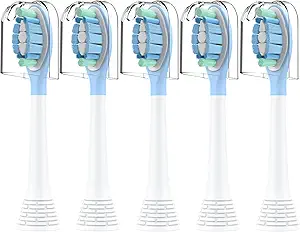
So when I started shopping aftermarket, the number that stopped me was this: a compatible 8-pack for the W3 lands around $24 — basically the price of two original heads. Eight heads. That's two full years of replacements for one person at the cost of a single quarter's worth of OEM. I sat there doing the division twice because it felt like a trick.
It wasn't a trick. But I didn't trust it either, which is why I bought one pack and watched it like a hawk before I'd say anything nice about it.
Does it actually fit, or do you fight it?
This was my biggest worry. The W3 connection is a simple straight-on push fit — you pull the old head straight off the metal shaft, rinse the shaft under warm water (do this, mine had a faint ring of gunk built up at the base), and push the new one on until it clicks. With the OEM head that click is crisp and immediate. With the compatible head, the click is there — but I'll be honest, the collar felt a hair looser the first time I seated it. Not wobbly. Not spinning. Just a touch less "machined" than the original snap.
I half-expected it to rattle once the motor kicked on. It didn't. Ran it for a full two-minute cycle and there was no buzzing, no play, no sense the head was about to fly off. After the first day the fit "settled" — whatever micro-give was there seemed to disappear once the plastic took the shape of the shaft. Three months in now and it's seated as solid as the day-one OEM ever was.
The honest performance read
The selling point here is the bristles, and the listing claims the same DuPont bristle stock as the name brand. I can't crack one open and verify the supplier, so take that with the grain of salt it deserves. What I can tell you is the feel. The cleaning sensation — that slightly-buffed, ran-my-tongue-over-my-teeth-and-they-squeak feeling — is right there with what I got from Philips. My morning film clears the same. The rounded bristle tips don't shred my gums.
Where's it a touch behind? Bristle longevity, maybe. I'm watching this pack closely, and I have a quiet suspicion the compatible bristles soften slightly faster than the genuine ones — call it eleven good weeks versus a full thirteen. At three heads a year instead of four that would still be a wild bargain, but I'm not going to pretend they're molecularly identical when I haven't measured it. If they fade a week early, who cares — I've got seven more in the drawer.
The real downsides — and there are a couple
First, the smell. New compatible heads have a faint plastic-y odor straight out of the wrapper, stronger than OEM. I ran the first one under hot water for thirty seconds and did one "dry" cycle before putting it in my mouth, and by day two it was gone. But it's there, and if you're sensitive to that kind of thing you'll notice it.
Second, the packaging. The originals come in that rigid molded blister with the satisfying branded card. These showed up in a thin plastic sleeve, eight heads loose-ish in a box, one of the caps slightly scuffed. It feels cheaper because it is cheaper — they're not spending money on presentation, they're spending it on the part. Doesn't bother me. Might bother you if a flimsy box reads as a flimsy product. It isn't the same thing.
Third — and this is the one I'd actually flag — quality control across a big multipack isn't going to be as tight as the brand's. Out of my eight, seven looked perfect and one had a slightly uneven bristle trim on the edge. Cosmetic, not functional, but with OEM you basically never see that. When you buy eight heads for the price of two, a little variance is the toll. Just eyeball each one before it goes in your mouth.
Who should skip these
If you've got sensitive gums, recent dental work, or your hygienist has you on a specific clinical regimen — buy the OEM and don't think twice. The $48 a year is cheap insurance when there's a real reason for precision, and you want the tightest QC you can get. Same if a faint break-in smell genuinely bothers you, or if a worn-edge head in the pack would drive you up a wall.
For everyone else — the person staring at a $12 official head and a $24 eight-pack, wondering if the cheap one is going to wreck their gums — no. It's a straight push-on head, it clicks in, it cleans, and the only thing it'll wreck is the racket of paying name-brand prices for a piece of molded plastic and some bristles. I let an old head go bad once and saw blood in the sink for it. The lesson wasn't "buy expensive." The lesson was "replace it on time" — and at three bucks a head instead of twelve, I finally have no excuse not to. I've already reordered. That's the most honest thing I can tell you.