Troubleshooting & Analysis
The bristles were splayed flat and I didn't even notice until my gums bled
I'd been running the same brush head on my Philips W3 for — honestly? Probably seven months. I tell people three months like it's gospel and then I let my own go double that. What snapped me out of it was spitting pink into the sink one morning. Not a little. Enough that I leaned in close to the mirror and actually looked at the head for the first time in forever. The bristles weren't standing up anymore. They were fanned out sideways, gray at the tips, mashed down like a brush you'd find in a junk drawer. I'd basically been scrubbing my teeth with a worn-out yard tool and wondering why my checkup went badly.
That's the thing nobody warns you about with these brush heads. They don't break. They just quietly stop working while you keep feeling the buzz and assuming the buzz means it's cleaning. A flattened bristle field doesn't reach between teeth, doesn't sweep the gumline, and — this is the part my hygienist hammered into me — it turns into a little reservoir for bacteria. Months of warm, wet, never-fully-dry plastic. You're putting that in your mouth twice a day.
The price math that made me stop buying OEM
So I went looking for replacements, and here's where I got annoyed all over again. The genuine Philips heads for the W3 run about $13 a piece when you buy them one or two at a time. A four-pack of the real ones is somewhere around $45. If you actually swap every three months like you're supposed to, that's roughly $52 a year just on brush heads, forever, for a chunk of nylon and plastic the size of your thumb.
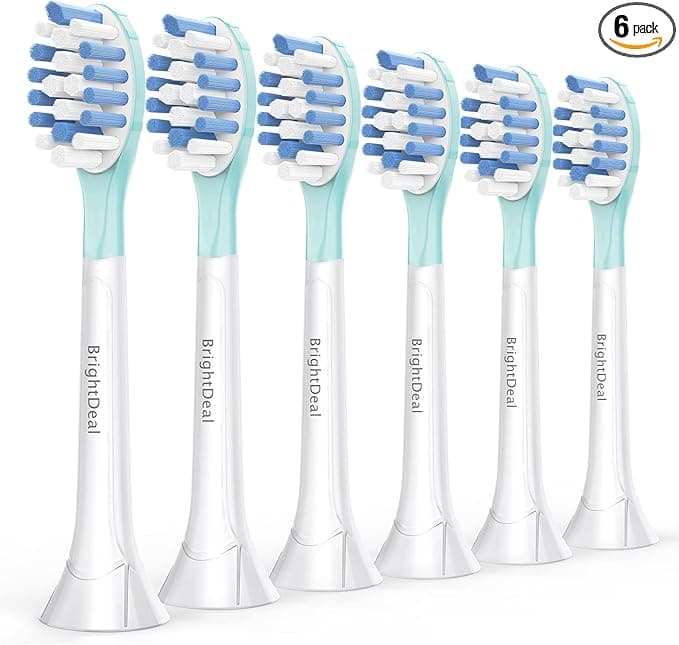
The compatible pack I landed on was a different story: an 8-pack for right around the price of two originals. Call it $26 for eight. That's a hair over $3 a head versus $13. Two full years of replacements for less than what four genuine heads cost. I did the napkin math twice because it felt too lopsided to be real.
And look — I went in skeptical. Cheap dental anything makes me nervous. The whole reason I let my old head rot was partly laziness and partly a quiet dread that the alternatives would be junk. So I treated the first one like a test.
Does it actually fit the W3?
This was my real worry. The W3 head just pulls straight off the metal shaft and the new one pushes on until it clicks — there's no thread, no lock, it's a friction fit over the drive pin. With an off-brand part, a friction fit is exactly where you'd expect slop. I pulled the old head off (it came away with a tired little sigh), rinsed the shaft under warm water to clear the gunk that builds up down there, and pushed the new one on.
It clicked. Seated flush. And here's my honest read after a few weeks: the fit is good but it is fractionally looser than a genuine head. When the motor's running you can feel a whisper more vibration in the head than I remember from the real ones — not a rattle, not a wobble you'd see, just a slightly buzzier feel against your hand if you're paying attention. After about three days of use it bedded in and I stopped noticing. But I'm not going to pretend the tolerance is identical to OEM, because it isn't.
How it actually cleans
The bristles are the Dupont type, same as the genuine heads claim, and that's the part that matters most to me. Stiffness felt right out of the gate — not the flimsy, too-soft mush I half-expected from a budget head. After a session my teeth had that squeaky, just-left-the-dentist feel, which is the whole point. Two weeks in, the bristles were still standing straight, no premature fanning, no shedding into my mouth.
Where's it a touch behind OEM? The bristle polishing — that slightly rounded, gum-friendly tip the genuine heads have — felt a little less refined the first couple of days. On day one I caught a faint scratchy edge along my gumline that I don't get from a fresh Philips head. It softened up fast once the bristles broke in, and by the end of week one I couldn't tell the difference. But if you've got sensitive gums, know that the break-in is real and the first two or three brushings are the roughest.
The downsides, for real
I said I'd give you at least one and I'll give you a few, because that's the only way this is useful.
- The packaging is cheap. Thin plastic clamshell, no individual seals on each head, a little color-coding ring that's slightly different shades than advertised. Doesn't affect the brushing, but it doesn't feel premium and it made me double-check I wasn't getting something counterfeit-sketchy.
- A faint plastic smell on the first use. Brand new out of the pack, the first head had a mild plasticky odor for the first day or two. I ran it under hot water before the first brush and it mostly went away. Gone completely by day three.
- The friction fit loosens slightly over the full three months. By the time a head is due for replacement, it had a touch more play than when it was new. Never came off mid-brush, never alarming — but it's another small reminder you're not holding a genuine part.
None of those are dealbreakers for me. They're the kind of small corners a budget maker cuts, and they're honest trade-offs for paying a quarter of the price.
Who should still buy genuine — and who shouldn't
If you've got genuinely sensitive gums, recent gum surgery, or your dentist has you on a specific therapeutic head, I'd spend the extra and stick with OEM. The break-in roughness and the slightly less-polished bristle tips are a small thing for most mouths but a real thing for a sensitive one. Same if you're the type who'll be bothered by a hair more vibration — some people just want the exact factory feel.
For everyone else? The single most important thing for your gums isn't the brand stamped on the head — it's that you actually swap it every three months instead of letting it flatten out like I did. And at $3 a head instead of $13, swapping on schedule stops feeling like throwing money away. That's the quiet win here: the cheap heads make me change them on time, which means I'm brushing with sharp bristles year-round instead of nursing one dead head for seven months out of guilt over the cost.
I've reordered the 8-pack. That's the most honest thing I can tell you. I tested it expecting to come back here and warn you off, and instead I'm two packs deep and my last checkup went fine. For fifty-plus bucks a year back in my pocket, doing the same job, I'll take the cheap clamshell and the day-one plastic smell.