Troubleshooting & Analysis
The morning my brush head finally gave up on me
I noticed it in the mirror, honestly, before I noticed it in my mouth. My gums along the bottom front teeth had a thin pink line that wasn't there a month before. Then came the smell — when I went to rinse the head one morning, that warm-water rinse pulled out a faint sour funk that no amount of scrubbing fixed. The bristles had splayed out flat like a worn-out broom, half of them bent sideways, and the little blue indicator fade had gone full white ages ago. I'd been running that same Philips Precision Clean head for something like six months because replacing it kept slipping my mind. Six months. On a head that's supposed to come off every three.
That's the part nobody tells you until it's already happening: a brush head past its life isn't just "less effective." It's actively working against you. The splayed bristles stop reaching the gum line and start dragging across it. And the base of those bristle tufts, where water sits between brushings — that's a little bacteria farm. My dentist had warned me about exactly this, that worn bristles damage gums and quit clearing plaque, and that old heads turn into a breeding ground for millions of bacteria. I'd nodded and forgotten. The pink line in the mirror made me remember.
So I did the math that finally annoyed me into switching
Here's what kept me cheap and lazy for too long: the genuine Philips Sonicare heads are not gentle on the wallet. You're looking at roughly $10 to $13 per head when you buy the official two-packs. Replace every three months like you're supposed to, and that's four a year — call it $40 to $52 annually, just to keep your toothbrush honest. And because they're pricey, you stretch them. That's the trap. The cost is exactly what makes people run a dead head for six months, which is how I ended up with that pink gum line in the first place.
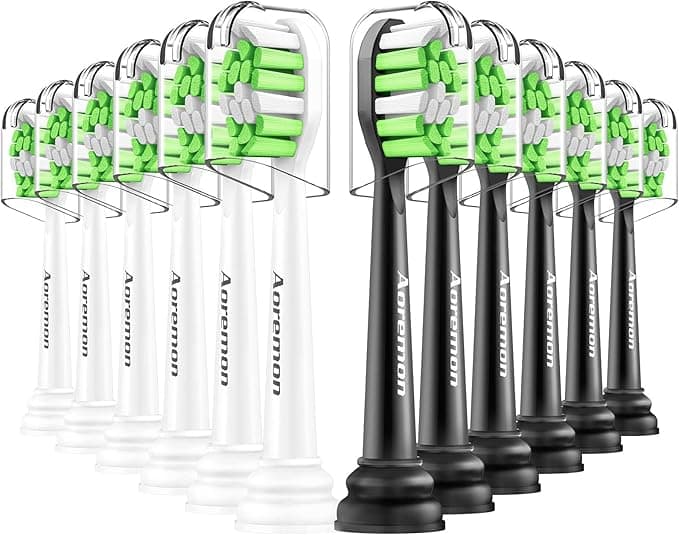
The compatible heads I switched to run as an 8-pack for roughly the price of two originals. Think about that for a second. Two genuine heads gets you through half a year if you're disciplined. The same money in compatibles gets you eight heads — two full years of replacing on schedule. The thing that was stopping me from changing my brush head on time was the price, and the cheaper option fixed the behavior, not just the cost. That alone made it worth trying.
The fit — does a third-party head actually click on?
This was my real worry. The whole appeal of the Sonicare system is that satisfying seat where the head locks onto the metal shaft and doesn't wobble. A cheap head that fits loose would rattle, lose power transfer, maybe fling off. So I paid attention.
Install is genuinely nothing. You pull the old head straight off — it just slides off the shaft, no twisting. I rinsed the metal shaft under warm water because, again, six months of gunk. Then you push the new head straight on until it clicks. And it did click. Same firm seat as the original, no side-to-side play once it's down. If I'm being a stickler — and I am — the very first new head went on with a hair less resistance than I remembered from the Philips ones, like the inner collar is molded a touch wider. But it seated fully, it doesn't wobble in use, and it hasn't loosened over weeks of twice-a-day brushing. Functionally I can't tell it apart on the handle.
How it actually cleans, honestly
The bristles are DuPont, same as what the premium heads use, and you can feel that. The first morning my teeth had that just-left-the-dentist squeak that a dying head simply can't produce anymore. Plaque at the gum line, the stuff that had been building because my old bristles couldn't reach — gone within a few days of normal brushing. The bristle tufts are arranged like the Precision Clean pattern, that rounded contour cup, so it hugs each tooth the way the original does.
Where's it a touch behind? Two honest things. One, the bristles felt a little stiffer the first two or three uses before they broke in — not painful, just firmer than a fresh Philips head, which softens almost immediately. By day four it was indistinguishable. Two, the colored wear indicator on these fades a bit faster than the genuine ones, so it'll tell you to replace the head before it's strictly necessary. Given they're cheap and I'd rather replace early than late, I've decided I don't mind that. But it's there.
The downsides I want you to hear before you buy
The packaging is cheap. Thin plastic clamshell, no nice box, a couple of mine had a print smudge on the cardboard insert. It doesn't affect the head, but if you were hoping for that Apple-unboxing-of-toothbrushes feeling, this isn't it.
There's a faint plastic-and-glue smell on a brand-new head, strongest the first time you run warm water over it. I gave each new one a 20-second rinse and a single dry test-brush before putting it in my mouth, and the smell was gone by the second use. It's the kind of thing that'd bother me if I didn't know to expect it, so — expect it. Rinse it first.
And quality across an 8-pack isn't perfectly uniform. Out of my eight, seven were flawless and one had a single bristle tuft set very slightly crooked. Totally usable, I'm still going to brush with it, but on a genuine pack you'd basically never see that. When you're buying eight heads for the price of two, that's the trade you're making, and I think it's a fair one.
Who should skip these — and what I actually do now
If your gums are already inflamed, if you've got a dental condition where your hygienist specifically told you to use a particular genuine head, or you're someone who will lie awake over one crooked bristle tuft — buy the OEM. The peace of a known-perfect head is worth $12 to some people and that's a legitimate choice.
For me? I keep the 8-pack in the bathroom drawer where I can see it. The whole reason I let a head rot for six months was that replacing it felt expensive and far away. Now there's a fresh head an arm's length away that cost me almost nothing, so I actually swap it every three months like I'm supposed to. The DuPont bristles do the job, the head clicks on solid, and the only real costs are a cheap clamshell and a two-day break-in smell. I'd buy it again — and I already have, because I'm two heads into the second pack. The pink line in my mirror is gone, and this time I don't have to talk myself into changing the brush.