Troubleshooting & Analysis
The click is the first thing that told me it was fine
I'll be honest — I bought my first pack of compatible DiamondClean heads half-expecting them to wobble. You push one of these onto the metal shaft of a Philips Sonicare DIAMONDCLEAN handle and you wait for that little click, the one that tells you it's seated. With the genuine Philips heads I'd been buying for three years, that click is crisp and immediate. So when I pressed the first aftermarket head down and felt it snap into place with the same definite stop — same seat depth, same flush line against the handle collar — I sort of paused over the sink. Huh. Okay. That's the same motion I've done two hundred times.
Then I turned it on, and the second tell showed up: the hum and the buzz against my teeth felt identical. No rattle. No off-axis vibration buzzing through the bristles like a cheap knockoff. If you've ever used a truly bad third-party head, you know the feeling — it sounds like a bee trapped in a jar and your gums can feel the slop. This wasn't that. This felt like a Sonicare.
The price math is genuinely stupid in your favor
Here's why I went looking in the first place. Genuine Philips DiamondClean replacement heads run you real money — you're typically staring at something close to $10 a head when you buy them in the small OEM packs, and Philips wants you swapping them every three months. That's four a year, per person. In a two-adult household that's eight heads a year, and you're suddenly spending $70 to $80 annually just on little plastic brush tips.
The compatible route I landed on is an 8-pack for roughly the price of two original heads. Read that again, because that's the whole pitch: eight compatible heads for what two genuine ones cost. So instead of $80 a year for the OEM path, my whole household's brush heads cost me the price of one OEM two-pack — call it $20-ish — and I've got a year of swaps sitting in the bathroom drawer. The savings gap isn't a rounding error. It's basically the entire cost of the product, four times over.
And the bristles aren't the cheap-out part, which surprised me. The set I use advertises DuPont bristle filament — the same nylon supplier the name-brand heads lean on — and after a few weeks of use I believe it. The bristles hold their shape. They flare and fade on the same timeline I'm used to.
Fit and install: nothing to learn here
If you've ever changed a Sonicare head you already know the whole procedure, and the compatible ones don't change a single step. Pull the old head straight off the shaft — straight up, don't twist it like a bottle cap, it just slides. Rinse the metal shaft under warm water for a second to clear any old toothpaste gunk that built up at the base (people forget this and then wonder why their handle smells faintly of mint-rot). Push the new head down until you feel that click I keep going on about. Done. Thirty seconds, no tools, no adapter, no "some assembly."
The bore on the inside of the head — the part that grips your handle's shaft — matched my DIAMONDCLEAN handle snugly on every one of the eight. Not loose, not so tight I had to fight it. That's the make-or-break for these, and it's where bad clones fail. These passed.
The downside, and it's a real one
Okay. So I told you the click and the fit and the bristles were all good. Here's where I'd be lying if I stopped: the color-band wear indicator is the weak spot.
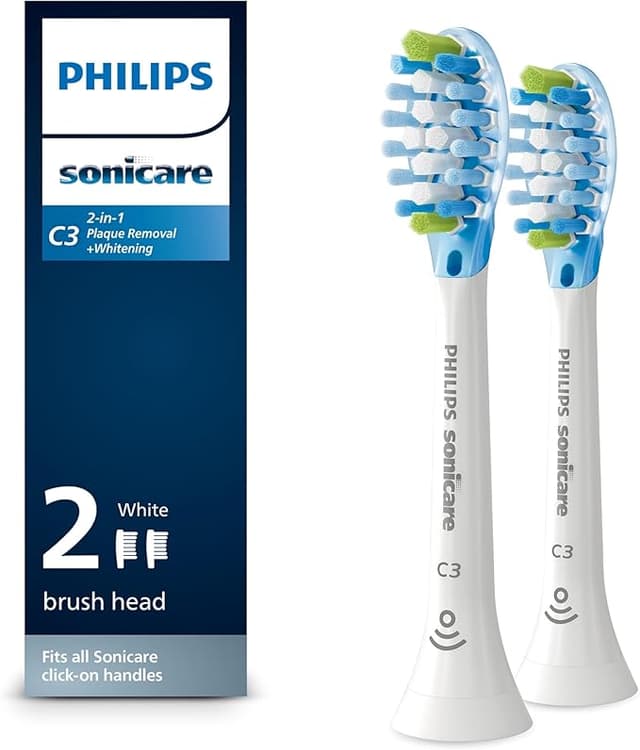
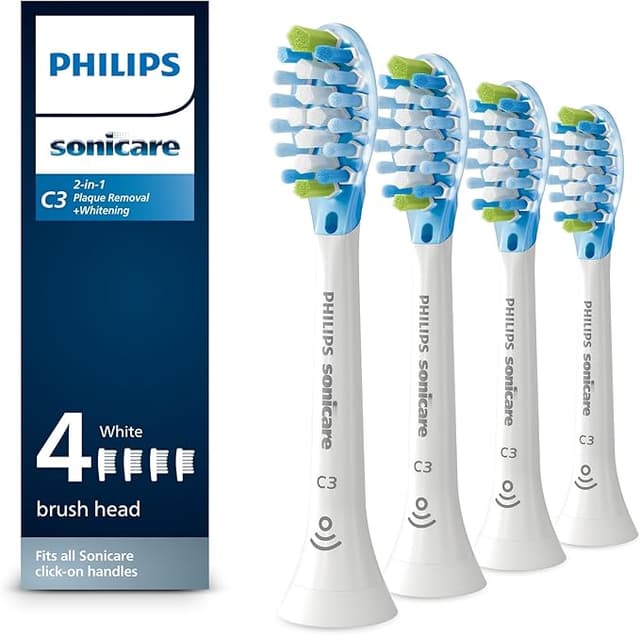
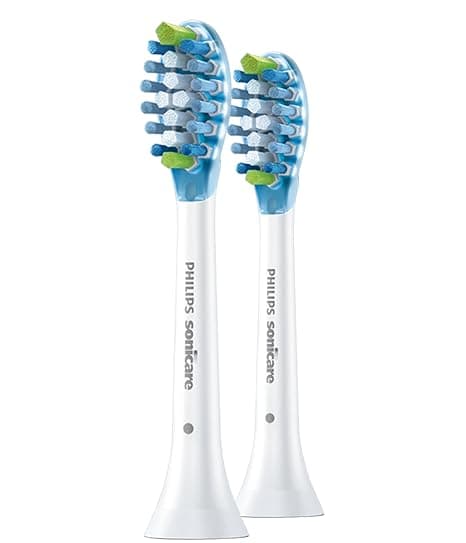
Genuine Sonicare heads have those blue indicator bristles that fade to pale as a built-in "time to replace me" timer. The compatible heads I used have a version of this, but the fade is less reliable — on a couple of them the color band stayed darker than it should have well past the point the bristles had actually splayed out. So I stopped trusting the color and went back to the old-school method: I just write the swap date on a sticky note inside the cabinet, or honestly I swap on the first of every fourth month and don't overthink it. It's a small thing. But if you're the kind of person who relies on that fading-bristle cue, know that on the aftermarket heads it's more decoration than instrument. Use a calendar instead.
The other minor gripe — the packaging is nothing. Thin plastic clamshell, no satisfying box, the heads sit in a flimsy tray. It doesn't affect the brushing one bit, but if you were buying these as a gift it looks like what it is: a budget multipack. I buy them for me, so I genuinely don't care, but I'll say it so you're not surprised when the mailer shows up.
Why I don't let any of these run long
One thing I won't compromise on, OEM or compatible: I don't ride a brush head past its life. There's a reason for the three-month rule beyond Philips wanting your money. Splayed, worn bristles stop reaching the gumline cleanly — they skate over plaque instead of sweeping it — and a frayed, soggy head that's been wet twice a day for months is, frankly, a bacteria farm. My dentist has flat-out told me that worn bristles on a powered brush can actually abrade the gums while doing a worse job on the plaque. So the cheap-per-head math here isn't just about saving cash — it's the thing that finally got me to actually replace on schedule instead of stretching a single tired head to five months because I didn't want to spend another ten bucks. When a fresh head costs me about two-fifty instead of ten, I swap without flinching. That's better for my mouth, not worse.
Who should skip these — and what I actually do
If your dentist specifically prescribed a particular Philips head for a clinical reason — a special gum-care or orthodontic geometry — buy the exact OEM head, no argument. And if the fading wear-indicator is a feature you genuinely depend on to remember replacements, the genuine ones do that one job better. For those two people, pay up.
For everyone else with a standard DIAMONDCLEAN handle who just wants clean teeth without the OEM markup? I grab the compatible 8-pack. They seat with the right click, they buzz like the real thing, the DuPont bristles hold up for the full three months, and I'm paying roughly a quarter of what Philips charges. I've now reordered them twice. That's the most honest endorsement I can give a thing — not that I reviewed it, but that I quietly bought it again with my own money. For the price of two genuine heads getting me a year of swaps, I'd do it a third time, and I will.