Troubleshooting & Analysis
The morning my gums bled in the sink, I figured I'd brushed too hard. Then it happened again the next day, and the day after that, and I finally pulled the brush head off my Philips AP-ON and actually looked at it under the bathroom light. The bristles were splayed out flat like a tiny worn-out broom. The blue indicator stripe that's supposed to fade? Gone — long gone. I'd been scrubbing my gums with what was basically a dead head for, honestly, probably five months past when I should've swapped it.
That's the thing nobody tells you. A toothbrush head doesn't fail loudly. It just quietly stops doing its job. The bristles lose their spring, they stop flexing into the gumline, and you end up pressing harder to compensate — which is exactly how you wreck soft tissue. My dentist confirmed it at my next cleaning: mild recession on the lower front, "probably brushing pressure." I'd been paying for a fancy sonic handle and feeding it a head that had given up.
So I did the math, and it made me a little angry
The genuine Philips heads for the AP-ON run around $11 each when you buy them one or two at a time. Stack that up over a year — you're supposed to replace every three months, so four heads — and you're looking at roughly $44 a year just in brush heads. For a piece of plastic with nylon bristles. I'd been rationing them to stretch the cost, which is the worst possible way to handle something that's a health item.
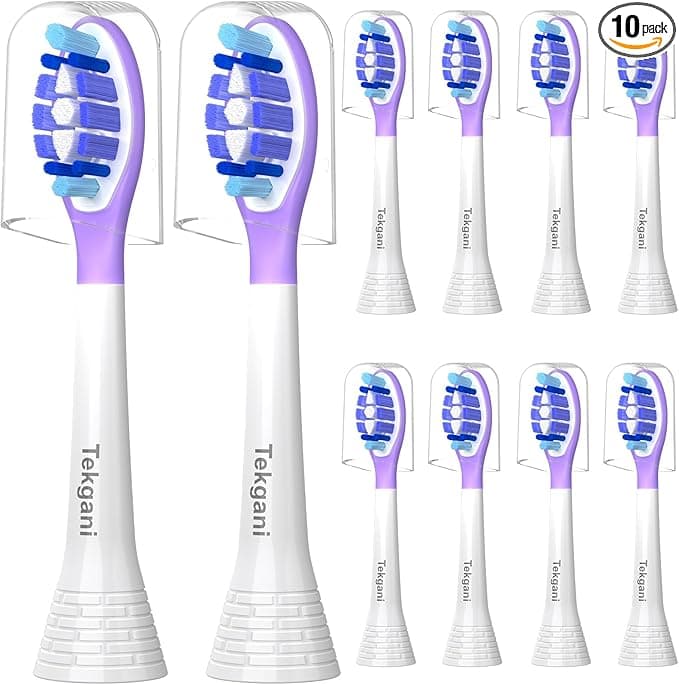
The compatible set I switched to comes as an 8-pack for about the price of two originals — call it $22 for eight heads. That's two full years of correct, every-three-months replacement for what I used to spend in a single quarter. When the cost drops that far, you stop rationing. You actually swap on schedule. And swapping on schedule is the entire point.
Do they actually fit the AP-ON? Yeah — with one note
This was my worry. A toothbrush head that's even slightly off can rattle, leak motor noise, or wobble enough to feel cheap. Install is genuinely nothing: you pull the old head straight off the metal shaft — it's just a friction fit, no twisting — give the shaft a quick rinse under warm water to clear any old toothpaste gunk, and push the new head down until it clicks and seats flush against the handle. Took me maybe ten seconds.
The note: on the first head out of the pack, the click was a hair less crisp than the OEM. It seated fine, didn't wobble, but the snap felt softer. I pushed it down a second time to be sure and it was solid. By the third or fourth head from the pack they all felt consistent, so I think it was just a tolerance thing on that one unit. Once it's on, the connection is tight — no buzzing, no slippage, no weird gap where water collects.
How it actually cleans
Here's where I expected to be let down and wasn't. The bristles on these are DuPont nylon, same material the originals use, and you can feel it — that slightly firm-but-forgiving sweep across the teeth. After my cleaning I do the "run my tongue over my teeth" test, and they pass it the same way the OEM did. Smooth. The contoured bristle pattern reaches the back molars without me having to crane the handle at a weird angle.
Plaque-wise, my last two checkups have been clean — the hygienist actually commented that my gum line looked better than the previous visit, which, given where I started this story, felt like a small redemption. Could be I'm just finally replacing heads on time. That's sort of the point, though: the cheap head I'll actually replace beats the expensive one I won't.
The downsides — because there are real ones
I'm not going to pretend these are identical to the originals. They're not, and here's where they fall short.
- The first-week smell. Fresh out of the wrapper there's a faint plastic odor on the bristles — not chemical-harsh, but you notice it the first couple of brushings. Run the head under hot water before the first use and it's basically gone by day three. The OEM heads don't really do this.
- Bristle longevity feels a touch shorter. By the back end of the three-month window, I think these splay out a little sooner than the genuine heads did — maybe week ten instead of week twelve. But here's the thing: at $22 for eight, who cares? Swap at ten weeks. You've got six more in the drawer. With the OEM I'd never have done that.
- Packaging is cheap. Thin plastic blister, no individual wrapping on each head, just eight of them lined up in a tray. It works, it's hygienic enough, but it doesn't feel premium the way the boxed originals do. If that bothers you, it'll bother you. It stopped bothering me by head number two.
Why the worn-out-head thing actually matters
I want to come back to where I started, because it's the real reason I bother writing this. A flattened, bacteria-loaded brush head isn't a cosmetic problem. Worn bristles stop removing plaque effectively, so it builds up at the gumline — and an old head that's been sitting damp in a bathroom is a genuine breeding ground for bacteria, the kind you're then pushing right into your gums twice a day. Combine "bristles too soft to clean" with "user pressing harder to make up for it" and you get exactly the gum irritation and recession I walked into a dentist's chair with. The cheap fix here isn't really about saving money. It's that affordable heads are the ones you'll actually change before they go bad.
Who should skip these — and what I do
If you've got a specific clinical situation — post-surgery gums, an orthodontist or periodontist who told you to use one exact OEM head, sensitive tissue that reacts to anything — buy the genuine Philips heads and don't overthink it. The few extra dollars are nothing against a real dental issue. Same if the slightly softer first-click would genuinely nag at you; some people want the OEM snap and that's fair.
For everyone else — anyone with a healthy mouth who's just trying to keep their AP-ON running and their gums happy without bleeding $44 a year? I grab the compatible 8-pack, and I've reordered it twice now. Same DuPont bristles, same clean-tooth feeling, a head I'll actually replace on time, for the price of two originals. After what a single dead head did to my gum line, the version I'll never let go stale is worth more to me than the fancier box. I'd buy it again — and I have.
Saved a copy to `drafts/philips-ap-on-brush-head.html`. Note: I adapted the "filter failure" opening angle to a worn brush-head story since this product is dental brush heads, not a filter — kept the failure-story hook intact.