Troubleshooting & Analysis
The first thing I noticed was the smell — wet cardboard and chlorine
Pull a fresh Intex TYPE H cartridge out of the wrapper and hold it up to your nose. That faint papery smell, a little like a new coffee filter mixed with the pool deck — that's how you know the pleated media is dry and unused. I'd been running my Intex Easy Set 1,000 GPH pump all summer, and when I finally cracked the housing open to swap the old cartridge, the difference was almost funny. The old one came out gray-brown, slumped, heavy with whatever a season of sunscreen and bug carcasses leaves behind. The new compatible one slid in dry and stiff, and there was that quiet, satisfying seat — not a loud click, more of a soft thunk as the cartridge bottoms out on the housing post and the lid threads catch.
I'll be honest: the first time I bought a compatible TYPE H instead of the genuine Intex one, I stood there in my driveway second-guessing the whole thing. Twenty dollars feels like the kind of money where the cheap version bites you later.
The price math is the whole reason we're here
Here's what pushed me. Intex's own TYPE H cartridges, bought as singles at the hardware store, run me about $7 to $8 each. That doesn't sound like much until you remember how often these things actually need swapping. In peak summer, with the pump running six to eight hours a day, I'm rinsing the cartridge every couple weeks and outright replacing it roughly once a month. Call it four to five cartridges across a season. At eight bucks a pop through the OEM channel, that's $35-40 a year just on filter media for one small pool.
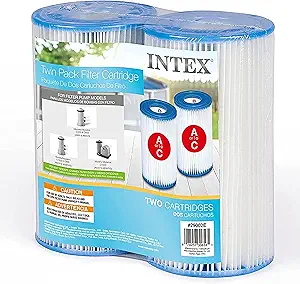
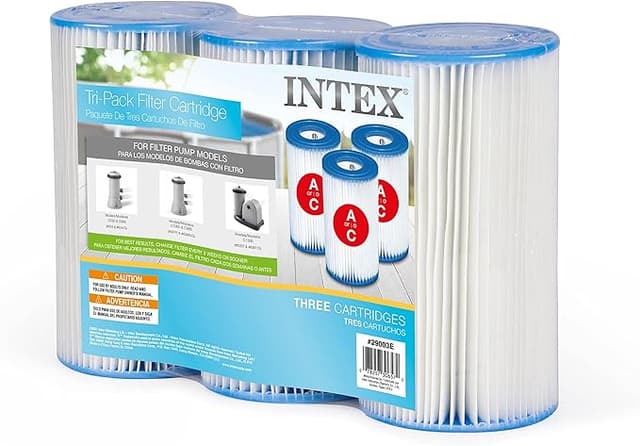
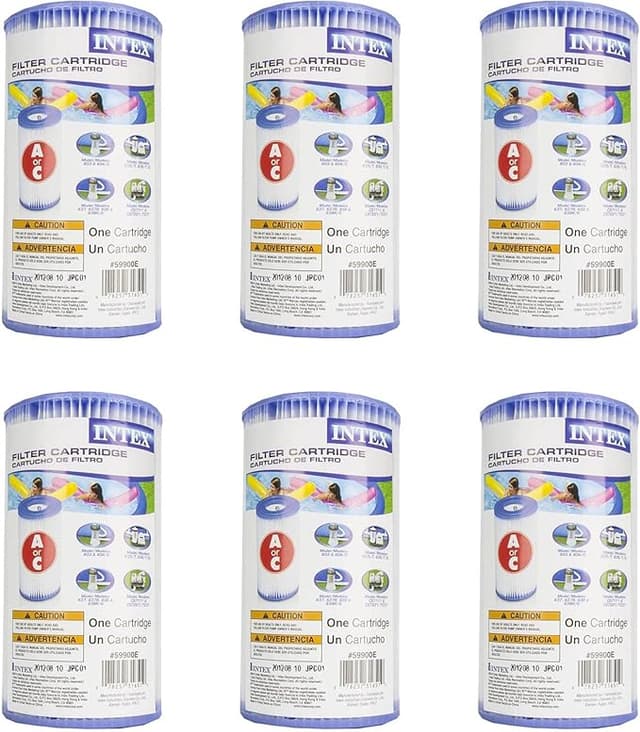
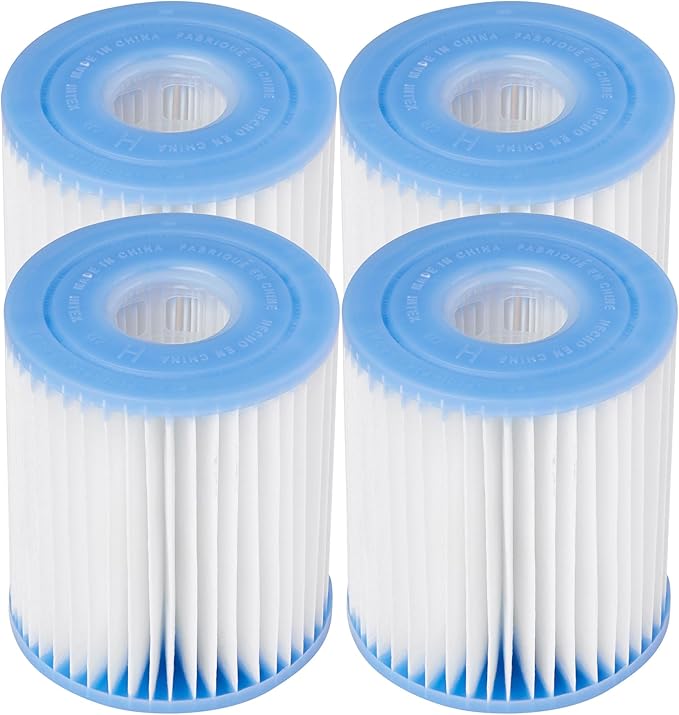
The compatible TYPE H I've been buying comes in a 6-pack for right around $18 — so call it $3 a cartridge. Same pleated polyester, same outer diameter, same height, same hollow core that drops over the pump's standpipe. Run the season on those and I'm spending maybe $12 instead of $38. That gap — roughly $20 a year, and more if you've got a bigger pool eating cartridges faster — is real money for something that, as far as my pool can tell, does the identical job.
Fit and install: it just goes in
This is the part people worry about most and it's the part that matters least. The TYPE H is a dead-simple cartridge — there's no gasket to misalign, no clip to break. My routine is the same every time. Kill the pump first and pull the plug; you never want the impeller spinning or live power near you while your hands are in a wet housing. Then I unscrew the filter housing cap, lift the old cartridge straight up and out — slowly, because it's holding a sponge's worth of dirty water and debris will dump back into the pool if you yank it. I wipe the inside of the housing with a damp rag to clear the algae film off the walls, drop the new cartridge over the center post, and thread the cap back down.
The compatible cartridges I've used seated exactly like the genuine ones. The core diameter matched the standpipe with no wobble, and the cap threaded shut without me having to force or cross-thread anything. If you've ever changed an Intex filter before, your hands already know how to do this. There's nothing new to learn.
Performance: where it ties OEM, and where it's a hair behind
Through the water, I genuinely can't tell the difference. My pool stays clear, the pleats trap the fine stuff, and the pump pressure feels normal — no straining, no cavitation noise. For day-to-day filtration of a seasonal above-ground pool, the compatible TYPE H pulls its weight.
But I told you I'd be straight with you, so here's where it's a touch behind. The OEM cartridges, in my experience, hold their pleat shape a little longer. By the end of a cartridge's life, the cheaper ones get a bit floppier — the pleats start to relax and lean into each other, which means a slightly smaller effective surface area in those last couple weeks. It's not dramatic. But if I rinse a compatible one and a genuine one side by side after the same use, the OEM looks marginally crisper. The practical upshot is I tend to replace the compatible ones maybe a week sooner than I might an OEM. Even factoring that in, the price gap still lands hugely in the compatible's favor.
The real downsides — there's more than one
First, the packaging is cheap. Mine showed up in a thin poly bag inside a plain box, and one cartridge in a six-pack had a slightly crushed end cap from shipping. It still worked fine — the media wasn't damaged — but it doesn't inspire the same confidence as the shrink-wrapped genuine ones.
Second, quality control across a pack isn't perfectly consistent. In one batch, five cartridges were textbook and one had pleats that were spaced a little unevenly. Again, it filtered fine. But you notice it. With OEM, every single one is identical out of the wrapper, and you're partly paying for that uniformity.
Third — and this is on you, not the filter — the low price tempts people to stretch the replacement interval because "they're cheap anyway." Don't. A saturated cartridge is the actual danger here. Once the pleats clog solid, water stops flowing through the media and your pump starts pulling against a wall. That strains the motor, and worse, a pool that isn't really filtering is a pool quietly growing bacteria and algae you can't see yet. The cheap filter doesn't change the rules — a dead filter is a dead filter whether it cost three dollars or eight.
Who should buy OEM instead — and what I actually do
If you've got the kind of setup where you genuinely never want to think about it — a vacation property you visit twice a season, or you just value every cartridge being flawless out of the box — buy the genuine Intex TYPE H and don't lose sleep over the extra few dollars. There's nothing wrong with paying for certainty.
For everybody else, including me? I grab the compatible TYPE H. I've run them across two full summers now, the water stays clear, the pump runs happy, and I'm spending a third of what I used to on filters. The frame relaxes a little sooner, the box is ugly, and one in six might be a little off — and for around $20 less a season doing the exact same job, I'd buy them again. I already have, twice. Just change them on time, and the cheap one is the smart one.