Troubleshooting & Analysis
The water went cloudy on a Saturday, and that's when I found it
I'd let it go too long. I knew it the second I popped the lid on my Intex pump and pulled the Type A cartridge out — the pleats were packed gray-brown, soft and slimy at the bottom edge, and there was this smell, sort of swampy, that hit me before I even had it all the way out of the housing. My above-ground 14-footer had gone from clear to that flat milky green over about three days, and I'd been blaming the chlorine. It wasn't the chlorine. It was a filter I'd run something like seven weeks straight in July heat without rinsing, basically a sponge full of sunscreen, pollen, and dead algae that the pump was just pushing water around instead of through.
So that's the backdrop for why I started buying compatible Type A cartridges by the sleeve instead of paying Intex prices one at a time. When your filter dies, you don't want to wait on shipping for a $13 part, and you definitely don't want to be stuck paying gas-station prices at the one hardware store still open on a Sunday.
The price gap is the whole reason I switched
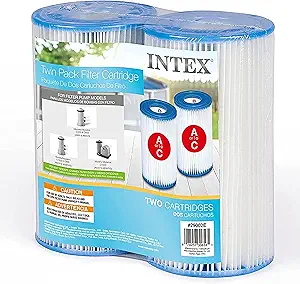
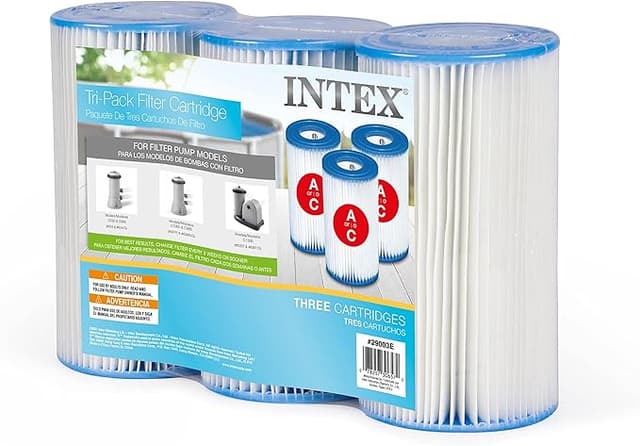
Here's the math that actually moved me. A genuine Intex Type A cartridge runs about $13 each if you buy a single, and the official 2-pack lands around $25 — so call it $12-13 a filter. The compatible Type A I've been running comes in a 3-pack for roughly $20, which is about $7 a cartridge. On a pool that's open from May through September, I go through one filter every two to three weeks if I'm rinsing them between swaps. That's somewhere around 8 to 10 cartridges a season.
Do that on OEM and you're spending $100-130 a year on filters alone. Do it on the compatible ones and you're closer to $60-70. That's a $50-ish gap, every single summer, for a part that gets thrown away by design. I'm not precious about a disposable cartridge. I switched and never looked back.
Does it actually fit the housing?
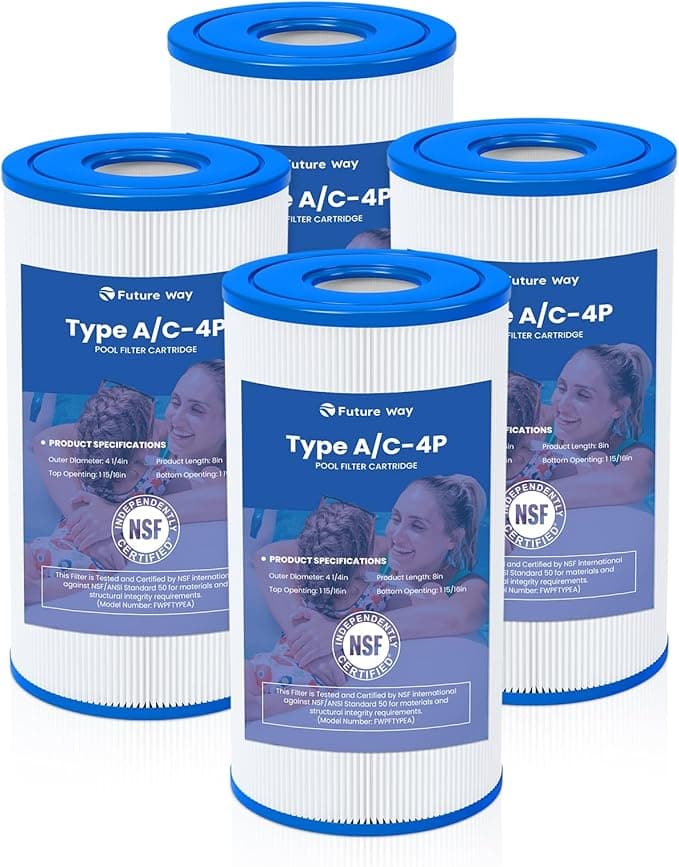
This is the part everyone's nervous about, and fair enough — a filter that doesn't seat is worse than no filter, because water just bypasses it. I'll tell you straight: the compatible Type A I use drops into my Intex housing and seats clean. The center hole slides over the post, the lid threads on, no shimming, no swearing. Type A is a standardized size — about 8 inches tall, 4.25 across — and the third-party makers hit it.
That said — and this is a real thing, not a throwaway — the molded plastic end caps on the compatible ones are a hair thinner than Intex's. On a couple cartridges out of a 3-pack, the top cap had the tiniest bit of play, like an eighth of an inch of wobble before the lid clamped it down. Once the lid's on and torqued, it's locked and it doesn't leak or bypass. But I noticed it. If you're the kind of person who's going to lie awake over an eighth-inch of wobble that disappears the moment you close the housing, that's worth knowing going in.
One install note from doing this dozens of times now: kill the pump first. Every time. Turn it off, let the flow stop, then open the lid — usually a counterclockwise twist on the Intex housings. If you crack it under pressure you'll get a faceful of pool water and a wet driveway. Pull the old cartridge, glance at the gasket on the lid to make sure it's still seated and not pinched, drop the new one straight down over the post, and thread the lid back on hand-tight. Prime it, restart, watch for a few seconds. Done in under three minutes once you've got the rhythm.
How it actually performs against OEM
Filtration-wise, I genuinely can't tell the difference in the water. The pleated polyester on the compatible cartridge grabs the same fine stuff — pollen, body oils, the fine silt that blows in — and my water clears up just as fast after a vacuum or a heavy swim weekend. I've run a turbidity check the lazy way, by dropping a coin to the bottom and seeing if I can read the date, and the compatible filters keep it readable.
Where it's a touch behind: lifespan. My honest read after two full seasons is that the compatible cartridges load up and need swapping maybe a few days sooner than a genuine Intex one. The pleat pack is a little less dense, so it does its job well but fills up a bit quicker under the same load. At $7 versus $13 a filter, I do not care even slightly. I'd rather swap a $7 part a couple days early than nurse a $13 one.
The downsides, said plainly
Let me give you more than one, because a review with only good news is a sales pitch.
- Packaging is cheap. Mine showed up in a thin plastic sleeve, no individual wrap. One cartridge had a slightly crushed pleat from shipping. It puffed back out fine once it got wet, but it looked rough out of the bag.
- That first-day plastic smell. Brand new, fresh out of the sleeve, there's a faint chemical-plastic odor on the end caps. It's gone after the first day of circulation — the water flushes it — but if you sniff a new one you'll catch it.
- Pleat consistency varies. Across a 3-pack, the pleat spacing wasn't perfectly even on every cartridge. Doesn't hurt function in my experience, but it's the kind of thing that tells you you're not holding the premium part.
- Thinner end caps. Back to the wobble — it's fine clamped down, but it's the clearest "this is the cheaper one" tell.
Why none of this is worth ignoring the filter
I want to circle back to that cloudy-Saturday story, because the real risk here isn't the brand of cartridge — it's running a dead one too long either way. A saturated filter doesn't just stop cleaning; it becomes a place where bacteria and algae set up shop, and it chokes your pump so the motor works harder for worse circulation. That's how you go from a clear pool to a green one in three days, and how a $200 pump dies early. The cheap insurance against all of that is having spares on the shelf so you actually swap on schedule instead of stretching a filter two weeks past its limit because you don't have a backup. That's the quiet argument for the 3-pack: you're more likely to change it when you should.
The verdict — who buys what
If you've got a small Intex unit you babied all season, you swap maybe four times a year, and the idea of an eighth-inch of end-cap wobble genuinely bothers you — buy the genuine Intex Type A. The tighter build and slightly longer life will feel worth the extra $6 a cartridge to you, and that's a legitimate choice.
For everyone else — anyone running a pool all summer, going through 8 or 10 cartridges, and looking at a $50-plus annual gap for a part that ends up in the trash — I grab the compatible Type A, and I've been grabbing it for two seasons now. It fits, the water's just as clear, and the only real cost is a cheap bag and a thinner end cap I forget about the second the lid clicks shut. For half the price, doing the same job in my pool, I'd buy it again. I already have, twice.