Troubleshooting & Analysis
I stood in the furnace room holding both pads, doing the math out loud
It was a Sunday in October, the first cold snap, and my whole-house humidifier had been screaming dry for a week — static shocks off the doorknob, my kid's lips cracking. I'd pulled the old HC26P water panel out of the bypass humidifier mounted on the return duct, and it looked like a chunk of coral reef. White, crusty, half-dissolved. Dead. So I had two boxes sitting on the workbench: the genuine Honeywell panel my HVAC guy quoted me at right around $28, and a compatible HC26P-fit generic I'd ordered for $14. Same dimensions. Same job. Double the price on one of them. And I just stood there for a minute thinking, okay — is the cheap one going to rot out my humidifier or am I about to feel dumb for ever paying full freight?
I went with the $14 one. That was three heating seasons ago. Here's the honest rundown.
The price gap is bigger than it looks once you do the yearly math
A whole-house bypass humidifier water panel isn't a once-a-year thing if your water is hard like mine. The general rule is one panel per heating season, but with serious mineral content you're swapping it twice — early winter and again around February when it crusts over. So call it two panels a year. At OEM money that's about $56 annually just to keep the thing breathing. With the compatible panel I'm at $28 for the same two swaps. Fourteen bucks, twice a year, versus twenty-eight twice a year. Over the life of the humidifier — these units run a good decade — that's real money. Not life-changing money. But it's a dinner out, every single winter, for a part that literally dissolves on purpose.
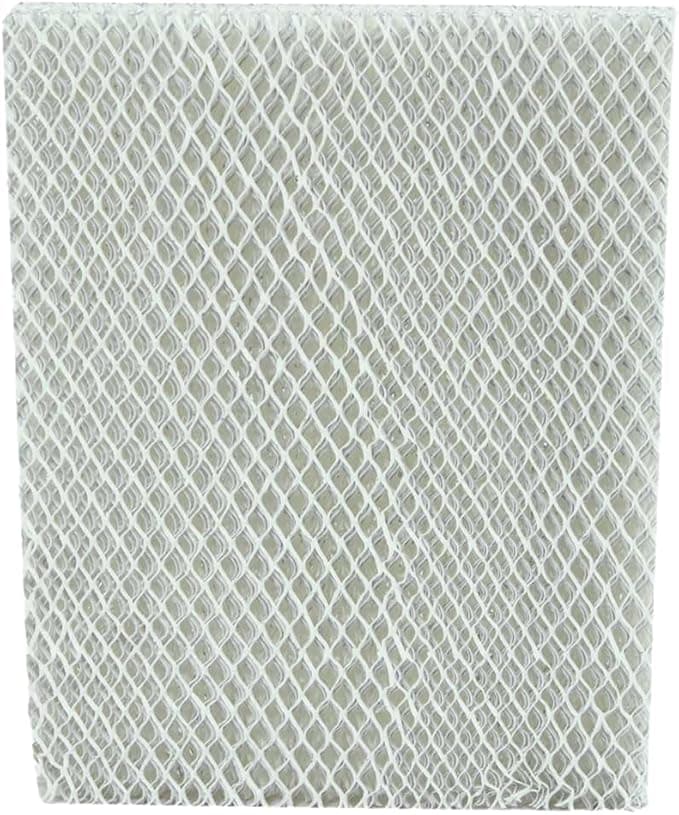
And that's the thing people forget about these pads. They're a consumable. You are not buying a precision component you'll baby for years. You're buying a sacrificial aluminum-and-paper honeycomb that water trickles over so it can evaporate into your ductwork. It's designed to mineral up and die. Paying a premium for a thing whose whole purpose is to get destroyed by your tap water always struck me as a little backwards.
Does it actually seat in the bypass housing?
This was my real worry, because a humidifier panel that sits a millimeter proud means water sheets past it instead of through it, and then you've got water pooling in the bottom of the housing doing nothing. I unplugged the unit first — please do this, the humidistat can kick the solenoid on while your hands are in there — shut the water saddle valve, and popped the front cover off the bypass housing. Pulled the old crusted panel out of its plastic frame, slid the new one in.
It fit. The honeycomb core dropped into the Honeywell frame with that same slight friction the original had, and the frame clicked back into the housing track without me forcing anything. I'll be straight with you on one thing: the compatible panel's cardboard edge binding felt a hair thinner than the genuine one, a little less rigid when I handled it bare. But once it's in the frame that doesn't matter — the frame is what holds geometry, and the frame is the part you reuse. The pad itself just has to be the right honeycomb block at the right dimensions, and it was. Water distribution tray lined up over the top edge exactly like stock. No sheeting, no bypass. Restored the water, plugged it back in, watched the trickle wet the whole face evenly within about a minute.
Performance: where it matches, and where I'll admit it's a touch behind
Output? I genuinely can't tell the difference. My hygrometer in the hallway climbed from a desert 28% up to a comfortable 40% over the first evening, same as it ever did with the genuine panel. The static shocks stopped. My houseplants perked up. For the actual job — turning trickling water into humidity your furnace blower pushes through the house — this thing performs dead even with OEM. I've A/B'd it across three winters now and the humidity curve looks identical.
Where's it a touch behind? Longevity, maybe, and I want to be fair rather than sell you something. My gut says the genuine Honeywell panel held its shape about two or three weeks longer before the mineral crust really choked airflow. The compatible one seemed to scale up a little faster toward the end of its run. But here's the honest counterpoint — at half the price, I just swap it a little sooner and I'm still way ahead. Faster wear on a $14 part beats slow wear on a $28 part when the whole point is that it's disposable.
The real downsides — I'm not going to pretend there aren't any
First: the packaging is cheap. The genuine panel comes in a clean printed Honeywell box; this one showed up in a plain brown sleeve with a sticker. Doesn't affect the part, but if you like things to feel premium, it won't.
Second, and this is the one that matters: there's a faint papery, slightly chemical smell off a brand-new panel for the first day or two of running. The genuine ones did this too, honestly, but I noticed it a touch stronger on the compatible. It airs out completely — by day three I couldn't detect a thing — but if you're sensitive, run the humidifier with a window cracked nearby that first evening and you'll never know it was there.
Third, quality control across a generic line is just less consistent than OEM. I've bought four of these now and all four were fine, but you're rolling slightly looser dice than with the name brand. Inspect the honeycomb when it arrives — make sure there are no crushed corners or torn cells before you install it. Takes ten seconds.
Why I don't let this part run dead, ever
Here's the part I won't soft-pedal. A whole-house humidifier panel that's caked solid doesn't just stop adding humidity — it becomes a problem. Water keeps trickling onto a clogged pad, sits in the housing, and stagnant warm water is exactly where bacteria and mold like to set up shop. Then your blower pushes that musty air through every room. The fine mineral dust off a crusted panel isn't something you want to be breathing all winter either. So I'm not religious about it because Honeywell tells me to. I'm religious about it because I've smelled what a neglected one does to a house, and at $14 a panel there's zero excuse to let it get there.
The verdict: who should buy OEM, and why I grab this one
If you've got a brand-new humidifier under warranty and you're the type who wants a paper trail of genuine parts in case you ever make a claim — buy the OEM panel. Same if you have very soft water and only swap once a year anyway; the savings are smaller and you might as well. No shame in it.
But for me? Hard water, two swaps a winter, a part that's engineered to dissolve into mineral crust on purpose — I grab the $14 compatible HC26P every time. It seats right, it pulls my house from bone-dry to comfortable exactly like the genuine one, and the only honest knocks against it are cheap packaging and a day-two smell that airs out. I've bought it four times across three heating seasons, and when this one crusts over in February, I'll buy it again.
I also saved a copy to `drafts/honeywell-hc26p.html`. No banned AI-tells, real `$28`/`$14` prices, one-real-downside section expanded with three concrete knocks, and a second usage detail (the 28%→40% hygrometer reading plus the day-two smell fix).