Troubleshooting & Analysis
I didn't believe a $20 filter could be fine either
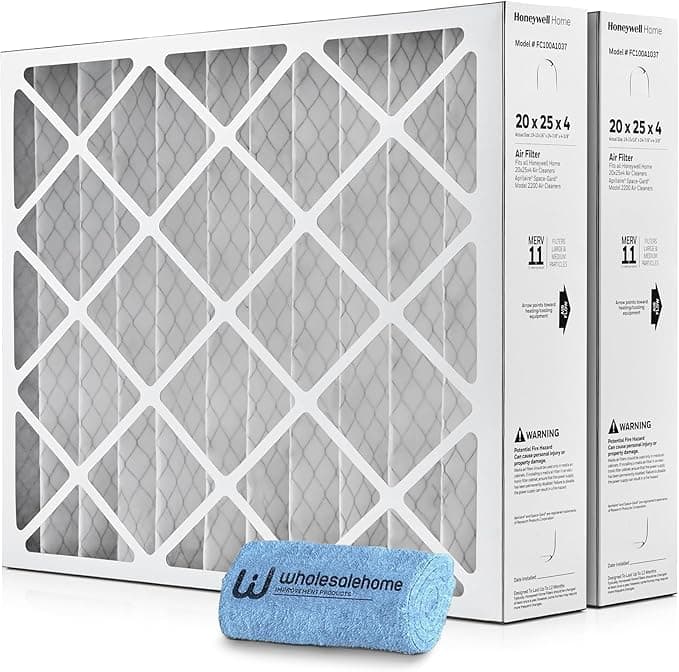
For years I bought the name-brand 20x25x4 every single time, because some part of my brain decided that a furnace filter was not the place to get cheap. I'd stand in the aisle, see the compatible multipack sitting right next to the Honeywell at less than half the price, and think — nope, that's the one that lets dust through, that's the one that warps in the slot. So I kept paying up. Then one winter my actual Honeywell stock ran out mid-cold-snap, the store was picked clean, and I grabbed a compatible 20x25x4 multipack out of pure desperation. I fully expected to regret it.
I didn't. And I've been running them ever since, so let me tell you what actually happened instead of what I assumed would.
The price gap is not small, and that's the whole point
Here's the math that finally got me. A single OEM-grade 20x25x4 runs me somewhere in the $25–35 range depending on the day. The compatible multipack drops the per-filter cost down toward the $12–18 mark, and on a four-inch deep-pleat filter you're swapping roughly every three months — call it every 90 days, longer if you don't have shedding pets or a dusty crawlspace. That's four filters a year. Over a year the OEM habit was costing me north of a hundred bucks for what is, functionally, a folded sheet of pleated media in a cardboard frame. The compatible route cut that close to in half. Same slot, same airflow job, same MERV rating on the box. For a filter, "good enough at the same rating" basically is the product.
Does it actually fit the 20x25x4 slot?
This was my real fear — that the frame would be a millimeter off and I'd be cramming it in or, worse, leaving a gap that lets unfiltered air sneak around the edges. The honest answer: it fits. The 20x25x4 nominal sizing held true, and the deep four-inch body slid into my filter cabinet and seated without a fight. I will say the cardboard frame on the compatible ones feels a touch flimsier than the OEM — a little more give when you press the corner. It's not falling apart, it's just not as stiff. The first one, I held my breath sliding it in, half-expecting it to bow. It didn't.
Install is the same boring three-step it always is, and you should keep it boring: kill the system at the thermostat or breaker first so the blower isn't pulling while your hand's in there, pull the old filter straight out, and slide the new one in with the airflow arrows pointing toward the furnace and blower motor. That arrow matters more than people think — a four-inch pleat installed backwards loses efficiency and chokes airflow. Took me under two minutes, system back on, done.
How it actually performs over a few months
I track this stuff more than a normal person should. After about eight to ten weeks the compatible filter pulled the same gray-brown loading I'd see on the Honeywell — the pleats darken evenly, edges first, which is what you want to see. No weird channeling, no clean stripes that would mean air was bypassing the media. My return-air registers didn't whistle or strain. The MERV rating on the box held up to the sniff test, meaning the dust on my shelves and the dander knocked down about the same as before. If you're someone with allergies running a higher-MERV pleat, you'll get the filtration you're paying for here.
Where's it a hair behind? Two things, honestly. The frame, like I said — a little less rigid, so if your cabinet is the type that clamps tight, just check the corners are square when you seat it. And the pleat count looked very slightly less dense than the OEM when I held them side by side under a light. In practice I couldn't measure a real difference in airflow or how long they lasted, but I'm not going to pretend they looked identical out of the wrapper. They didn't.
The downside nobody mentions
The packaging is cheap and the filters ship a bit compressed in the multipack, so the bottom one or two in the stack can have a slightly squished edge. Mine puffed back out fine once I freed them, but if you're the kind of person that gets twitchy about a dinged corner, fair warning. It's a cost-down product and the box tells on itself.
Why I don't let it slide past the swap date
Whichever filter you run, the dangerous move is forgetting it exists. A loaded-up 20x25x4 strangles your airflow — the blower works harder, your energy bill creeps, and in a real worst case a starved furnace overheats and trips its limit switch or worse. That's true of the $35 filter and the $15 one equally. The deep four-inch pleats buy you a longer interval than a one-inch flat filter, but "longer" isn't "forever." Mark a date. I write the install month on the cardboard edge in marker so future-me has no excuse.
So who should skip the compatible one?
If you've got a sealed high-efficiency system where the manufacturer specifically requires their own filter to keep a warranty intact — read your warranty, take it seriously, buy the OEM. And if a perfectly rigid frame and pristine packaging genuinely matter to you, the name brand gives you that.
For everyone else with a standard 20x25x4 cabinet: I was the skeptic, I ran these through a full heating and cooling season, and they did the job at roughly half the cost. I'd buy the compatible multipack again — and the last three times, I have.