Troubleshooting & Analysis
The day my V11 just... gave up mid-vacuum
I was halfway across the living room rug when the suction dropped off a cliff. Not gradually — it just sagged, like the motor was sucking through a wet sock. Then the thing got warm in my hand, warmer than it should, and the run-time light started doing that nervous flicker. I knew before I even popped the bin open. The filter. I'd been "meaning to wash it" for, oh, three months at that point.
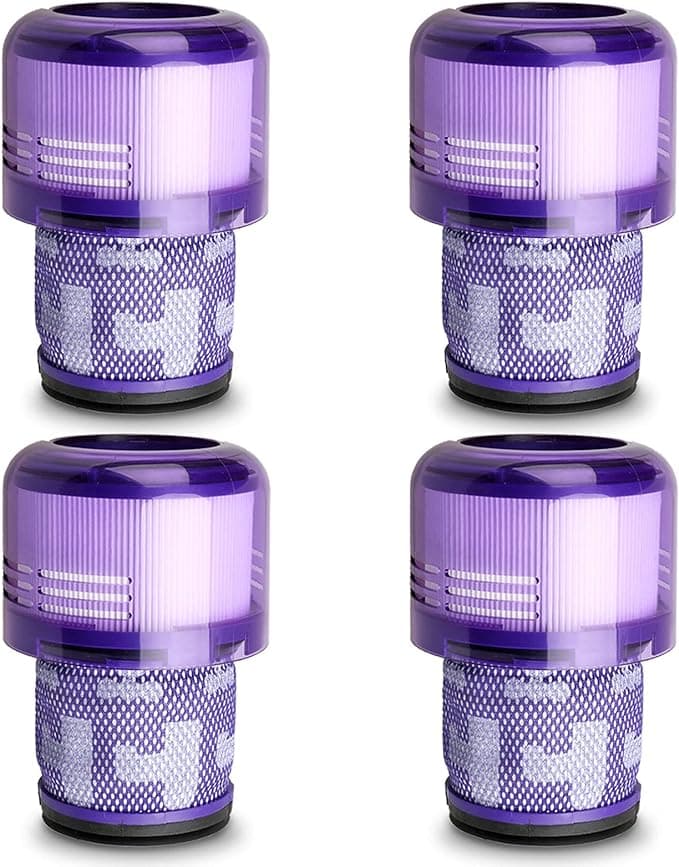
I pulled it out and it was gray-brown and packed solid. The pleats you're supposed to be able to see between? Gone. It was basically a felt disc of dog hair and drywall dust. That clogged filter wasn't just costing me suction — it was making the motor work overtime to pull air through a wall, and an overworked Dyson motor is exactly how you end up shopping for a whole new vacuum instead of a $15 part.
So why was I about to pay Dyson $35 for a replacement?
Here's where I got annoyed. A genuine Dyson V11 filter runs around $30 to $35 depending on where you catch it. For a washable piece of foam-and-pleated-media in a purple plastic cap. I've owned the vacuum for years and that little disc costs almost as much as a decent corded handheld used to. The compatible ones? I was looking at roughly $13 to $18 for a single, and I've seen two-packs land under $25.
Do that math over the life of the machine. If you actually replace on schedule — and most people don't, which is how we got here — you're looking at one a year, maybe more if you've got pets or a renovation going. Over five years that's the difference between spending $175 with Dyson or about $70 going aftermarket. That's a real dinner out. Several, actually.
I'd held off on the cheap ones for the usual nervous reason: it's a Dyson, the tolerances feel precise, and I didn't want some loose knockoff letting unfiltered air blow past the seal and back into the motor. That's the actual fear, right? Not "will it fit" but "will it quietly ruin the expensive part."
Putting it in — does it actually seat?
The install on a V11 is genuinely a 20-second job, OEM or not. Twist the filter unit off the back top of the wand, the purple cap, and the new one drops into the same threaded mount. On the compatible filter I bought, the cap clicked and turned to the stop the same way the original did. No cross-threading, no gap where the cap meets the body.
I'll be straight about the one thing I noticed: the plastic on the aftermarket cap is a hair less premium. The original has this dense, slightly soft-touch feel; the compatible one is a little more hollow, a touch more "toy." It seats fully and locks, but if you're the kind of person who notices these things, you'll notice. Did it affect the seal? I checked by running my hand around the seam with the unit on — no air leaking where it shouldn't. So, cosmetic gripe, not a functional one.
One real tip, and this is true for the OEM too: if you wash it (these are the rinsable type), you have to let it dry completely. Like 24 hours, cap-side up, not "eh it feels mostly dry." I got impatient once and ran a damp one — the suction was garbage and I panicked thinking I'd bought a dud. It was just water in the media. Bone dry, it was fine.
How it actually cleans
This is the part that matters and the part I was most skeptical about. After a full dry and re-seat, suction came back to what I'd call honest-V11 — that satisfying grab where the head practically pulls itself across a low-pile rug. I ran it through my normal weekly circuit: hardwood, a wool rug, the stairs, the car. Fine particulate is the real test, the flour-and-dust stuff that proves the filter media is doing its job and not just passing it through. No gray haze blowing out the back, no dusty smell in the exhaust.
Where's it a touch behind OEM? Honestly, after about four months of use, I think the genuine media holds its loft slightly longer between washes — the compatible one seemed to load up and need a rinse a week or two sooner. Small. But if you're someone who never washes the filter (be honest), that shorter interval matters, because a filter you ignore is a filter that clogs, and we already covered how that movie ends.
The honest downsides, in one place
- Cap plastic feels cheaper. Cosmetic, but real.
- Seemed to need washing slightly more often than the original.
- Packaging is bare-bones — mine came in a thin box, no instructions. You don't need them, but it tells you where the savings come from.
Who should just buy the Dyson — and who shouldn't
If your V11 is brand new and still under warranty, and you're the type who'd blame an aftermarket part for any hiccup, buy the genuine one and don't think about it. Same if you have a respiratory thing where you want the documented capture spec on paper. That's a fair reason to pay up.
For everyone else — me included — I keep grabbing the compatible filter. It fits, it seals, it brings the suction back, and it does the actual job a V11 filter is there to do for less than half the money. I've now bought it twice. The first one's still in rotation. For the price gap, on a part you rinse and reuse anyway, I'd rather keep the cash and just stay on top of washing the thing. Which, after that mid-rug death, I finally do.