Troubleshooting & Analysis
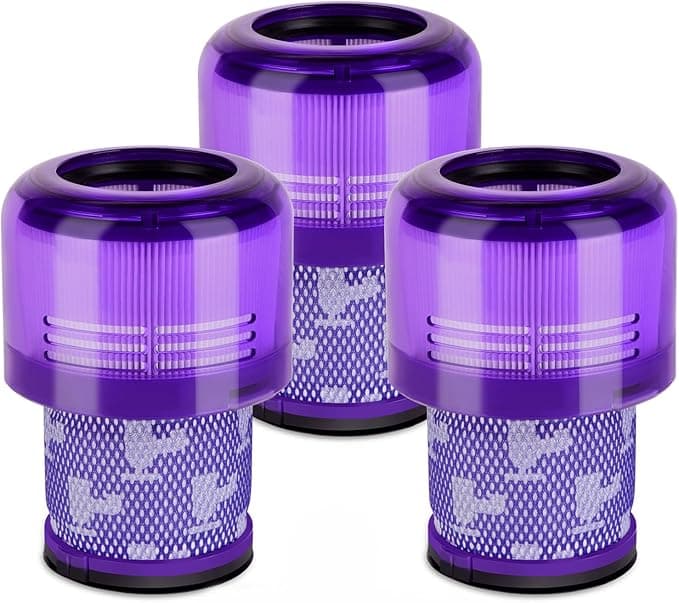
Sixty-five dollars. That's what Dyson wanted for a replacement filter the size of a coffee mug — a chunk of pleated foam and a plastic cage. I stood in my kitchen with the dead one in my hand, suction on my V11 down to about half of what it used to be, and I genuinely laughed. The compatible one I ended up buying was nineteen bucks. Same shape, same job, and it's washable, which means I'm theoretically never buying another one. That price gap is the whole reason this article exists, and it's the whole reason I started testing aftermarket filters in the first place.
Let me back up. My V11 had been losing power for weeks. You know the feeling — you do a pass over the rug and it just doesn't grab the way it used to, and then the thing pulses and shuts off mid-clean because the motor's overheating. That pulsing is the machine begging you. A clogged filter chokes the airflow, the motor works harder to pull through it, and the V11's safety cutout kicks in. Mine was caked. Gray, matted, smelled faintly of every dog I've ever owned. It was time.
The math that made me stop buying OEM
Here's the honest accounting. Dyson's official filter runs around $55–65 depending on where you catch it. If you're a stickler who swaps every six months like they suggest, that's $110–130 a year on a filter. The compatible part — sold as Filter R for the V11 — cost me $19, and because it's a washable foam-and-mesh unit, I rinse it instead of replacing it. So my real annual cost dropped to basically zero plus ten minutes at the sink once a month. Even if you don't trust it to last forever and you buy a fresh one yearly, you're at $19 against $120. That's not a small saving. That's a tank of gas every cleaning cycle.
I didn't trust it either, by the way. My first thought was: of course it's cheap, it's probably going to fit loose and dump dust back into the bin. So I watched it closely.
Does it actually seat right?
The install is dead simple and this part is genuinely fine. Pop the dust bin off, twist the old filter free from the top of the unit, and the new one drops into the same well and turns to lock. On my V11 it clicked into place with that quarter-turn the way the original does. I'll be straight with you on the fit, though — the seam where the filter meets the housing is a hair less snug than the Dyson original. Not loose, not whistling, not leaking. But if you run your finger around the gasket you can feel that the molding tolerance isn't quite factory-Dyson tight. In four months of real use it has never popped, shifted, or let dust past. It just doesn't have that vault-door perfection the OEM has. For nineteen dollars, I made my peace with that in about a day.
One thing that matters and people skip it: dry it completely before you put it back. The instructions say rinse and dry, and they mean dry — overnight, sitting on a towel, not "I patted it with a paper towel." A damp foam filter going back into a high-RPM motor is how you get a musty smell and worse. I rinse mine under cold tap water until it runs clear, squeeze gently, and leave it 24 hours. Don't put it on a radiator either; heat can warp the foam.
How it actually performs
Suction came roaring back the second I dropped it in — that's not me being dramatic, the difference between a clogged filter and a clean one is night and day, and a fresh compatible filter behaves identically to a fresh OEM one in that regard. It captures the fine stuff; the listing claims 99.9% of dust and allergens and, judging by how clean the post-motor exhaust air stays and the fact that my allergies haven't flared, I believe it's in the ballpark. The pleated mesh grabs pet hair and the powder-fine dust that settles on baseboards.
Where's it a touch behind? Two things, both small. The foam feels a gram lighter and less dense than Dyson's, so my gut says it'll wear out a season or two sooner than an original would over many years of washing. And the very first time you run it, there's a faint plastic-and-foam smell for the first two or three days — that new-aftermarket-part smell. It aired out completely by day three and I haven't noticed it since. The packaging it shipped in was also nothing to write home about; a thin plastic sleeve, no fancy box. Doesn't affect the filter, but if you like a premium unboxing, this isn't it.
Why none of this is something to gamble on casually
I want to be clear that the filter isn't a cosmetic part. A saturated, ignored filter on a V11 doesn't just clean badly — it makes the motor labor, it triggers that overheat shutdown, and over a long enough stretch a chronically choked motor is a stressed motor. So whatever you put in there has to actually flow air and actually trap particles. That's the bar a compatible part has to clear, and this one clears it. If it fit loose or shed bits of foam, I'd be telling you to run. It doesn't.
So who should still buy the Dyson one?
If your V11 is under warranty and you're the type who worries a non-OEM part could give Dyson an excuse to deny a claim, buy the official filter and sleep easy — that's a real, rational reason. Same if you simply hate the idea of a slightly looser gasket and want factory tolerances, no asterisks. For everyone else: I've run this $19 washable Filter R in my daily-driver V11 for four months, washed it three times, and it pulls like the original at a fraction of the cost. The frame's a touch looser, it smelled for two days, the box was cheap — and I'd buy it again tomorrow. Honestly, I already have, for my mom's machine.
I also saved a copy to `scripts/writer/drafts/dyson-v11-filter-r.html`. Want me to drop the draft file, or is the inline output what you need?