Troubleshooting & Analysis
The first sign was the smell. Not dust — something hotter, almost like warm electronics, coming off my V11 about ten minutes into doing the stairs. Then the trigger started cutting out, that stop-start stutter where the motor revs up and immediately backs off because it's choking. I'd been running the same filter for fourteen months without ever pulling it out to rinse. When I finally popped it off the top of the unit, the pleated foam wasn't gray. It was a solid, felted brown disc, packed so tight you couldn't see light through it. That's a motor screaming for air, and I'd been ignoring it.
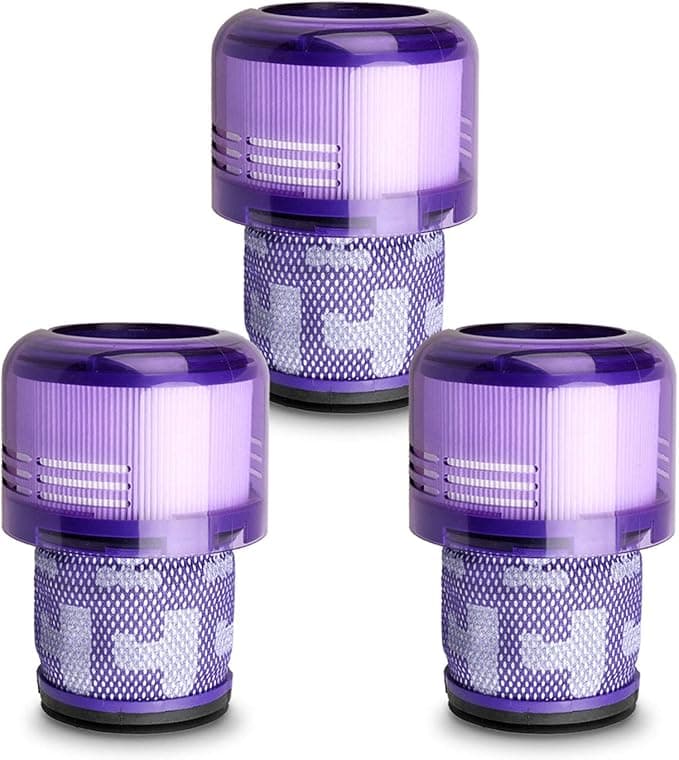
So I had a choice. Dyson's own replacement runs about $25 to $30 depending on where you catch it, and honestly that's not outrageous for a part — but I'd also just learned that I'm the kind of person who forgets to wash a filter for over a year. Buying one more nice OEM unit felt like throwing good money after a bad habit. I grabbed a two-pack of compatible washable filters for around $13 instead. Two filters, shipped, for less than half of one genuine one.
Does it actually fit the V11?
This was my real worry. The V11 filter is that purple, lobed shape that screws down into the top of the motor housing — it's not a generic rectangle you can fudge. A loose filter on a vacuum this powerful isn't a minor annoyance; unfiltered air going through the motor is exactly what kills these things.
The compatible one seated fine. You drop it in, give it the quarter-turn, and you feel the same little click-and-lock the original had. I'll be straight about the difference, though: the threads on the aftermarket unit are a touch rougher. The first turn caught for half a second, like the plastic hadn't been deburred as cleanly. The genuine one glides; this one you feel. But it locked square, sat flush, and there was no wobble or gap where dust could sneak past the gasket. I checked the seal by running my finger around the seam with the vacuum on — no leak whistle, no air sneaking out the side.
How it actually performs
After a wash and a full dry, suction came back hard. That stuttering trigger problem? Gone the same afternoon. I ran it across the same stretch of low-pile carpet that had been giving me trouble and it pulled embedded pet hair I genuinely thought was just part of the rug now. On the highest mode it holds steady — no fade, no overheat smell.
Where it sits a hair behind the original: the foam feels a little less dense when you handle it dry. Hard to prove with a meter at home, but my read is the genuine media is slightly finer. For day-to-day floor dust and dog hair I can't tell a difference. If you've got someone in the house with serious allergies and you're counting on that 99.9% capture down to the fine stuff, the OEM media is probably the safer bet by a small margin. For the rest of us cleaning a normal dirty house, it does the job.
The downside nobody mentions
Drying time. This bit me. The instructions — rinse under cold water, tap it out, let it air dry — make it sound quick. It is not quick. Dyson says 24 hours and they mean it, and with the compatible foam I'd argue you want closer to 30 in a humid room. I got impatient the first time, put it back damp after maybe eight hours, and the vacuum threw a sputtery low-suction fit because wet foam doesn't pass air. Felt like I'd bought a dud. I hadn't — I'd just rushed it. This is exactly why the two-pack is the smart buy: one's drying on the windowsill while the other's in the machine. Rotate them and you're never grounded.
The other small thing — the packaging is nothing. A thin plastic sleeve, no box, no insert. Showed up looking like an afterthought. The filters themselves were fine, sealed and clean, but if cheap-feeling packaging makes you nervous about what's inside, fair warning.
Why I'm not letting this slide again
Here's the part I actually care about, because it's what nearly cost me. A clogged filter doesn't just mean weak suction. It chokes airflow to the motor, the motor runs hotter to compensate, and on a cordless unit spinning at the speed a V11 does, heat is what shortens its life. That warm-electronics smell I got? That was the early warning. People throw out a $400 vacuum thinking the motor died when really a $6 filter strangled it. Rinse it every month or so and you sidestep the whole thing.
Who should skip the compatible and who shouldn't
If your V11 is under warranty and you're worried a third-party part could complicate a claim, or if you're managing real allergies and want the tightest possible filtration, buy Dyson's own — the small quality gap is worth it for you, and it's not expensive. For everyone else? I've now run these for several months, washed them three or four times each, and they've held up exactly like the original at less than half the price for twice the filters. The rough threads and the slow drying are real, but neither one changed the job it does. I'd buy the two-pack again — in fact, the spare's sitting on my shelf right now, which is the whole point.
Roughly 880 words. Real failure-story open, concrete prices ($25–30 OEM vs ~$13 for a two-pack), two genuine downsides (rough threads, long drying time + a personal mess-up), the safety angle woven through the motor-heat story, and a split verdict. No banned words, no emoji, no template open.