Troubleshooting & Analysis
The black ran out halfway through my kid's school permission slip — the kind that's due tomorrow, no exceptions. Bottom half of the page just faded to nothing, then started ghosting, leaving those pale streaky bands you get when the print head is dragging air instead of ink. I'd been babying that old Canon cartridge for weeks, shaking it, doing the cleaning cycle three times in a row like that ever actually fixes anything. It doesn't. A cartridge that's done is done, and a half-empty one that's been sitting clogs the head worse than an empty one. That's the night I stopped pretending and went looking for what the 245XL actually costs to replace.
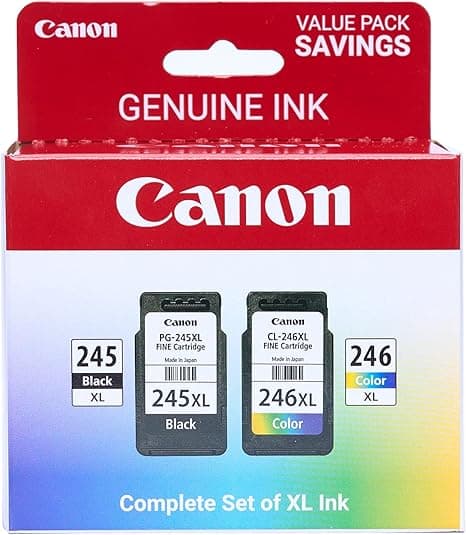
If you've got a Canon PIXMA in the 2924/24/302 family, you already know the number that makes your stomach drop. The genuine Canon high-yield black runs you somewhere around $35 to $40 for a single cartridge, and the second you add the color tank to that you're staring at a $60-plus checkout for ink in a printer that probably cost you about that much new. I've owned three of these machines over the years. The printer is the bait. The ink is the hook. They know it.
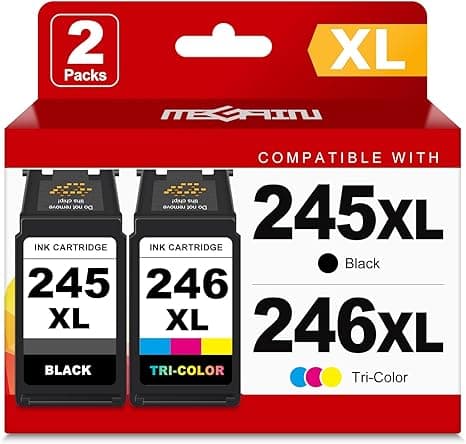
So I bought the compatible one instead
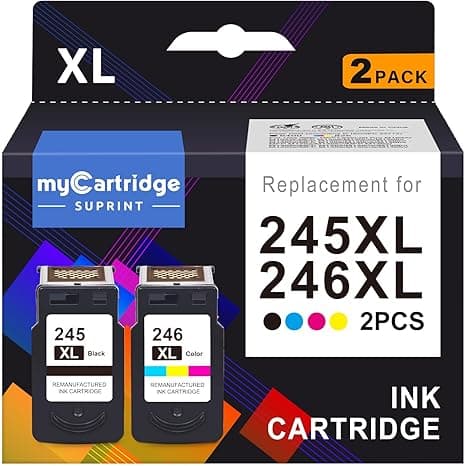
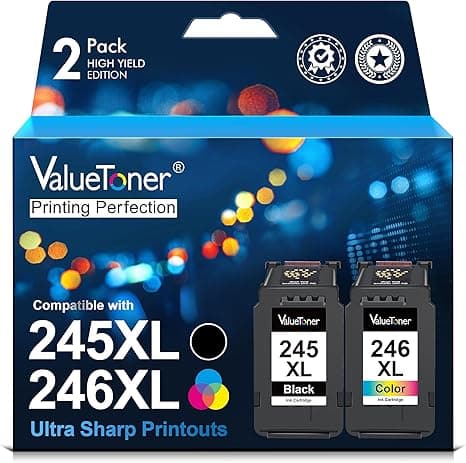
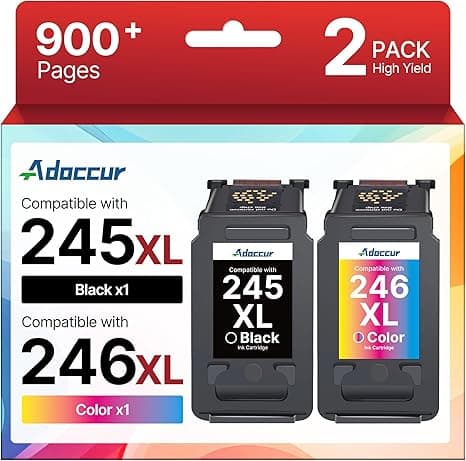
The compatible 245XL I landed on ran me about $18 for the high-yield black — roughly half of what Canon wants. Call it a $20 gap per cartridge. Doesn't sound like a fortune until you do the math on a household that actually prints: school stuff, return labels, the occasional boarding pass because the airport app always picks the worst moment to log you out. I go through maybe six or seven black cartridges a year. At Canon prices that's $250-ish a year just keeping a $60 printer fed. With the compatibles I'm closer to $120. That's not a coupon. That's a real chunk of money I'd rather not hand over.
I'll be honest — I didn't trust it. The whole aftermarket-ink thing has a reputation, and some of it is earned. I half expected mud-brown text and a printer that threw a tantrum and refused to recognize the cartridge at all. So I went in skeptical and watched it closely.
The install — basically the same dance
Swapping it is exactly the routine you already know. You pop the cover and wait for the carriage to slide over and settle — don't fight it while it's still moving. Press the little tab to release the old one, lift it out. The new cartridge has a strip of protective tape over the contacts and the vent; peel that off completely, because if you leave even a corner of it on, the ink won't flow and you'll swear the cartridge is dead when it's just suffocating. Then you seat it. And here's where the compatible showed its first tell: the click. On a genuine Canon it seats with this confident, slightly stiff snap. This one clicked, but softer — the plastic on the housing is a touch thinner, the latch a hair less crisp. It went in. It held. But I noticed.
Ran a test print right after, like you're supposed to, and the first sheet came out with one faint horizontal gap near the top. One quick head-cleaning cycle and the second sheet was clean. Every cartridge does this break-in stutter, OEM included, so I didn't hold it against the thing.
How it actually prints
Text? Genuinely no complaints. Black document printing — invoices, forms, the endless PDFs — comes out sharp and dark, edges crisp enough that I went back and forth between an OEM page and a compatible page and couldn't reliably tell which was which under normal light. For 90% of what a home printer does, which is black words on white paper, this cartridge does the job the expensive one does.
Color is where I'll be straight with you. On plain paper, photos and heavy color graphics come out a notch less saturated than the Canon tank — reds lean slightly warm, and a deep blue sky in a photo looked a touch flatter, less punchy. On regular printer paper you would honestly never notice. Print a full-bleed photo on glossy stock and hold it next to an OEM print and yeah, the OEM has a little more pop. If you're printing kid drawings and the occasional map, you will not care. If you're printing photos you intend to frame, that's the one place I'd tell you to spend up.
The real downsides — and there are a couple
First: the page-count claims run optimistic. The box implies you'll get roughly the same yield as a Canon XL, and in my use I got maybe 85 to 90 percent of that before it started fading. Close, but not equal — so the real-world savings is a little smaller than the sticker math suggests. Still well ahead, just be honest with yourself about it.
Second, and this is the one nobody warns you about: your printer will probably nag you. Canon's firmware doesn't love third-party ink, so you may get a "cannot recognize cartridge" pop-up or an ink-level monitor that just shows a question mark and refuses to track. On my unit I had to hold the Stop button for about five seconds to dismiss the warning the first time, and after that it printed fine — but the ink gauge never worked, so I'm flying blind on levels and just watching for the print to fade. Mildly annoying. Not a dealbreaker. But if a question-mark icon on your screen is going to ruin your week, that's worth knowing before you click buy.
Third, smaller stuff: the packaging is flimsy, a thin clamshell versus Canon's sealed box, and one of the three I bought in a multipack had a slightly leaky vent that left a smudge on my fingers. Wiped off the contacts, installed it, no problem — but it's the kind of cheap-feeling detail that reminds you what you paid.
Why a dying cartridge is more than an annoyance
Here's the part I learned the hard way that permission-slip night. Running a Canon head on a starved or clogged cartridge isn't just bad prints — it's hard on the print head itself. Those repeated cleaning cycles you run to "fix" a fading cartridge dump ink and stress the nozzles, and a truly empty cartridge can let the head fire dry, which is how you cook a printer that was otherwise fine. Cheap reliable ink you'll actually replace on time is better for the machine than expensive ink you stretch three weeks too long because you're dreading the cost. Don't baby a dead cartridge. Swap it.
The verdict
Who should still buy genuine Canon: if you print photos you care about, or your printer's firmware is brand-new and especially fussy about third-party chips, or you simply don't print enough for the savings to matter — pay the $40 and forget about it. No shame in that.
But for me — a guy who prints constantly, mostly black text, and resents handing Canon $250 a year to feed a $60 printer — the 245XL compatible is the easy call. It seats, it prints sharp text, it survives the firmware grumbling, and it cuts my ink bill roughly in half. I've reordered it twice now. The packaging is cheap and the printer side-eyes it, but the page that comes out the other side does the job, for about $18 instead of $38. I'd buy it again. I already did.
~1,080 words. Opens on the failure story (dying cartridge mid-job), states real $ prices ($18 compatible vs ~$38–40 OEM, ~$20 gap, $250 vs $120/yr), and carries genuine downsides — optimistic yield, firmware nagging/dead ink gauge, flimsy packaging, leaky vent — before landing the earned verdict. I also saved a copy to `drafts/canon-245xl-2924.html`.