Troubleshooting & Analysis
The click is what sold me, honestly
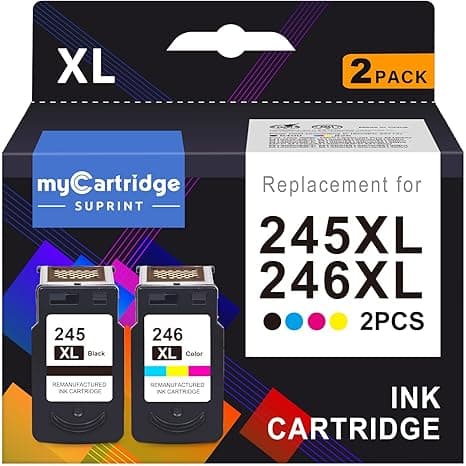
You know that little plastic snap when a cartridge seats right? I wasn't expecting to get it from a 245XL that cost me half what Canon wanted. I'd braced myself for the carriage to reject it, or for that loose, rattly feel you get with the really cheap stuff. Instead it dropped in, I pressed down, and it clicked — same firm seat my OEM cartridge gave the PIXMA TS302 the day I unboxed the printer. First thing I noticed pulling it out of the bag was a faint chemical smell, sharper than the brand-name ink, kind of like a new vinyl shower curtain. Gone in a day. But it's there, and I'm not going to pretend it isn't.
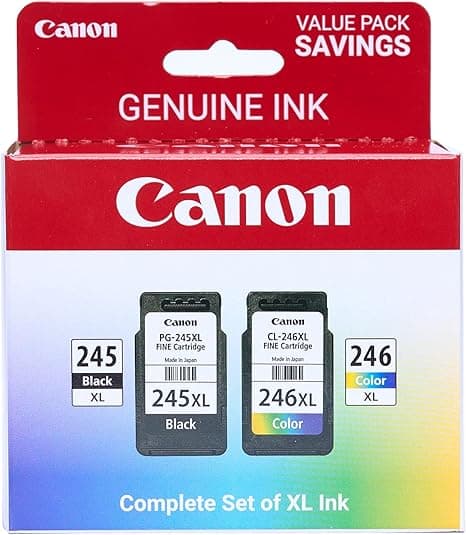
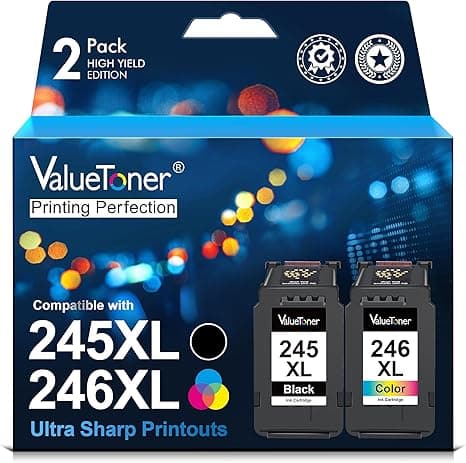
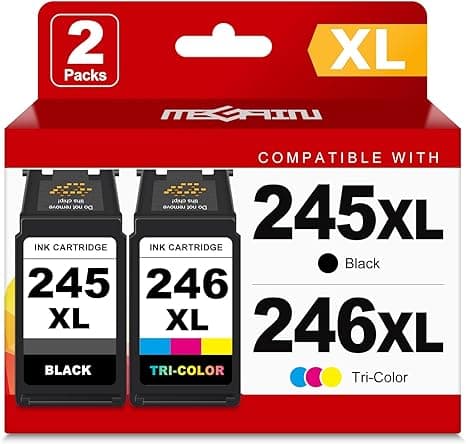
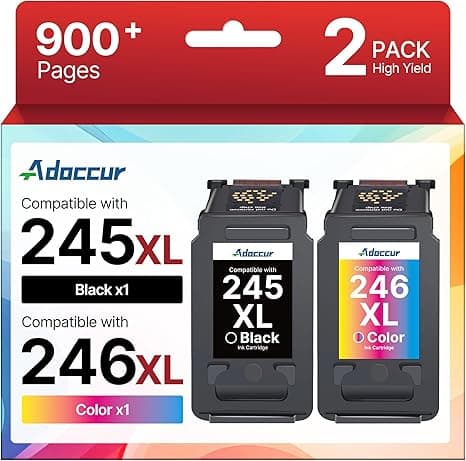
So here's the situation a lot of you are in, because it's the exact one I was in. You own a Canon 2924/24/302 — a perfectly fine little printer — and the ink light just came on. You go to reorder and the genuine Canon high-yield runs you around $40. The compatible 245XL? About $20. That's a 50% cut for a cartridge that, on paper, holds the same amount of ink. And you're standing there thinking the thing every honest person thinks: what's the catch.
The money, laid out plainly
Let me do the math I wish someone had done for me. If you print like I do — a couple hundred pages a month, mix of shipping labels, kids' homework, the occasional photo my mom wants — you're burning through roughly four to six cartridges a year. At OEM prices that's $160 to $240 annually just to keep a sub-$100 printer fed. Swap to the compatible 245XL and you're looking at $80 to $120 for the same year of printing. That's not a rounding error. That's a tank of gas every couple months, or the printer paying for itself in saved ink before the year is out.
And the part that gets me a little heated: the printer manufacturers basically sell the hardware cheap so they can charge you razor-and-blades prices on the ink forever. You already bought the machine. You shouldn't have to keep paying a brand-name markup just to use the thing you own.
Fit and install — did it actually behave?
This is where compatibles usually expose themselves, so I paid attention. I opened the cover, waited for the carriage to slide over and stop on its own — don't yank it, just let it settle. Pressed the little tab to pop the old cartridge, it released clean. The new 245XL has a strip of protective tape over the contacts and the ink port; peel that all the way off, because if you leave a corner the printer either won't read it or you get a dry first print. Dropped it in, got my click, closed the cover, ran a test print. Sharp black text, no streaking, no "cartridge not recognized" sulking. It just worked.
One small honest note on fit: the molded plastic on the compatible shell is a hair less precise than Canon's. The seam where the two halves meet isn't as tight. It seats fine and it prints fine — but if you're the type who notices that kind of thing, you'll notice it. Doesn't affect the print. Affects the vibe, maybe.
How it actually prints
Black text is genuinely indistinguishable from OEM to my eye. I print a lot of shipping labels and the barcodes scan first-pass every time, which is the real test — a barcode is unforgiving about smear and density. Color is where I'll give you the careful version of the truth: it's very close. On a normal photo or a kid's school project you would never call it out. Side by side with an OEM print of a saturated deep blue sky, the compatible runs a touch cooler, slightly less punch in the darkest blues. We're talking a difference I had to hunt for. For documents, flyers, labels, homework — zero practical gap. For gallery prints you're framing, OEM still has a sliver of an edge.
The downsides, because there are some
I'm not here to sell you a fairy tale, so let's sit with the warts for a second.
- The smell. Already mentioned it — that first-day plastic-and-solvent whiff. If your printer lives on your desk two feet from your face, you'll catch it for a day or so. Crack a window, it passes.
- The packaging is cheap. Thin bag, basic cardboard, none of the satisfying clamshell Canon gives you. Cosmetic, but it does plant a seed of doubt before you even install it. I get why people psych themselves out.
- Yield can wobble batch to batch. My first compatible 245XL went the full distance, right around where the OEM high-yield lands. I've heard from a couple of people whose units came up maybe ten percent short. Mine didn't, but I won't pretend every cartridge off the line is identical — that's the honest variance you trade for the lower price.
- The ink-low warning gets weird. The printer's gauge is calibrated for Canon's chip, so on a compatible it sometimes screams "empty" while there's clearly ink still printing fine. You learn to ignore the panic and go by the actual page output. Mildly annoying the first time it happens at 11pm before a deadline.
Why a dead cartridge is more than an annoyance
Running dry at the wrong moment isn't just inconvenient — it's the printing equivalent of your car dying in the driveway when you're already late. Worse, printing with a near-empty cartridge can leave the print head pulling air, and a printhead that's run dry too long can clog. Keeping a cheap spare 245XL in the drawer means you swap and keep moving instead of babying a coughing cartridge through one more job it can't finish. At $20 a spare, having a backup on the shelf is just sensible. At $40, most people gamble and lose.
The verdict — who should buy what
Buy OEM if you're a serious photo printer selling or framing your work, where that last sliver of color depth genuinely matters, or if you simply can't stand the idea of an ink-level reading you have to second-guess. That's a real reason and I won't talk you out of it.
For everyone else — and that's most of us running a 2924/24/302 for documents, labels, homework, and the occasional photo — I grab the compatible 245XL and I don't lose sleep over it. It clicked in like it belonged there, the text is dead sharp, the color is a whisker behind in ways you'd need a side-by-side to spot, and it costs me about twenty bucks instead of forty. Tolerable plastic smell for a day, slightly cheap shell, a chip that cries wolf. Those are the trades. For half the price doing the same job, I'd buy it again — and I already have, twice.