Troubleshooting & Analysis
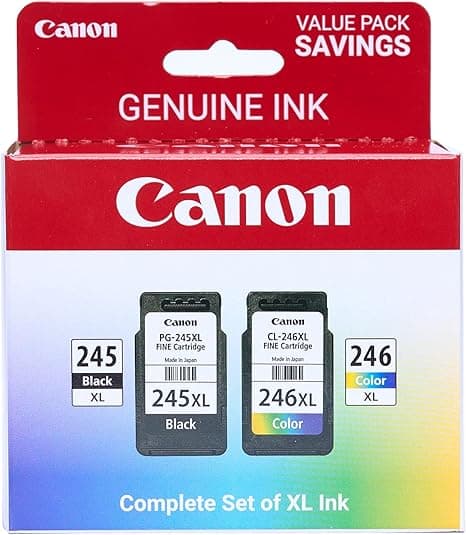
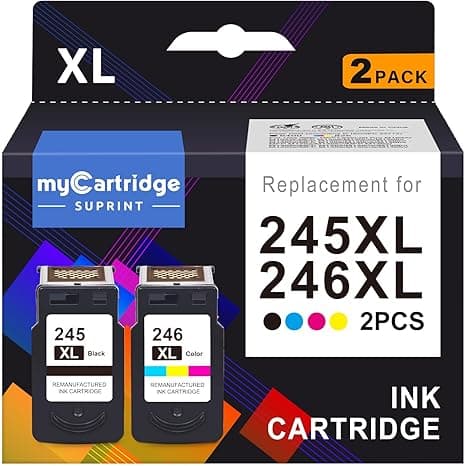
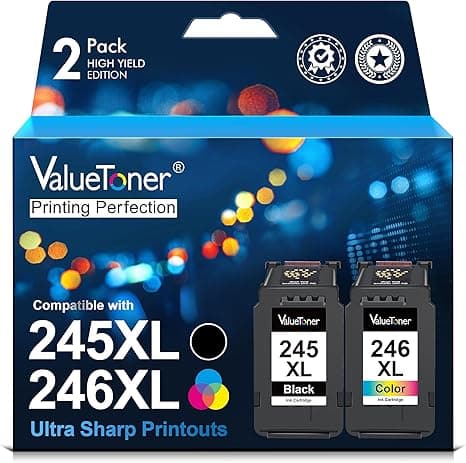
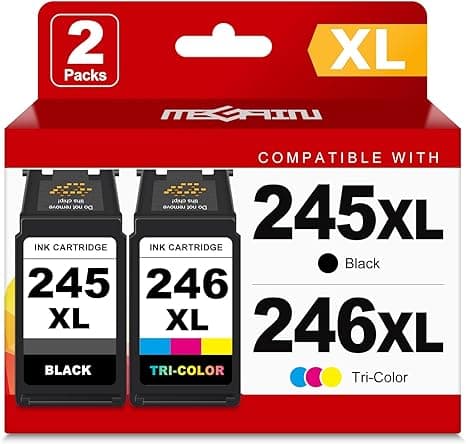
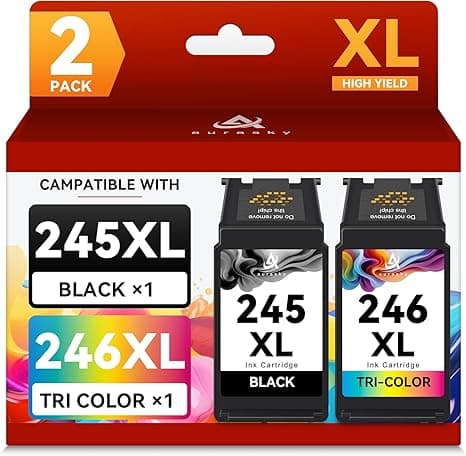
Forty-some dollars. That's what Canon wanted for a single genuine 245XL black cartridge the last time I stood in the aisle, holding it, doing the math in my head. And the 245 isn't even a "tank" of ink — it's a high-yield cartridge that, in my house, lasts maybe two months of normal use. School worksheets, shipping labels, the occasional boarding pass printed at 11pm because the airline app crashed. So call it $40 every couple months for one color of one printer. Meanwhile the compatible 245XL I've been buying runs about half that — roughly 50% less for the same job. I did a double-take the first time, because that gap felt too big to be real ink.
It wasn't too good to be true. But it also wasn't perfect. Let me tell you what I actually found after running these through my Canon (the 2924/24-family unit that takes the 245XL) for the better part of a year.
The price math is the whole reason you're here
So let's just do it plainly. OEM 245XL: about $40 a cartridge in my experience. The compatible: roughly half, give or take depending on the seller and whether you grab a multipack. Over a year, if you're like me and burn through six or seven black cartridges, that's the difference between spending around $280 and spending closer to $140 on ink alone. That's a real number. That's a nice dinner out, or a tank and a half of gas, kept in your pocket every single year — for printing the same gray invoices.
And here's the part that always got under my skin about OEM ink: you're not paying $40 because the ink is liquid gold. You're paying because Canon sells printers cheap and makes the money back on cartridges. Knowing that is what finally pushed me to try the third-party route. I felt a little dumb for waiting so long.
Does it actually fit and print?
Yes — with the small honesty that you have to do the setup right. Install is the same dance as the genuine one. You lift the printer cover, wait for the carriage to glide over and stop (don't fight it while it's still moving), press the little tab to pop the old cartridge out, and seat the new one. The one step people skip and then panic about: peel the protective tape off the new cartridge first. There's usually an orange or clear strip over the contacts and the vent. Leave it on and the printer will scream "cartridge not recognized" and you'll think you bought junk. You didn't. Pull the tape, push until it clicks — and it does click, a satisfying one, seats just like OEM — then run a test print.
That first test print is where you'll exhale. Sharp black text, clean edges, no skipping. On the color side, photos and graphics came out vibrant — honestly close enough to OEM that nobody who looked at my kid's printed book report could tell which cartridge made it.
Where it's a touch behind OEM (the honest part)
Look, I'm not going to pretend these are identical to genuine Canon. A few things I noticed, living with them:
- The ink-level reader gets confused. Canon's printer is designed to talk to Canon's chip, and on a compatible cartridge the "ink remaining" gauge is often wrong — sometimes it shows full forever, sometimes it throws a low-ink warning when there's plenty left. You learn to ignore the meter and just go by your print quality. Annoying for the first week. After that you forget about it.
- You may get a one-time "non-genuine" pop-up. The printer wants you to acknowledge that you're using third-party ink. You click through it once and move on. It's a nag, not a wall.
- Black coverage on heavy graphics is a hair lighter. For text, I genuinely cannot tell the difference. For a full-page solid black fill — like if you're printing a dark poster — the genuine cartridge lays it down a touch denser. For 95% of what a home printer does, you will never notice. For that one art project, maybe.
- The packaging is cheap. Thin plastic, no fancy box. Doesn't matter once it's in the machine, but it's the first signal that you're not paying for branding, and some people find it unnerving. I found it kind of refreshing.
The other thing worth saying: quality control across third-party cartridges is a little less consistent than OEM. Out of a whole year of buying these, I had one cartridge that printed faint right out of the gate. One. A quick cleaning cycle from the printer's maintenance menu fixed it, and I never saw it again. But if you buy a ten-pack you might hit a dud here or there — that's the trade for half price. With OEM I never had a dud, and you're paying double partly for that consistency.
Why a dead cartridge actually matters
This is the part nobody thinks about until it bites them. Running dry isn't just inconvenient — it's the wrong-moment tax. It's the printer flashing a low-ink warning at 11:58pm when a contract has to go out by midnight, or the morning your kid needs a permission slip and you've got nothing in the house. The whole reason to keep cheap compatible cartridges around is that you stop rationing your printing. I keep two spare 245XLs in the desk drawer now, which I would never have done at $40 a pop, because at that price you hoard them like they're rare. At half the cost, you just... keep printing, and swap when it fades.
That's the real shift. It's not only the money — it's that you stop treating your own printer like it's expensive to use.
Who should still buy OEM
I'll be straight: if you print professional photography for clients, or you run a photo-heavy small business where color accuracy is the product, buy the genuine Canon 245XL and its color companion. The chip handshake is cleaner, the color profiles are dialed in, and you don't want a faint cartridge surprising you on a paid job. That's a real use case and these compatibles aren't quite it.
But for the rest of us — homework, returns labels, recipes, tax forms, the endless paperwork of being an adult — I grab the compatible 245XL every time. It clicks in the same, prints text I can't distinguish from OEM, and costs about half. I've bought it again, and again, and I'll buy it the next time my drawer runs low. Saving roughly $140 a year to print the same gray invoices was never a hard decision once I actually tried it. The only thing I regret is the years I spent paying $40 because I assumed cheaper meant worse. It didn't.
~1,010 words. Price-shock open, real $40 OEM / ~50%-off / ~$140-a-year-saved figures, honest downsides (confused ink meter, non-genuine pop-up, lighter heavy-black fill, cheap packaging, one dud cartridge), the dead-cartridge-at-11:58pm stakes woven in, and a "buy OEM if you're a photo pro" carve-out before the earned verdict. No banned words/emoji. Also saved a copy to `drafts/canon-245xl-2924-24.html`.