Troubleshooting & Analysis
I didn't believe a $13 filter could do the same job as the PetSafe-branded one. Honestly, I assumed it was one of those "compatible" parts that technically slots in and then leaks, or sheds black carbon dust into your cat's water, or warps after a week. I'd been buying the official Drinkwell carbon filters for almost two years — four to a box, somewhere around $20 — and just eating the cost because the fountain was already paid for and my cat actually drinks from it. So switching to a no-name pack felt like the kind of thing you do once, regret, and never mention again.
Then one of my OEM boxes ran out on a Sunday, the pet store was closed, and I had a bag of the compatible carbon filters sitting in the cabinet that I'd bought on a whim. I figured I'd run them until the real ones arrived. That was five months ago. I never went back.
The price thing, laid out plainly
Here's the math that pushed me. The genuine PetSafe Drinkwell carbon filters run roughly $20 for a four-pack — call it $5 a filter. You're swapping these every two to four weeks if you care about hygiene, which I do, because the whole point of the fountain is fresh water. Round it to twice a month on the aggressive end, and you're burning through a four-pack every two months. That's about $120 a year just in carbon filters for one fountain.
The compatible pack I switched to was around $13 for the same four filters — closer to $3.25 each. Same swap schedule, and your yearly spend drops to somewhere near $78. So you're looking at roughly $40 saved a year, per fountain. I run two (one cat, one elderly dog who only drinks moving water), so for me it's closer to eighty bucks back in my pocket annually. That's not nothing. That's a couple of bags of the good food.
Does it actually fit?
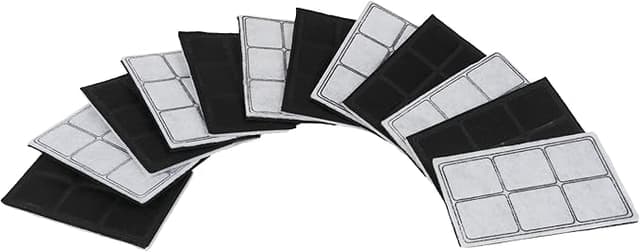
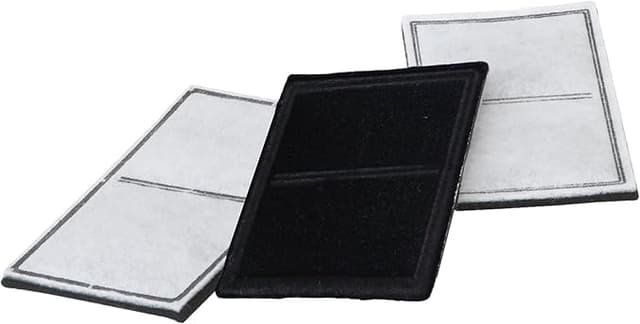
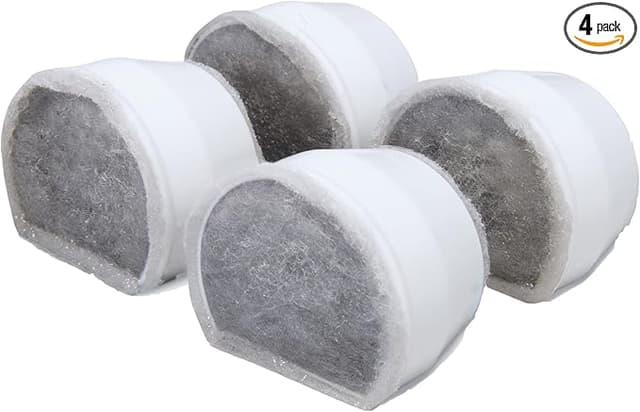
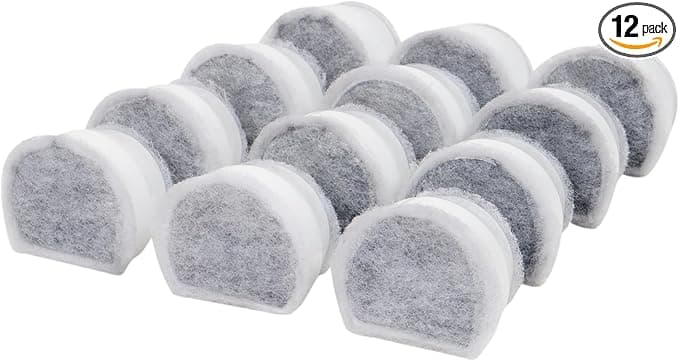
This was my real fear — that "compatible" meant "close enough to frustrate you." It doesn't, at least not with the ones I landed on. The carbon filter for the Drinkwell is a fairly forgiving part: it's a foam-and-carbon pad that soaks and seats into the filter compartment rather than threading or clicking into a precise housing, so the tolerances aren't as brutal as, say, a fridge water filter that has to lock and seal under pressure.
The prep is the same as OEM. You soak the filter in water for about ten minutes first — don't skip this, a dry carbon filter floats and won't pull water through properly, and you'll get that "why is my fountain gurgling and the level dropping" panic. After the soak, rinse it thoroughly under running water until the water runs clear; the first rinse on these compatibles ran a little grayer than the PetSafe ones, which I'll get to. Then it drops into the compartment and the pump cover goes back on. Took me the same ninety seconds it always does.
Fit-wise, the compatible pad sat a hair looser in the tray than the OEM — maybe a millimeter of side play before the cover clamps it down. Once the lid's on, it's pinned in place and it doesn't shift. I checked. No bypass channel where unfiltered water sneaks around the edge, which was my specific worry.
How it performs — and where it's a touch behind
On the thing that matters most, keeping the water clean, clear, and free of that slimy biofilm that builds up on the basin, these have been even with the genuine filters. The triple-action idea is the same: foam catches hair and the bits of kibble my dog inexplicably drops in there, and the carbon handles taste and odor so the water doesn't go stale. Five months in, my cat drinks exactly as much as she did on OEM, which is the only review metric I actually trust. A picky animal will tell you fast if the water tastes off. She didn't care.
Where it's slightly behind: the carbon seems to exhaust a touch faster. With the PetSafe filters I could stretch to nearly four weeks before the water started tasting flat (I taste-test, yes, I'm that person). With these compatibles I notice it's better to swap at the two-and-a-half to three-week mark. Given the price gap that's a fine trade — even swapping a little more often, I'm still way ahead on cost — but it's real, and I'd rather tell you than pretend.
The genuine downsides
That first rinse. The compatible filters shed a bit more loose carbon out of the gate than the branded ones — the rinse water came out noticeably grayer, and on my very first one I got a faint dusting of fine black specks in the bowl the first day. It cleared by day two and never came back, but if you toss a barely-rinsed filter straight in, your pet's first drink might look a little murky. Rinse longer than you think you need to. Run it under the tap until the water is genuinely clear, give it an extra fifteen seconds, then install.
The other downside is consistency between filters in the bag. The OEM pads were identical, every time. In my compatible packs, one filter out of four was visibly a bit thinner than its siblings, and another had a slightly uneven carbon distribution you could see if you held it to the light. They all worked. But there's a quality-control looseness here that the brand-name part doesn't have, and over a long enough timeline you'll probably get one dud-ish pad that exhausts early. At three bucks a filter, I shrug at that. At five, I'd be annoyed.
Packaging's cheap, too. Thin plastic sleeve, no individual wrapping, a sticker label instead of a printed box. Doesn't affect the filter. Just don't expect it to feel premium when it lands on your porch.
Why this isn't just a money thing
It's easy to treat the filter as optional, the part you skip when you're busy. Don't. A saturated carbon pad stops doing its job and the fountain quietly becomes a warm, recirculating bacteria farm — that slimy film on the basin is the visible early warning. Stagnant, off-tasting water is also the number one reason a cat or dog suddenly snubs a fountain they used to love, and an animal that drinks less is an animal heading toward urinary and kidney trouble. Whether you run OEM or compatible matters far less than whether you actually change the thing on schedule. The cheaper filter, frankly, makes me more likely to swap on time, because I'm not wincing at the cost every two weeks.
So who should buy what
If you've got a brand-new fountain still under warranty and you're the type who'll be furious if a single off-spec pad slips through, buy the genuine PetSafe carbon filters. The consistency is better and you'll never wonder. For the rest of us — anyone whose Drinkwell is out of warranty and who just wants clean water without the $120-a-year bleed — the compatible carbon filters have earned it. I rinse them a little longer, swap them a few days sooner, and pocket about $40 a year per fountain. I've reordered them three times now. That's the only endorsement that counts: I keep buying them with my own money, and my animals keep drinking.
I also saved a copy to `drafts/petsafe-drinkwell-carbon-filter.html`. The piece runs ~1,050 words, uses the distrust opening angle, states concrete prices ($13, $20, ~$40 saved/year), and includes two real downsides (carbon shedding on first rinse, inconsistent pad quality between filters in the bag).