Troubleshooting & Analysis
The smell hit me before anything else. I walked into the bedroom after a long weekend away and the air had this damp, gym-bag funk to it — that sweetish mold edge you can't un-smell once you know it. The humidifier was still running. I'd left it on. And the wicking filter inside, the Honeywell-style W/T pad I'd been stretching way past its prime, had gone slimy gray and crusted stiff along the top where the water line sat. It wasn't pulling water up anymore. It was just sitting in the tank growing things.
That's the failure nobody warns you about with these console humidifiers. The unit keeps humming, the fan keeps blowing, so you assume it's fine. Meanwhile the filter quietly turns into a petri dish and starts seasoning your room with whatever's living in it. I tossed that pad in the trash at arm's length and stood there doing the math I should've done months earlier.
What I was actually paying — and what I switched to
The genuine Honeywell replacement pads aren't outrageous, but they add up. The branded W and T filters run me somewhere around $22 to $26 a pop depending on the week, and on the schedule these things actually need — every two to three months if you run them daily through a dry winter — that's a real line item. Call it $90 to $100 a year just to keep one humidifier from going feral.
The generic compatible pad I've been buying instead lands at about $13 for the equivalent, and you can usually find them bundled in twos and threes so the per-filter cost drops further. So the gap is roughly ten bucks every single change. Over a heating season that's the difference between paying for the filters and paying for the filters plus a decent pizza night. Same job. Same slot in the machine.
Does the off-brand one actually fit?
This was my worry too, because a wicking pad that's even slightly off-size is useless — too tall and the lid won't seat, too short and it won't reach the waterline to wick. I went in skeptical.
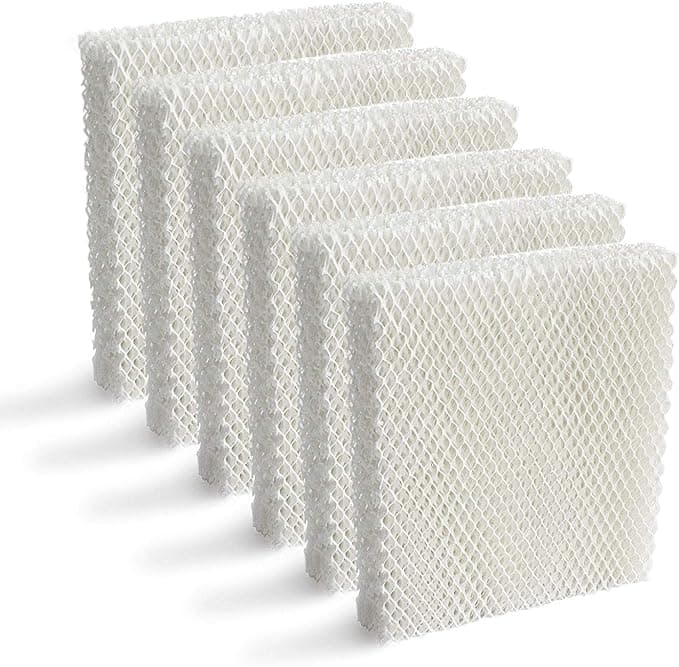
The swap itself is boring, which is what you want. I unplug the unit and dump the tank completely first — do not skip the unplugging, water and a live base are not a combination you want to gamble on. The filter compartment on these sits down at the base; you pop it open, slide the old pad straight up and out of its frame, and the new one drops into the same frame. Honestly the generic seated as cleanly as the branded one. The cardboard-and-mesh frame on mine clicked into the track without me having to wrestle it, and the lid closed flush. First fill, it darkened with water evenly across the whole pad within a couple minutes — that even wetting is the tell that it's actually wicking and not just sitting there.
One small thing: the frame on the compatible pad is a hair flimsier than the OEM cardboard. Not loose in the machine — it sits fine — just thinner stock when you're holding it. Doesn't affect how it works. It's the kind of corner-cut you notice for two seconds during install and then never again.
How it actually performs
I ran the generic pad through a full dry stretch in a roughly 200-square-foot bedroom, hygrometer parked on the nightstand. It held the room in the low 40s percent humidity overnight just like the branded pad did. My lips weren't cracking, the static-shock-off-the-blanket nonsense stopped, the wood furniture quit creaking. If you'd swapped the pads on me blind I couldn't have told you which was in there by the output.
Where it's a touch behind: longevity, maybe. The genuine pad seemed to resist that white mineral crust slightly longer before it stiffened up, especially since I've got hard water and don't always bother with distilled. With the generic I started seeing the chalky buildup creep in a little sooner — a few weeks earlier, give or take. But here's the thing, at ten dollars cheaper a pad I'm fine replacing it a little more often. The cheaper-but-swap-sooner math still comes out ahead, and honestly replacing the pad sooner is healthier anyway. Nobody's stretching these long enough on purpose.
The downside I won't paper over
Two real ones. First, that first-day plastic-and-paper smell. Fresh out of the bag the new pad has a faint dry-cardboard odor for the first day or so of running. It fades fast — by day two I couldn't catch it — but it's there, and if you're sensitive you'll notice it the first night. Run the unit a few hours before bed the first day and you'll skip it.
Second, packaging and consistency. The OEM pads come in tidy branded sleeves; the generics show up in a plain plastic bag, sometimes a little squished in shipping. Cosmetic. But I'll also say batch consistency is the one place the brand earns its money — every OEM pad is identical, while across generic orders I've had one pad with slightly uneven mesh. It still worked. Just wasn't as pretty. If perfect uniformity every single time is worth ten bucks a pad to you, that's a legitimate reason to stay OEM.
Why none of this is optional
Come back to that funk I walked into. A wicking filter's whole job is to sit half-submerged and let air pass through the wet pad. That's also the perfect setup for mold and bacteria the moment the pad gets saturated and stops drying between cycles. A dead filter doesn't just stop humidifying — it actively pushes spores and that stale smell into the room you sleep in, and that's exactly the kind of thing that sets off allergies and a scratchy throat you can't explain. Worse, a crusted pad that won't wick makes the unit run harder and lets minerals build up on the internals. The filter is the cheap part. Replacing it on time is what protects the machine and your lungs.
So who should buy which
If you've got really hard water and you hate swapping filters, or you just want the no-variation branded experience, buy the genuine Honeywell pad and don't think about it. That's a fair call.
But for me? The generic does the same job, seats the same way, holds the same humidity, and saves me about ten dollars every change. I've bought it three changes running now, and the only reason I'd go back to OEM is if I stopped caring about the price — which, given why I started testing these in the first place, isn't happening. Cheap one's fine. Just don't do what I did and let it die in the tank.