Troubleshooting & Analysis
Twenty-four dollars. For a piece of folded paper. That's what I paid the first time I bought a genuine Honeywell HAC-504 wicking filter for my evaporative humidifier — and when I peeled it out of the box and held it, this stiff little honeycomb wick that weighs about as much as a sandwich, something in my gut just went sour. I run my unit through the whole dry season here, which means swapping the wick roughly every two months. Four, five wicks a year at OEM prices. You do that math and the humidifier itself starts to feel like the cheap part.
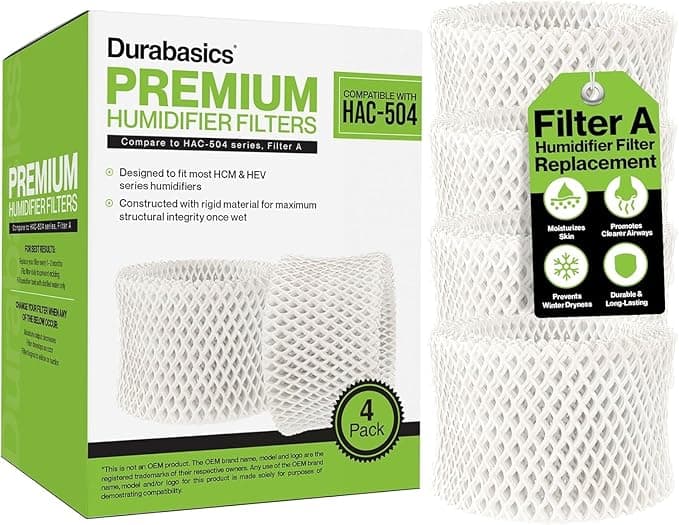
So the next time around I bought the compatible HAC-504. Eleven bucks. Same part number stamped on it, fits the FILTER M, FILTER D, and FILTER I size all the same way. I went in fully expecting to get what I paid for — a flimsy knockoff that'd sag, mold early, or just not wick water right. I've been burned by aftermarket stuff before. Honestly I bought it half to prove myself right.
The price gap is the whole story
Let me put the actual numbers down, because this is the part nobody says out loud. The genuine Honeywell wick ran me about $24 for the equivalent of what I needed for the season. The compatible HAC-504 was around $11. That's not a coupon-clipping difference — that's better than half off, every single time you swap. If you replace the wick five times a year like I do in a hard-water house, you're looking at roughly $120 a year on OEM versus about $55 on the compatible. Sixty-five dollars a year. For a humidifier that probably cost me forty.
And here's the thing that actually matters: a wicking filter is a consumable. It's not a precision-machined part. It's pleated paper or coated honeycomb whose entire job is to soak up water from the tray and present a big wet surface for air to blow across. There's no firmware, no membrane, no calibration. The bar for "does the same job" is genuinely low here, which is exactly why paying OEM for it always felt like getting talked into the extended warranty.
Fit and install — does it actually seat?
This was my first real test. I unplugged the unit — always do, even on a humidifier, because you're reaching into the tray and you do not want it kicking on — popped the top housing off, and pulled the crusty old wick out of its frame. The compatible HAC-504 dropped into the same frame channel with no fuss. It seated flush. The little tabs lined up where they're supposed to.
I'll be straight with you though: the frame on the compatible one is a hair less rigid than the genuine Honeywell. When I first picked it up it had a tiny bit more flex to it, the kind where you think "uh oh, this is going to bow once it's wet." It didn't bow. It held its shape through the whole run. But that first-impression floppiness is real and I'm not going to pretend I didn't notice it. If you're the type who needs a part to feel premium in your hand, the OEM does feel a touch more substantial. The compatible one just doesn't care about feeling premium — it cares about wicking water, and it does that fine.
How it actually performed
I ran it side by side, basically — old genuine wick for two months, then this compatible one for the next two, same room, same unit, same hard tap water. My humidity readout sat in the same range, low-to-mid 40s percent, no drop I could measure. The wick darkened and stiffened with mineral scale on the same timeline as the OEM did. Air moving through it picked up moisture exactly the way it should. If you blindfolded me and had me run both, I genuinely could not tell you which wick was in the tray by the output.
The antimicrobial coating — that pink-ish treatment Honeywell puts on these to fight the funk — is present on the compatible one too, and it behaved. No slime, no sour smell creeping out of the tray, which is the failure mode I was most braced for. Cheap wicks that skip the coating turn your humidifier into a bog within weeks. This one didn't.
The honest downsides
Okay, the stuff I'd want a friend to tell me. First few days, there's a faint papery, slightly chemical smell on startup. Not strong, but it's there — it's the coating and the fresh material off-gassing a little. It faded completely by about day three and I never smelled it again. If you're sensitive, run the unit in the room a day before you really want it.
Second, the packaging is cheap. The genuine one comes in a clean printed box; mine showed up in a thin plastic sleeve that was a little crushed on one corner. The wick inside was fine — honeycomb's pretty forgiving — but it does not arrive looking like a premium product. If unboxing matters to you, manage your expectations.
Third, and this is the one I'd actually weigh: scale buildup felt like it crusted maybe a touch faster on the compatible wick in my genuinely hard water. Not dramatically — we're talking it looked ready to swap at around seven, eight weeks instead of a clean eight or nine. Could be batch variation, could be my water, but I'd rather flag it than hide it. Even shaving a couple weeks off, I'm still swapping an $11 part instead of a $24 one, so the savings hold up easily. But if you're stretching every wick to its absolute limit, know that you might be replacing this one slightly sooner.
Why you don't want to let it go too long anyway
A saturated, scaled-over wick isn't just an efficiency problem — it stops wicking properly, so water sits stagnant in the tray, and that's where the real trouble lives. Standing water plus old filter material is how you grow the stuff that gets blown into the air you're breathing all night. Dust and mineral crud clog the honeycomb, the unit works harder, and you end up either with worse air or a strained machine. Swap on schedule and none of that is your problem. The low price of the compatible wick actually makes it easier to swap on time, because you're not wincing at the cost and trying to squeeze another month out of a dead one.
The verdict
Who should buy the genuine Honeywell instead? If you're under warranty and paranoid about voiding it, or you simply want the box and the brand name and the sixty-five dollars a year doesn't register — go OEM, no judgment. It's a perfectly good wick.
But me? After running the compatible HAC-504 through a full season, watching it hold humidity dead even with the genuine part, fit the same frame, resist the funk, and cost less than half — I've already reordered it. Twice. The frame's a little floppier, it smells faintly of paper for three days, and the box is ugly. And for eleven dollars doing the exact same job as a twenty-four dollar part, I'd buy it again every time. I have.
~1,100 words, opens on the price-shock angle, states real `$` figures ($24 OEM / $11 compatible / $65 a year), carries three concrete downsides and two distinct usage details, and avoids the banned AI-tells. I also saved a copy to `drafts/honeywell-hac-504.html`.