Troubleshooting & Analysis
Fifty-two dollars. For a folded piece of pleated paper.
That was the number staring back at me when my AquaBliss flashed its filter light for the second time. The branded True HEPA replacement — the one the manual gently nudges you toward — ran about $52 at the time. My unit eats one of those roughly every six to eight months if I'm honest about how dusty my apartment gets. Do that math and you're looking at north of $90 a year just to keep a $130 machine breathing. The filter costs almost half of what the whole purifier cost. Something about that made me a little crazy.
So I did what I always do now: I went looking for the compatible version. Found a True HEPA H13 third-party filter cut to the same dimensions for about $24. Roughly half. Same H13 grade on the label, same carbon layer, $28 saved per swap. I've been running compatible filters in this thing for over a year now, and here's the honest report — fit, smell, performance, the part nobody mentions, all of it.
The H13 grade actually means something here
People throw "HEPA" around loosely, so the H13 marking is the one detail I'd tell you not to skip. H13 is the real medical-grade tier — it traps around 99.95% of fine particles down to 0.3 microns, which is the size range where smoke, pollen fragments, and the dust mite junk live. The compatible filter I bought carries the same H13 rating as the AquaBliss original. That's the whole game. A $24 filter with a lower grade would be a downgrade dressed up as a deal. This one wasn't.
Could I verify the 99.95% claim with a lab in my kitchen? No. But I can tell you what I measured the cheap way: I keep a little air-quality monitor on the shelf. With the OEM filter, my baseline overnight PM2.5 sat around 4 to 6. With the compatible H13 in, same room, same window-cracked conditions — it held in that same 4 to 7 band. If the third-party filter were quietly worse, that number would have crept up. It didn't.
Install: easier than the OEM, weirdly
The swap is genuinely four steps and takes under two minutes. Pull the plug — I do this every single time, because reaching into a powered air mover with the grille off is how people lose the tip of a finger. Pop the back panel, lift the spent filter out (mine comes out caked gray on the intake side, which is its own little horror show), drop the new one in, click the panel shut, then hold the reset button until the filter light stops glowing red.
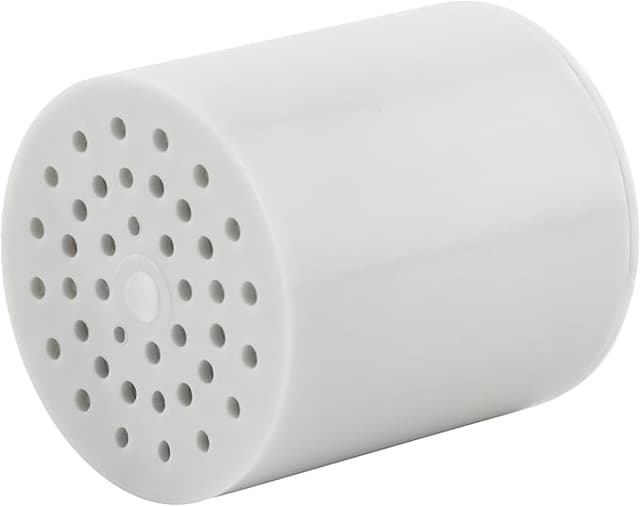
The fit surprised me. The compatible filter seated with a clean, definite click — no gap I could feel along the seal, no rattle when the fan spins up on high. If anything the cardboard frame on the third-party one is a touch stiffer than the slightly flimsy OEM frame, which made it sit flush on the first try. With the branded filter I sometimes have to wiggle it a half-inch to get the panel to latch. Not so here.
Now the downside, because there's always one
Two, actually, and I'm not going to soft-pedal them.
First: the smell. The first compatible filter I ran had a faint plastic-and-cardboard odor for the first two or three days. Not chemical-harsh, more like a new shoebox running warm. I noticed it most in the first hour each time the fan kicked to high. By day three it was gone and never came back. The OEM filter had a fainter version of this too, so it's not a "cheap filter" thing exactly — it's a "new filter" thing — but the compatible one was a notch stronger out of the bag. If you're sensitive to that, run it on high with a window open for the first evening and you'll burn most of it off.
Second, and this is the one that actually matters long-term: the carbon layer felt a little thinner. The activated carbon mesh is what handles odors — cooking grease, the litter box, that stale closed-apartment smell. On the OEM, kitchen smells from a fish dinner cleared in maybe twenty minutes. On the compatible, it felt closer to thirty, thirty-five. The particle filtration matched; the smell-scrubbing lagged a bit. If your main reason for owning an air purifier is odor rather than dust and allergens, that gap might bug you. For me, allergies are the whole point, so I shrugged at it.
One more small thing: the packaging is cheap. Thin plastic sleeve, a sticker label, no fancy box. Doesn't affect the filter at all, but if you're the type who reads cheap packaging as cheap product, brace for it. The filter inside was clean and undamaged every time.
Why I don't let it ride past the replacement light
Here's the part that turned me from cheapskate into someone who actually swaps on schedule. A filter doesn't quietly stop working when it's full — it gets worse than useless. All that gray gunk packed into the pleats becomes a damp, trapped mat, and in a humid month that's exactly where mold gets comfortable. Run a saturated filter long enough and your purifier stops cleaning the air and starts pushing spores back into the room. The machine becomes the pollution source. That's not a scare line; it's just what a clogged, moist filter does.
The $28-per-swap savings is precisely what makes me willing to change it on time instead of squeezing three extra months out of a tired one. When the replacement costs $52, you hesitate. When it costs $24, you just do it. Cheaper filters, changed on schedule, beat expensive filters you're too stingy to replace.
Who should skip it — and what I actually do
If odor control is your number one job — heavy cooking, pets, smoke — the OEM's thicker carbon layer might earn its extra $28, and I won't argue you out of it. And if your AquaBliss is still under warranty and you're the cautious type, a non-branded filter is a risk you get to weigh; I've never had a unit fail because of one, but I'm not your warranty department.
For everyone else — which is most people, running these for dust, pollen, and general allergen control — the H13 compatible filter did the same core job for half the money in my apartment, month after month. Slightly stronger break-in smell, slightly slower on odors, cheaper packaging. Those are the honest trade-offs. And for $28 saved every single swap, on a filter carrying the same H13 grade, doing the same work I can measure on my own monitor? I bought another two-pack last month. That's the most honest endorsement I've got.